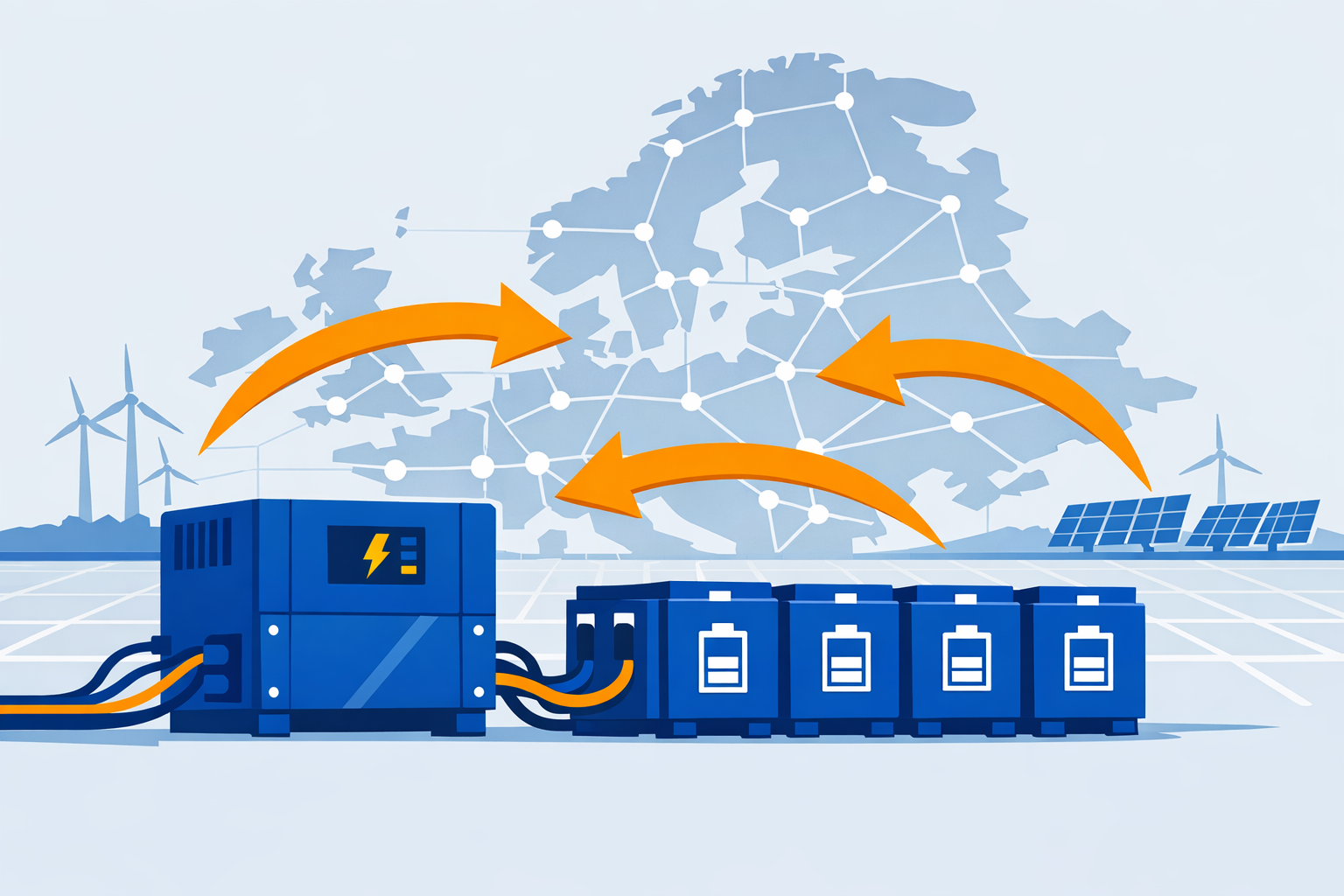
European regulators have introduced a framework mandating grid-forming inverter requirements and harmonized interconnection rules to support cross-border long-duration energy storage (LDES) pilot projects in the EU. The European Network of Transmission System Operators (ENTSO-E) published its Phase II technical report in November 2025, establishing requirements for new storage and renewable plants above 1 MW to provide voltage control, inertia response, and frequency regulation using grid-forming functionality[1]. The European Commission is expected to include these standards in the forthcoming RfG 2.0 network code, after which member states will adopt national transition schedules[1].
Background
Grid-forming inverters (GFMs) operate as active voltage sources with internal impedance, allowing inverter-based resources to replicate synchronous machines in frequency and voltage control during both normal and disturbed conditions[2]. Previously, the EU lacked consistent standards for this functionality. In Germany, the VDE-FNN guideline "Grid-Forming Capabilities" took effect in May 2025, supporting new markets for inertia and system services[3]. Concurrently, ENTSO-E's report provides the foundation for mandatory grid-forming capability in new installations exceeding 1 MW across the EU[1].
Details
ENTSO-E's report formalizes requirements for storage systems and power conversion systems (PCS) to operate like synchronous machines, delivering voltage control, inertia response, and frequency regulation even during grid disturbances[1]. The new technical rules will apply to new and substantially modified plants rated above 1 MW once NC RfG 2.0 is adopted by the European Commission[1]. Member states will set national transition periods for technical adaptation[1].
Belgium's transmission system operator (TSO) Elia has launched a fast-track public consultation on grid-forming battery energy storage systems (BESS) for transmission-connected sites, citing delays in the formal adoption of NC RfG 2.0. Elia aims to accelerate national implementation to maintain system strength as inverter-based resource (IBR) integration accelerates[4]. In Germany, the four TSOs started procuring inertia services through fixed-price contracts in January 2026, opening new revenue opportunities for certified grid-forming BESS[5]. The service, known as Momentanreserve or instantaneous reserve, will feature fixed pricing and contracts lasting up to ten years, with contracted volumes published starting in 2027[6].
Outlook
After European Commission approval of NC RfG 2.0 and national implementation, mandatory requirements will apply to new projects above 1 MW. Early-adopting markets such as Germany and Belgium are deploying certification and procurement mechanisms to support GFM BESS adoption. As technical definitions and testing standards evolve, cross-border pilots for long-duration storage are expected to advance under unified requirements.