Germany's Federal Ministry for Economic Affairs and Energy has released a working draft for a fundamental reform of the Renewable Energy Sources Act (Erneuerbare-Energien-Gesetz - EEG), targeted to take effect on 1 January 2027. The draft represents the most sweeping overhaul of Germany's renewable energy support framework in years, with three provisions carrying particular weight for the storage sector: a permanent solar feed-in cap designed to incentivize co-located batteries, a new two-sided contract-for-difference (CfD) mechanism, and expanded cross-border tender arrangements that open German subsidy flows to neighboring EU markets.
Background
The draft bill aims to make renewable expansion more planned, cost-efficient, grid-compatible, and market-oriented, shifting away from long-standing subsidy models toward a more integrated system. The reform arrives against a backdrop of accelerating deployment ambitions: the EEG 2023 set a target of at least 80% of Germany's gross electricity consumption from renewables by 2030, raised expansion corridors significantly, and established renewable energy priority as a governing principle.
Separate from the EEG 2027 draft, the German Bundestag took a significant near-term step in late 2025. The Act on the Amendment of Energy Industry Law, passed by the Bundestag on 13 November 2025 and by the Bundesrat on 21 November 2025, introduced extensive changes to energy industry law - particularly regarding battery storage. For the first time, large-scale battery storage gained recognition as privileged infrastructure under building law, and the legislation explicitly reiterated the government's goal of accelerating approval procedures and standardizing and digitizing grid connection processes.
Germany's energy industry association BDEW described 2026 as a "key year" for the country's energy policy, not least due to the EEG reform, which must be completed before year-end.
Key Provisions
Solar Feed-in Cap and Storage Incentive
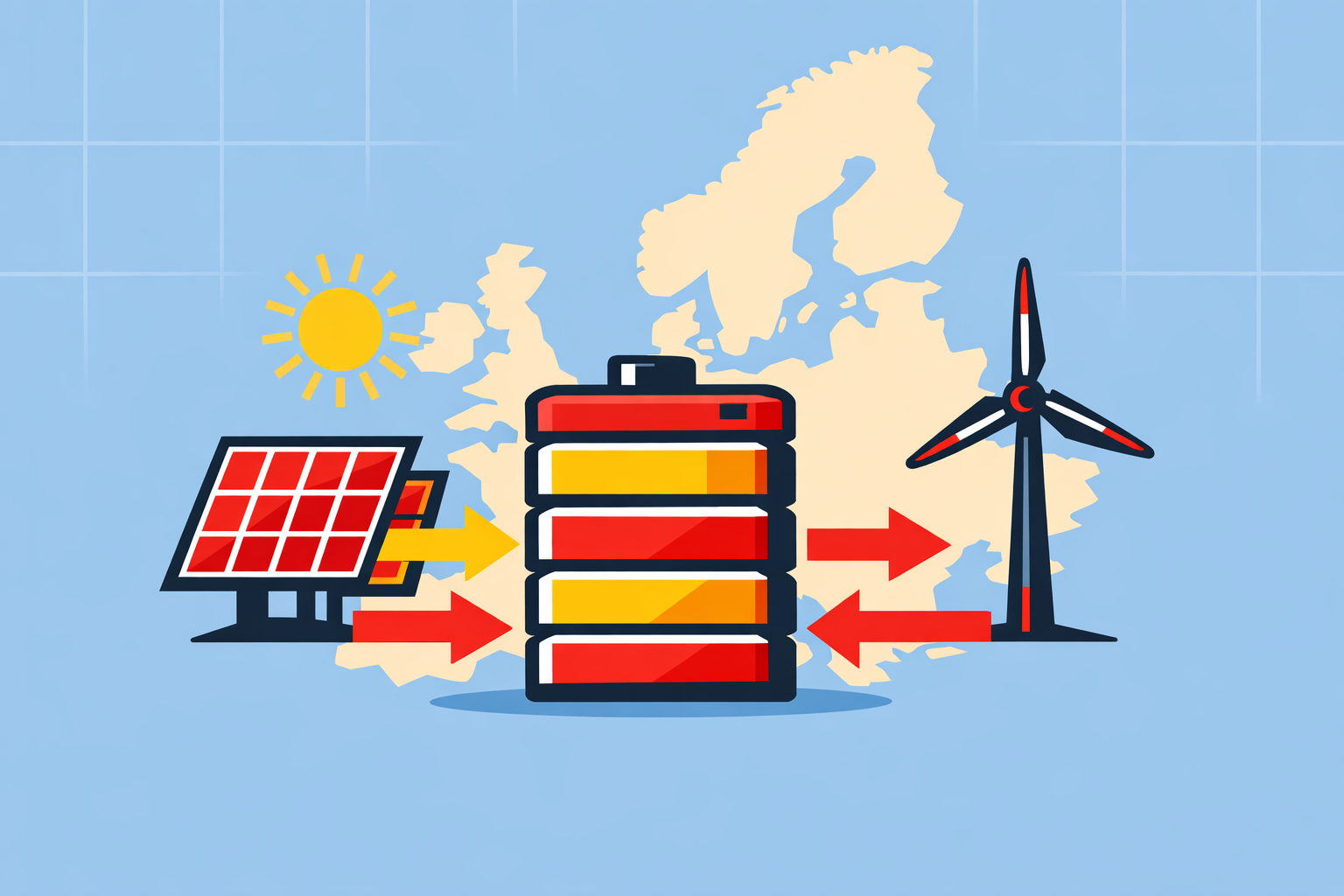
One of the EEG 2027 draft's most consequential storage-related measures targets smaller solar installations. A new permanent cap on feed-in power limits these systems to 50% of their installed capacity. This creates a strong incentive for operators to install battery storage, enabling them to capture solar power generated during midday peaks and feed it into the grid during evenings when demand and electricity values are higher.
Two-Sided Contracts for Difference
A cornerstone of the reform is the introduction of a mandatory two-sided CfD mechanism for all new subsidized plants with an installed capacity of 100 kW or more. Plant operators will continue to receive a market premium when the annual market value of electricity falls below their subsidized bid price, but they will now be obligated to repay revenues exceeding that price during "high-price phases." This "refinancing contribution" aligns Germany's support scheme with new EU electricity market rules and state aid requirements. While it caps upside potential for operators, it offers greater revenue certainty - potentially lowering capital costs and de-risking investments. Biomass plants are the only technology exempt from this new clawback mechanism.
Cross-Border and Resilience Tenders
Beyond the two existing cooperation mechanisms under the current EEG - joint national and open foreign tenders - the draft introduces a third option. Under this arrangement, one or more EU member states may carry out the tender and administer the subsidy, with Germany participating financially downstream and receiving a share of any levy revenue.[1] The arrangement must be underpinned by an agreement under international law and administered by transmission system operators acting as paying agents.
To implement the EU's Net-Zero Industry Act, "resilience tenders" will be established for onshore wind and large-scale solar projects. These tenders incorporate non-price criteria to evaluate bids, aiming to strengthen supply chain resilience and reduce strategic dependencies across the European energy sector. The specific qualitative criteria are yet to be defined in a separate ordinance. Initial annual volumes are set at 3,500 MW for onshore wind and 500 MW for solar.
On ground-mounted solar, the draft introduces a significant shift in tender volumes, setting the annual allocation for each year from 2027 to 2032 at 14,000 MW.
Risks and Legislative Outlook
Industry response has been sharply divided. The most pointed criticism targets the planned elimination of subsidies for small-scale installations and the proposed abolition of feed-in tariffs. The German Solar Industry Association described the draft as a "frontal attack on the energy transition," while the German Renewable Energy Federation called the cuts to rooftop installations particularly critical.
The timeline itself poses a risk. The working draft has not yet been agreed upon by the government, let alone passed by the Bundestag or relevant committees, and must also be re-notified and approved by the European Commission. Implementation by 1 January 2027 therefore appears ambitious. Stakeholders across sectors have also called for the EEG amendment to be combined with the planned grid package and grid fee reform; without a coherent overall framework, financing costs could rise.
For the storage sector specifically, a structural tension identified by legal analysts remains unresolved: while the Energy Industry Act defines battery storage as an "independent pillar," the German Federal Court of Justice confirmed in July 2025 that storage facilities continue to be treated as consumers for construction cost contributions. The EEG 2027 process will need to address this contradiction alongside the grid connection overhaul to deliver the accelerated rollout the draft envisions.