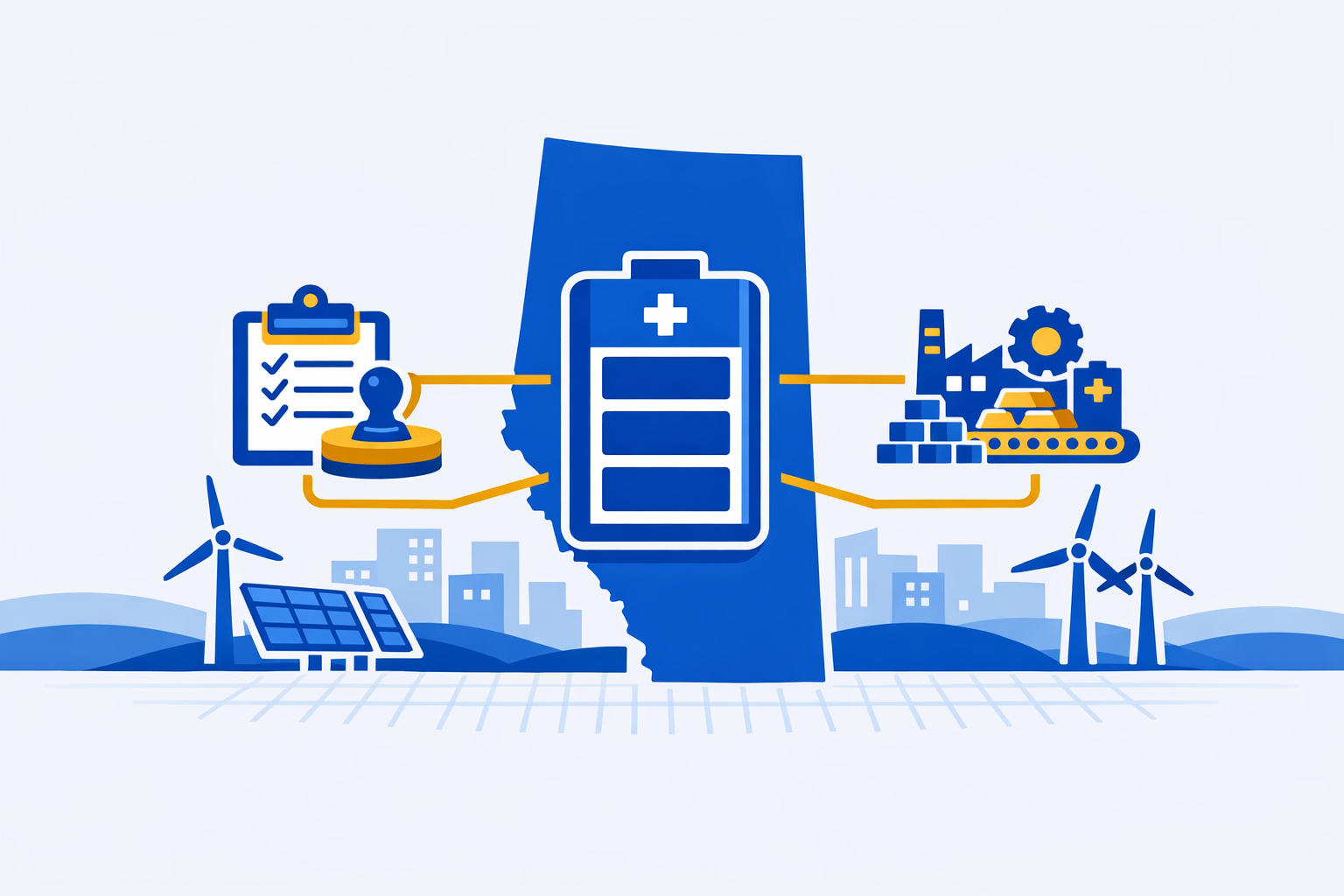
Alberta has introduced a fast-track policy framework to accelerate energy storage deployment, offering incentives, streamlined permitting, and dedicated procurement mechanisms to enhance grid reliability and attract investment.
The initiative centers on Bill 203, the Energy Storage Planning for Investment Act, introduced in November 2025. The bill mandates a coordinated approach to incentives, long-duration storage research, and the development of a local battery supply chain using materials sourced from oilfield wastewater and brine. It also addresses legacy rate structures that classified energy storage as both load and generation, requiring new regulatory frameworks from government ministries and system operators. Proponents state the framework aims to reduce electricity costs, strengthen grid stability, and restore investor confidence following recent solar and wind project moratoriums.
Background
Alberta's electricity market has faced investment uncertainty due to policy changes and a 2023 moratorium on wind and solar projects, which led to an estimated loss of CA$33 billion in investment and tens of thousands of job-years. Bill 203 builds on prior legislation that recognized energy storage as a unique asset class, separate from traditional generators and loads. The prior absence of storage-specific incentives and market structures limited deployment, despite increasing demand for grid reliability services across North America.
Details
Bill 203 directs Alberta utilities and regulators to adopt simplified participation rules for small or aggregated storage systems at the distribution level, avoiding restrictive bulk market requirements that previously hindered smaller projects. The framework permits contracted storage costs to be recovered through rate structures similar to those used for conventional wire investments. It calls for integrated planning among the Ministries of Affordability & Utilities, Technology & Innovation, and Energy & Minerals, alongside coordination with the Alberta Electric System Operator (AESO) and Alberta Utilities Commission (AUC). The policy package includes support for long-duration storage research and a domestic battery supply chain based on critical minerals extracted from oilfield wastewater and brine.
Alberta's energy storage project pipeline currently includes 3.7 GW of standalone projects in the connection queue, 4.2 GW of natural gas projects, and a further 17.5 GW of generation capacity under review. The Jurassic Battery Energy Storage System, an 80 MW/160 MWh facility financed in April 2025 at a cost of approximately CA$120 million, is expected to begin operations in late 2026, delivering about CA$15 million in annual adjusted EBITDA.
Outlook
If Bill 203 is enacted and implementation stays on track, Alberta could become a leading North American jurisdiction for energy storage deployment. Anticipated results include improved project economics through incentive alignment, accelerated permitting, and enhanced grid reliability from distributed resources. Industry observers and policymakers in other jurisdictions will closely watch Alberta's approach, with particular interest in its regulatory and supply-chain strategies.