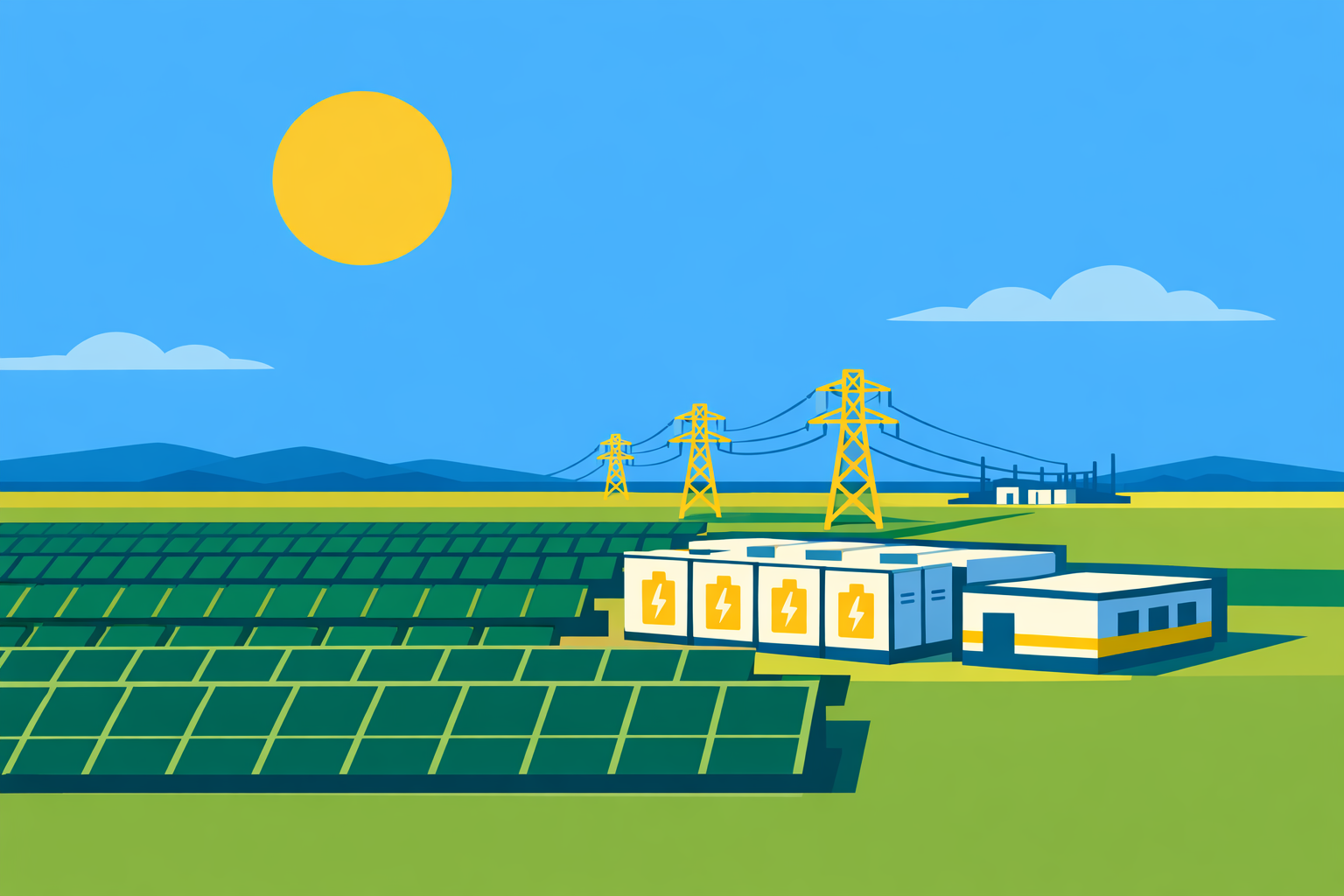
California has surpassed 17,000 megawatts of cumulative installed battery storage capacity, state energy officials confirmed this week, marking a decisive inflection point in the state's push to anchor grid reliability on storage rather than fossil-fuel peakers. The milestone arrives as regulators activate new procurement mandates, launch a regional day-ahead electricity market, and begin soliciting long-duration storage contracts - all converging in a policy window that extends through 2030.
Background
The scale of California's storage buildout has few global precedents. Battery storage capacity in California grew from 500 MW in 2018 to more than 16,900 MW by mid-2025, according to the California Energy Commission (CEC), and resource additions in 2025 pushed the cumulative total past 17,000 MW, per state energy agency data. That trajectory implies a doubling time of roughly 1.2 years over the past decade, according to analysis by Occidental College physicist Daniel Snowden-Ifft, outpacing even the state's record solar adoption curve.
The expansion is driven by interconnected policy obligations. Senate Bill 100 set the requirement that 60 percent of retail electricity sales must come from renewable resources by 2030, with 100 percent clean electricity required by 2045. To meet that target, CAISO projects the need for 165.1 GW of new generation across its market footprint, including nearly 58 GW of electricity storage, according to its 2024 Special Report on Battery Storage.
Details
The California Public Utilities Commission (CPUC) reinforced the procurement pipeline in early 2026. A February 2026 CPUC decision requires electricity providers to procure 6,000 MW of new clean energy and storage capacity by 2032, with at least 25 percent of that procurement coming from resources with clean firm power or long-duration energy storage attributes.
On the long-duration front, the CPUC has authorized a new solicitation tranche. Set to begin in 2026, the planned solicitations will request bids for up to 1 GW of resources with durations of at least 12 hours and 1 GW of multi-day storage resources that can be commissioned between 2031 and 2037, according to a CPUC fact sheet. The California Department of Water Resources will lead the procurement through its Statewide Energy Office, with an additional 7.6 GW of floating offshore wind and up to 1 GW of geothermal generation solicited beginning in 2027.
Market infrastructure is also being updated to accommodate the expanded storage fleet. On May 1, 2026, CAISO launched the Extended Day-Ahead Market (EDAM), with PacifiCorp as its first participant, creating what CAISO describes as the first coordinated 24-hour look-ahead scheduling system for Western utilities. A 2022 EDAM benefits study projected total annual operational savings for the West of $543 million per year from reduced power production expenses and a West-wide EDAM could reduce CO₂ emissions by an estimated 2.92 million metric tons per year.
On April 21, 2025, batteries met 36.6% of CAISO's evening load between 5 and 9 p.m., dispatching 9.72 GW and 42.6 GWh of energy in that interval - up from a 5.6% average share during those hours in 2023. CAISO's energy storage interconnection queue now contains 101 GW of battery capacity, with batteries accounting for approximately 46 percent of total queue capacity as of Q2 2025, according to CAISO filings, though a substantial share of queued projects is expected to withdraw before completion.
The buildout is reshaping grid economics. Planned storage additions are projected to exceed 25 GW through 2028, putting California ahead of pace on its 2027 and 2045 targets, according to RaboResearch. California is expected to add 3.4 GW of new battery storage capacity in 2026, representing 14 percent of total planned U.S. battery storage additions that year, according to the U.S. Energy Information Administration. Most batteries in the CAISO market have a four-hour discharge duration, a configuration that serves evening ramp needs but leaves multi-day resilience gaps the new long-duration solicitations are designed to fill.
Resilience concerns remain acute. Extreme weather events, including wildfires, heat waves, and storms, are increasingly damaging California's transmission and distribution infrastructure, according to CAISO. Up to 4,500 MW of contingency resources are available for summer 2026 in case of extreme events, state agencies reported this week, with the majority provided through the Strategic Reliability Reserve. California has not called a Flex Alert for the past three summers - 2023, 2024, and 2025 - despite periods of extreme heat and record-setting temperatures, according to state energy agency reports. "Extreme heat, unpredictable weather-driven challenges and increased demand mean we must manage our resources carefully," said CAISO President and CEO Elliot Mainzer.
Outlook
The CEC projects that peak demand in the CAISO balancing area will reach 68 GW by 2040, up 20 GW from 2024 levels, driven by data center load growth and electrification. That trajectory creates additional pressure for accelerated storage and transmission investment. Portland General Electric is scheduled to join the EDAM in fall 2026, with additional participants committed for 2027, expanding the dispatch footprint available to California storage operators. The CPUC's February 2026 decision and the forthcoming long-duration solicitations are expected to set contract terms that will define the investment climate for multi-GWh projects through the early 2030s.