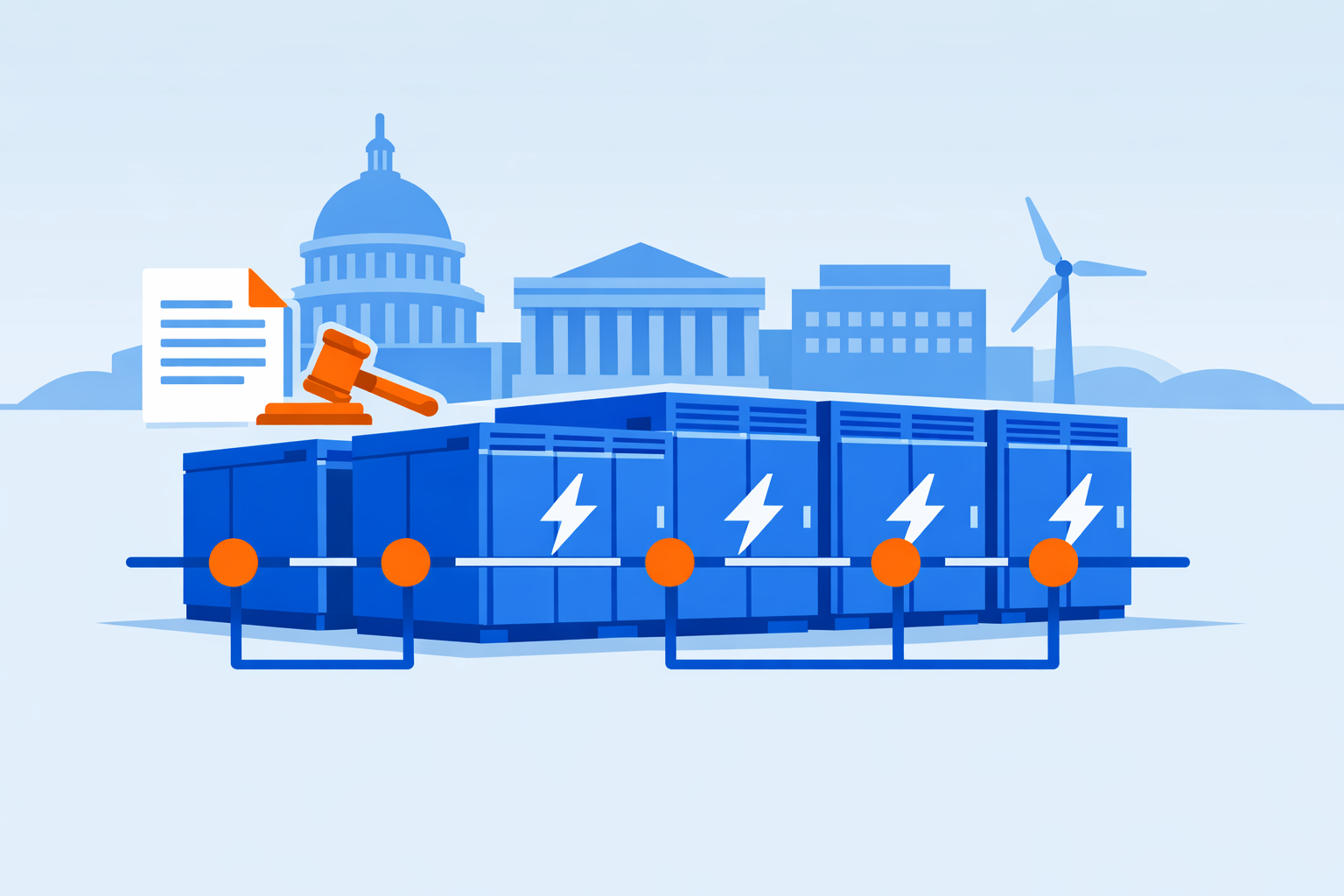
Pending federal permitting reforms remain stalled in the U.S. Senate, injecting uncertainty into deployment schedules for grid-scale battery energy storage projects targeting 2026-2027 commercial operation. Analysts warn the legislative window may be narrowing, as potential shifts in House and Senate leadership following the 2026 midterm elections could complicate efforts to pass a comprehensive package. The outcome stands to affect how quickly developers can navigate environmental reviews under the National Environmental Policy Act (NEPA) - a process that shapes project timelines for battery storage on federal land and federally funded installations.
Background
The U.S. House of Representatives passed the Standardizing Permitting and Expediting Economic Development (SPEED) Act on December 18, 2025, by a 221-196 vote. The bill limits the scope of NEPA and modifies environmental review of major federal actions to reduce the number of actions triggering review and expedite the process. The SPEED Act would cap NEPA environmental reviews at two years and narrow reviews to project-specific impacts, according to the Bipartisan Policy Center.
The bill faces steep odds in the upper chamber. The permitting reform bill needs 60 votes to pass the Senate, where Republicans hold a slim majority. The White House's suspension of already-permitted offshore wind projects led top Senate Democrats to withdraw from SPEED Act talks in January. On March 5, Senators Martin Heinrich and Sheldon Whitehouse announced they had reopened negotiations on permitting reform, though their statement conditioned continued talks on the administration not interfering further with permitted renewable energy projects.
Details
The stakes are substantial for battery storage developers. The U.S. energy storage market hit a record 18.9 gigawatts of battery energy storage system installations in 2025, a 52% increase over 2024, according to ACP and Wood Mackenzie. The same report projects the U.S. will install half a terawatt-hour of storage between 2026 and 2031, a 250% increase over the previous five-year period.
Wood Mackenzie's high-case scenario assumes approximately 36 GW of new battery storage deployed by 2031, contingent on higher demand growth, federal permitting relief, and workable Foreign Entity of Concern guidance. Without legislative action, that figure drops. Allison Weis, Global Head of Storage at Wood Mackenzie, stated that "federal policy will determine whether we reach the high case" or a more conservative trajectory.
Meanwhile, the U.S. interconnection queue has swelled to a 2,600 GW backlog as of 2026, with median wait times approaching five years. Battery projects average 3.2 years in MISO's queue, longer than any other resource type, according to Modo Energy research. The median time for NEPA reviews with a final decision issued in 2024 was 26 months, according to Jones Day analysis - a timeline that could shorten or lengthen depending on which reforms, if any, reach the president's desk.
The Department of Energy has already moved administratively to reduce maximum environmental assessment and impact statement completion times from three years to two years and to require designation of a lead agency to coordinate interagency review. Legal experts note, however, that executive action alone may not provide the durable certainty developers need to commit capital to multi-year projects.
Outlook
Permitting overhaul discussions are set to resume when Congress returns, but industry groups say lawmakers must act quickly or risk another failed attempt. Approaching midterms and competing priorities add to the difficulty of reaching a deal. For battery storage developers planning 2026-2027 deployments, the regulatory landscape remains a moving target - one that could either unlock record capacity or extend an already strained timeline further.