Ford Motor Company has formally unveiled Ford Energy, a wholly owned subsidiary that will manufacture and sell U.S.-assembled battery energy storage systems (BESS) for utilities, data centers, and large commercial and industrial customers. The company plans to invest approximately $2 billion over the next two years to scale the business, targeting annual deployments of at least 20 GWh, with first customer deliveries expected in late 2027. The launch, announced on May 12, 2026, formalizes a strategic pivot from the automaker's struggling electric vehicle segment into grid services, where storage economics - not vehicle sales - define the revenue thesis.
Background
Ford reported a $19.5 billion charge in 2025 as it rationalized EV-related assets in response to demand that fell materially short of earlier projections. The automaker is repurposing underutilized EV battery manufacturing capacity in Glendale, Kentucky. Last year, Ford, SK On, SK Battery America, and BlueOval SK agreed to restructure ownership of their jointly developed U.S. battery manufacturing projects, enabling Ford to independently own and operate the Kentucky plants. Ford still expects to lose $4 billion to $4.5 billion on EVs in 2026, according to reporting by the New York Post.
The move places Ford in direct competition with Tesla, the current market leader. After years of negative margins, Tesla's energy division has become a key profitability driver, accounting for 23% of total profit while generating just 13% of revenue and lifting the company's overall margins by nearly two percentage points by August 2025. Mercedes-Benz Energy has developed stationary battery storage systems based on repurposed vehicle batteries, primarily for commercial and industrial customers. General Motors has also manufactured energy storage products and explored supplying both new and used EV batteries for large-scale stationary storage through partnerships including with Redwood Materials.
Details
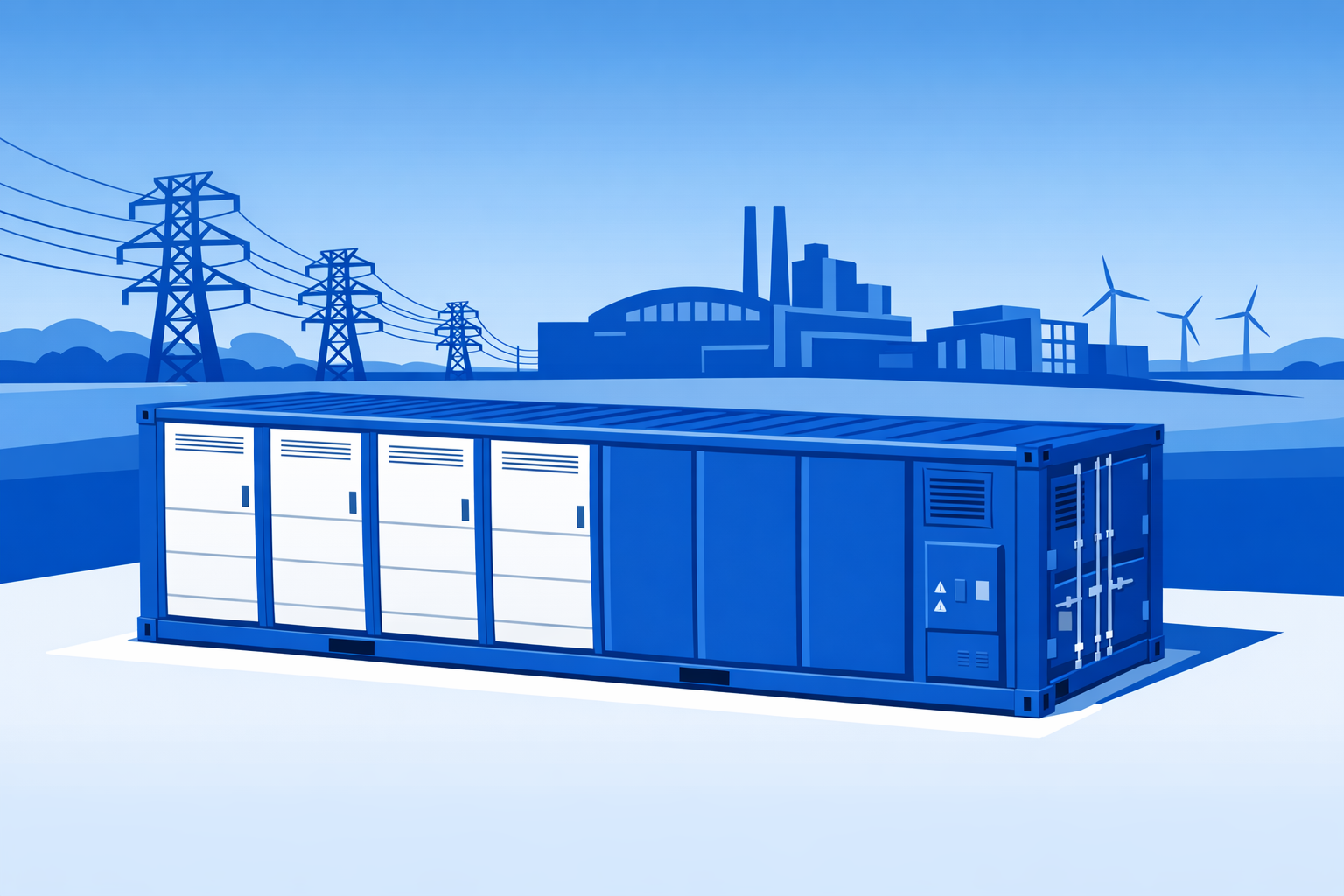
Ford Energy's flagship product, the Ford Energy DC Block, is a 5.45-MWh system housed in a standardized 20-foot DC container, available in two-hour and four-hour discharge configurations using 512-Ah prismatic LFP cells, assembled at the Glendale, Kentucky facility. Ford Energy will manufacture battery cells, assemble packs and containers, and provide sales and service support. The approximately $2 billion commitment is intended to convert and equip the site for a full production sequence, from cell manufacturing through containerized system assembly.
Ford Energy President Lisa Drake oversees the subsidiary's end-to-end operations, encompassing battery cell manufacturing, system assembly and sales, and leadership team buildout. She brings more than 30 years of Ford experience to the role, most recently as Vice President of Technology Platform Programs and EV Systems.
The company is explicitly positioning its supply chain for the current regulatory environment. Ford stated that its "manufacturing and supply chain strategy is designed to support a changing regulatory environment for battery energy storage," aligning with Investment Tax Credit requirements and meeting material assistance and domestic content standards relevant to grid-scale storage. Separately, Ford plans to use its BlueOval Battery Park Michigan facility in Marshall, Michigan, to manufacture smaller amp-hour cells for residential energy storage applications.
The market Ford is entering carries significant structural tailwinds. The integration of intermittent renewable generation at scale has placed a premium on assets capable of delivering firm capacity and grid ancillary services. The United States is expected to add approximately 24 GW of new utility-scale battery storage in 2026 alone, nearly double the record set the previous year, with industry projections pointing to more than 600 GWh on the U.S. grid by 2030, according to Automotive Manufacturing Solutions. Global energy storage additions rose 48% in 2025 to 112 GW, the first year to surpass the 100-GW mark.
The grid services opportunity extends beyond stationary BESS. Regional transmission organizations are opening the way for EV participation in ancillary service markets. PJM Interconnection serves as a prime example, allowing electric vehicles to bid directly into its frequency regulation market and creating a transparent revenue stream for EV owners. In June 2025, Maryland adopted the nation's first comprehensive V2G interconnection rules, and Sunrun and Baltimore Gas & Electric subsequently launched a vehicle-to-home aggregation pilot using Ford F-150 Lightnings, linking dozens of households into a single dispatchable power resource. The global vehicle-to-grid market was valued at $6.27 billion in 2025 and is projected to reach $65.84 billion by 2035 at a compound annual growth rate of 26.50%, according to Astute Analytica.
Outlook
Late 2027 deliveries mean Ford remains more than a year from shipping product, and Tesla will have its next-generation Megapack 3 in volume production by then, according to Electrek. Ford has not disclosed system pricing - a critical factor in a market where cost per MWh is the primary purchase decision driver. By entering now, Ford joins competitors like Tesla and GM in a sector projected to grow 15% annually, offering a potential offset to its EV losses. For utilities and independent storage developers, Ford's entry adds a domestically manufactured, ITC-eligible supply option at scale, a differentiation that carries weight given ongoing trade policy uncertainty around Chinese BESS manufacturers.
For further context on the broader battery-maker pivot driving this trend, see our earlier analysis: Battery Makers Pivot to Grid-Scale Storage Amid EV Slowdown.