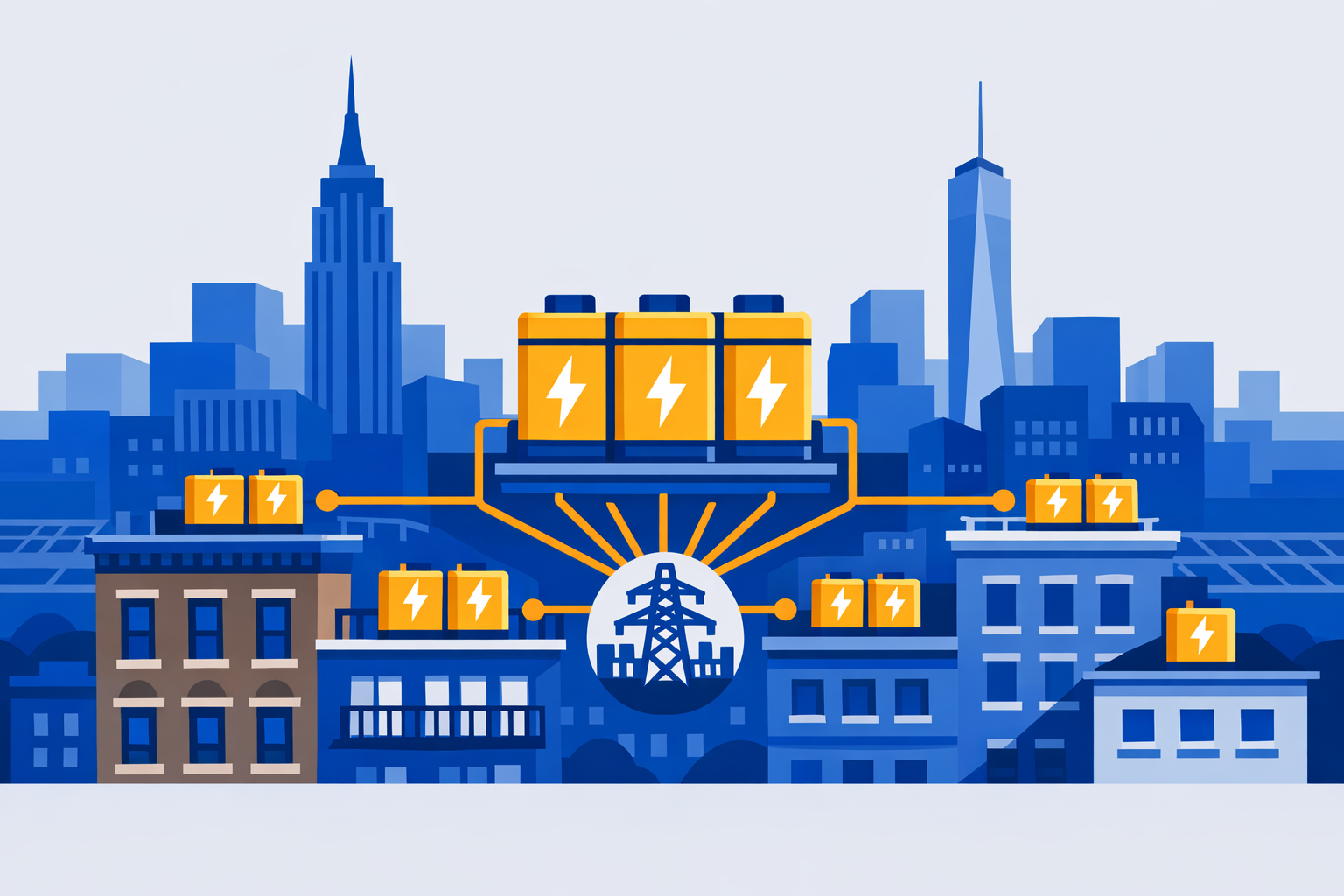
New York City launched its first home battery storage pilot in 2025 to test distributed resilience in an urban setting. The initiative, developed by Standard Potential in partnership with Con Edison, deployed residential-scale battery units integrated with Con Edison's grid operations. The batteries supported air conditioning loads during peak system demand, bolstering reliability.
Background
In October 2025, the Department of Buildings adopted installation and permitting standards for energy storage systems, responding to a 2024 Public Service Commission order targeting 6 GW of storage by 2030. These regulations address the entire system lifecycle, from design to decommissioning. Earlier in 2025, NYSERDA expanded a $675 million retail energy storage incentive program, accelerating distributed and residential storage deployment across the city. The regulatory and financial measures established the foundation for pilot projects such as the Standard Potential-Con Edison initiative.
Details
During the summer of 2025, Standard Potential and Con Edison commissioned what has been described as New York City's largest home battery network. The network supplied backup power to residential air conditioning, allowing the utility to manage peak electrical loads while improving reliability for participating households, according to a Standard Potential statement at its ChargeUp accelerator event. The pilot deployed sodium-ion batteries, selected for their favorable safety characteristics and suitability for residential use in dense urban settings.
The Department of Buildings' October 2025 rules mandate strict criteria for energy storage system safety, design, and installation, closing regulatory gaps and enabling this first-of-its-kind project. Staten Island's deployment of utility-scale battery systems previously increased public awareness of storage technology in residential environments, supporting permissive zoning and community engagement strategies.
Outlook
If technically and commercially viable, the pilot could guide wider adoption of distributed storage paired with renewable energy and virtual power plant programs. Continued regulatory development and incentives from NYSERDA and utility companies may support scaling in other New York City neighborhoods and offer a model for other urban areas.