Long-duration energy storage (LDES) is advancing into mainstream deployment as a series of high-profile battery fires intensifies scrutiny of system safety and compliance. A de facto U.S. safety framework is forming, rooted in updated NFPA standards, new UL test methods, and more assertive environmental and fire-code enforcement. This analysis examines how the framework is evolving, its requirements for long-duration storage projects, and its impact on costs, insurance, and deployment schedules.
The U.S. Department of Energy defines long-duration energy storage as systems capable of storing energy for more than 10 hours at a time. While much of the framework applies to all high-energy stationary storage, its consequences are especially pronounced for LDES sites that concentrate significant energy inventories.
From High-Profile Fires to a Systemic Safety Response
U.S. battery fires at large-scale storage facilities have accelerated demands for a more rigorous and standardized safety regime.
Gateway and Moss Landing: Catalyst Events
In May 2024, a fire at the 250 MW Gateway Energy Storage facility in San Diego persisted for 17 days, triggering a federal cleanup order from the U.S. Environmental Protection Agency. The incident prompted local calls for storage project moratoria and revealed lapses in post-incident environmental monitoring.
A January 2025 fire at Vistra's Moss Landing battery plant in California-the world's largest grid-scale storage facility-forced the evacuation of 1,500 to 1,700 people due to smoke and air quality concerns. Fire services managed the lithium-ion batteries by controlled burning, highlighting the challenges of extinguishing large battery energy storage system (BESS) fires and underscoring the importance of containment and plume management.
Although these events involved multi-hundred-megawatt lithium-ion projects designed for shorter durations, regulators, standards bodies, and insurers are applying lessons from these incidents to all large stationary energy storage systems, including next-generation LDES chemistries.
Public Perception and Local Moratoria
Public opposition has intensified alongside increased deployment. In the second quarter of 2025, developers installed 4,908 MW of new battery storage capacity in the U.S., with Arizona, California, and Texas contributing about three-quarters of this growth, while numerous jurisdictions pursued temporary moratoria on large BESS projects over fire and explosion concerns.
Key community concerns:
- Thermal runaway risk and cascading container fires
- Toxic smoke and particulate emissions from prolonged fires
- Potential groundwater or soil contamination from firewater runoff and damaged cells
- Lack of clarity on emergency response protocols and evacuation zones
These pressures are influencing utilities, developers, and authorities having jurisdiction (AHJs) to adopt stricter NFPA and UL standards before permitting or interconnection.
Core Pillars of the Emerging U.S. Safety Framework
The U.S. energy storage safety regime is a layered system of codes, standards, and regulatory practices rather than a single federal statute. For long-duration storage, four elements are shaping the landscape: NFPA standards, UL standards, fire and building codes, and environmental and utility oversight.
NFPA 855: Installation Standard at the Center
The second edition of NFPA 855, published in 2023, serves as the primary U.S. installation standard for stationary energy storage systems, spanning all major storage technologies. It sets requirements for siting, separation, detection and suppression, ventilation, gas detection, and emergency planning.
For electrochemical systems, particularly lithium-ion, NFPA 855 links installation approval to product safety listings:
- NFPA 855 requires lithium-ion battery systems above approximately 20 kWh to be listed to UL 9540 and tested using UL 9540A data to inform fire and explosion hazard analyses.
- Technology-specific chapters define when and how stronger fire suppression or explosion control measures must be implemented.
NFPA 855 (2026): Large-Scale Fire Testing Mandate
Recent events at Gateway, Moss Landing, and earlier sites are reflected in the forthcoming edition of NFPA 855.
The 2026 edition of NFPA 855 will require large-scale fire testing for many battery storage installations, combining UL 9540A testing with full-container fire propagation evaluations.
Key changes:
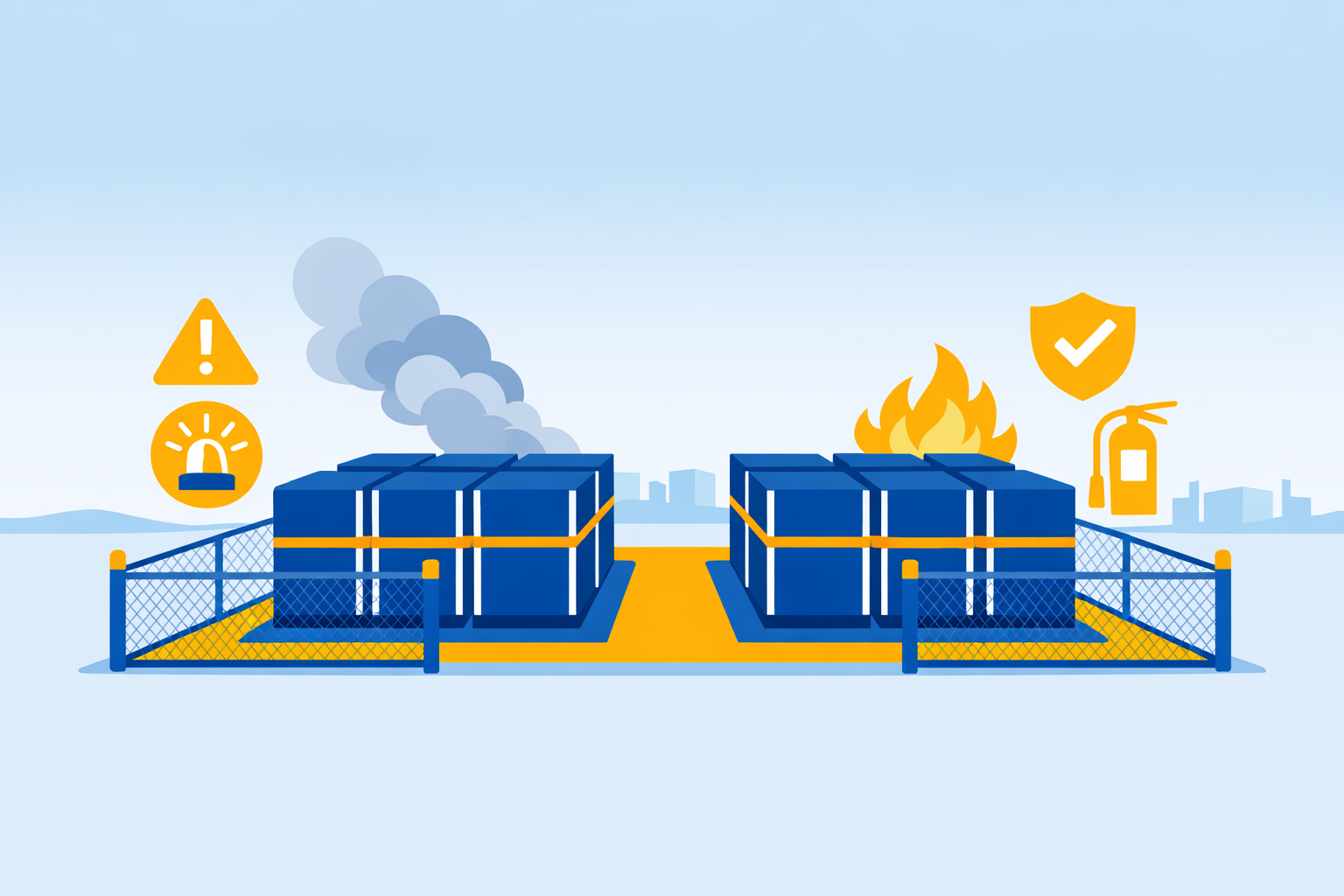
- Large-Scale Fire Testing (LSFT): Projects must show a worst-case fire in one unit will not spread unchecked to adjacent units.
- UL 9540A integration: LSFT complements component-level testing; a complete test suite, from cell to installation, is expected.
- Emergency response planning: The 2026 edition clarifies emergency plan requirements and mandates annual reviews with local responders.
- Fire suppression: Automatic fire control expectations-sprinkler or alternative systems-are consolidated into a single section.
For LDES developers, demonstration of non-propagation and controlled gas and heat release at full installation scale will be mandatory at many sites.
UL 9540 and UL 9540A: Product and Test Standards
UL standards serve as the technical basis for NFPA 855 installation requirements.
- UL 9540 - System Safety Standard: Covers the safety of complete storage systems, including batteries, controls, and associated equipment. UL 9540 listing is required by NFPA 855, IFC, and NEC for larger systems.
- UL 9540A - Fire Propagation Test: Assesses behavior at cell, module, unit, and installation levels, supporting requirements for separation, ventilation, and fire suppression.
UL 9540A's 6th Edition (March 13, 2026) tightens requirements addressing thermal runaway, flammable gas production, deflagration risk, and installation-level fire behavior for storage systems.
Advancements include:
- Expanding focus on large-scale and installation-level scenarios
- Detailed guidelines on flammable gas production and ignition
- Improved instructions on sensor placement and test setup for reproducibility
- Enhanced alignment with NFPA 855 (2026) and updated code language
Fire and Building Codes: NFPA 1, IFC, and NEC
NFPA 855 and UL standards become legally enforceable when adopted into fire, building, and electrical codes:
- NFPA 1 (Fire Code)
- International Fire Code (Chapter 12 for ESS)
- International Building Code (IBC)
- National Electrical Code (NFPA 70) - notably Article 706 on ESS
Most new U.S. utility-scale and commercial projects follow the 2023-24 code editions, with AHJs preparing to adopt NFPA 855 (2026) as soon as it is finalized.
Environmental and Reliability Oversight: EPA, NERC, and WECC
Environmental and reliability regulators also shape the safety framework:
- The EPA's post-fire actions at Gateway reinforced expectations for air and water monitoring, hazardous waste management, and remediation after major BESS incidents.
- NERC and entities like WECC have issued analyses linking BESS fire risk to system reliability, influencing utility procurement and operational standards.
Implications for Long-Duration Energy Storage
Long-duration storage often differs from standard 2-4 hour lithium-ion projects in chemistry and configuration. While the framework is largely chemistry-agnostic, its effects vary across technologies.
Technology Classes Under the New Framework
| Technology Class | Typical Duration | Primary Safety Risks | Regulatory Focus |
|---|---|---|---|
| Lithium-ion BESS (NMC, LFP) | 2-8 hours (some >10h) | Thermal runaway, gas deflagration, cascading fires | UL 9540/9540A at all levels; LSFT; gas detection |
| Aqueous flow batteries (e.g., VRFB) | 8-20+ hours | Electrolyte spills, hydrogen evolution, equipment | Containment, ventilation, spill control, non-Li fire test |
| Metal-hydrogen/metal-air | 10-24+ hours | Hydrogen generation, pressure, venting | Gas monitoring, explosion protection, hybrid codes |
| Mechanical (pumped hydro, CAES) | 10-100+ hours | Mechanical failure, pressurized vessels/caverns | Existing dam/pressure codes; integration w/ ESS |
| Thermal storage (molten salt, PCM) | 6-15+ hours | High-temperature containment, insulation fires | Process safety, thermal-fluid management |
NFPA 855 and related UL/CSA tests are being updated for non-lithium chemistries. For LDES developers, core concerns include:
- Test requirements: Non-lithium technologies may be required to complete UL 9540 and UL 9540A-equivalent tests, with adapted methods as needed.
- Hybrid systems: Projects combining lithium-ion with other technologies are subject to overlapping code requirements.
- Siting and zoning: LDES sites with multi-day output focus attention on spacing, fire barriers, and maximum credible events.
Performance and Operational Expectations
LDES projects typically experience deeper cycles and more frequent multi-hour discharges. Under the new framework, operators must:
- Implement continuous monitoring of cell temperatures, gas concentrations, and thermal system health
- Manage state-of-charge to reduce risk during high-stress periods (e.g., heatwaves, wildfire smoke)
- Establish detailed emergency procedures, including isolation and controlled discharge protocols
Cost, Insurance, and Schedule Impacts
System-level, performance-based safety standards have pronounced commercial impacts.
Capex: Testing, Engineering, and Fire Suppression
New requirements drive capital costs in several areas:
- Testing/certification: Complete UL 9540A 6th Edition and LSFT campaigns increase laboratory and engineering expenses. Manufacturers perform multiple LSFTs for differing layouts and configurations.
- Fire suppression/detection: NFPA 855 (2026) and IFC harmonization drive installation of:
- NFPA 13 sprinkler or equivalent systems
- Clean-agent or aerosol suppression within enclosures
- Multi-criteria detection (smoke, heat, and gas)
- Structural/layout modifications: Wider separations, fire-rated walls, deflagration vents, and cable routing affect site footprint and balance-of-plant costs.
Clean Energy Associates' 2024 factory inspections found 28% of energy storage systems with detection or suppression issues and 15% with thermal management defects, across 330 inspections covering 29 GWh. These findings shape insurer and lender requirements as much as manufacturer quality programs.
Insurance and Finance: Underwriting to NFPA and UL
Insurers and tax equity providers increasingly require conformity to NFPA 855 and UL 9540/9540A for project coverage and financing:
- Some underwriters mandate full UL 9540A reports, including LSFT data, for technical due diligence.
- Recent policies may include higher deductibles or exclusions for systems not meeting the latest standards unless retrofitted or retested.
- Portfolio analytics now integrate defect and incident rates, such as the 28% suppression-issue rate, to model premiums.
Larger total stored energy and longer durations mean LDES projects receive higher scrutiny around loss scenarios and business interruption risk.
Timelines: Permitting and Interconnection
Tighter safety validation impacts project schedules:
- Design-to-test cycles: Project teams often revise designs following preliminary LSFT data, especially for ventilation and separation.
- AHJ review: Fire marshals and officials use NFPA 855 (2023) as the benchmark, preparing to adopt 2026 revisions, delaying approvals until comprehensive data is available.
- Grid readiness: Utilities and ISOs in some regions now align interconnection reviews with updated NERC and WECC guidance on BESS fire risks and performance.
Projects lacking a demonstrable, standards-aligned safety approach should expect extended reviews and possible redesigns.
Policy Trajectory and State-Level Adoption
The reach of the safety framework depends on state and local code adoption and enforcement.
Patchwork Adoption of NFPA and IFC
U.S. states and major cities adopt model codes at different times:
- Some still use earlier versions with limited ESS provisions.
- Others have transitioned to NFPA 855 (2023) and plan to adopt the 2026 edition rapidly.
States with large BESS pipelines (California, New York, Arizona, Texas) increasingly reference NFPA 855 and UL standards in utility and regulatory guidance, sometimes ahead of formal code updates.
Alignment with Federal LDES Initiatives
DOE's Long Duration Storage Shot and supporting analysis designate LDES as essential for deep decarbonization, linking commercial viability to cost and proven operational safety. These programs stress:
- Need for credible, scalable safety demonstrations for LDES chemistries
- Integration of standards development into demonstration funding
- Sharing of best-practice testing and incident data across stakeholders
DOE policy and analysis consistently define LDES as having 10+ hours discharge and link its market success to both cost targets and safety.
As NFPA and UL revisions align with DOE demonstration requirements, LDES safety practices are likely to coalesce, even if formal state code adoption remains uneven.
Actionable Conclusions and Next Steps
The convergence of headline incidents, evolving NFPA standards, and rigorous UL testing now defines the environment for LDES stakeholders.
For Manufacturers and Technology Vendors
- Design with LSFT in mind: Optimize layouts, venting, and suppression for the new test and code requirements.
- Expand test coverage: Provide data equivalent to UL 9540A LSFT for new chemistries.
- Invest in quality assurance: Address known failure modes-suppression wiring, detectors, thermal hardware-early in production.
For Developers, Utilities, and Asset Owners
- Adopt NFPA 855 (2026) design criteria immediately where possible.
- Use UL 9540A LSFT results in risk modeling, including loss and evacuation planning.
- Engage AHJs and responders early to coordinate emergency procedures and training.
- Align procurement with insurer minimums for UL and NFPA compliance.
For Policymakers and Regulators
- Promote uniform adoption of updated ESS codes to avoid inconsistent rules.
- Tie incentives to compliance with the latest safety standards.
- Enable transparent data sharing about storage incidents and test results for collective learning.
As long-duration energy storage transitions from demonstration to grid-critical infrastructure, its acceptance will depend on credible, standards-based safety. The emerging U.S. framework-anchored in NFPA 855, UL 9540/9540A, and reinforced oversight-sets a clearer path. Adhering to these expectations will facilitate faster approvals, lower risk, and stable project deployment environments.
Frequently Asked Questions
How do NFPA standards and UL standards differ in the context of energy storage safety?
NFPA standards, such as NFPA 855 and NFPA 1, are installation and fire-protection codes, dictating how and where storage systems are sited and protected. They are enforced at the local level.
UL standards, including UL 9540 and UL 9540A, are product and test standards. UL 9540 certifies system safety; UL 9540A provides methods to evaluate fire hazards and propagation. NFPA 855 references these UL standards to confirm that installed systems have undergone safety testing.
Why is large-scale fire testing (LSFT) becoming mandatory for battery energy storage systems?
Large-scale projects can exhibit complex fire dynamics beyond what cell or module tests capture. LSFT simulates worst-case fires in full enclosures, covering gas release, flame spread, structural integrity, and propagation. NFPA 855 (2026) mandates LSFT to ensure empirical, installation-level data guides approval decisions rather than small-scale extrapolation.
Does the new safety framework treat long-duration energy storage differently from shorter-duration systems?
Codes and standards focus on capacity, configuration, and hazards, not strictly on chemistry or duration. However, larger LDES projects can prompt stricter expectations for separation, containment, gas control, and emergency planning due to size and complexity.
How are fire suppression systems expected to evolve under the updated standards?
Suppression systems are moving from basic sprinklers to engineered, system-specific designs. NFPA 855 (2026) expects use of LSFT data to tailor suppression technologies-water-based, clean-agent, or aerosol-proven to manage worst-case fires. Multi-criteria detection and integration with remote monitoring are also increasingly required.
What practical steps can project teams take now to prepare for NFPA 855 (2026) and UL 9540A 6th Edition?
Teams should specify compliance with current and forthcoming UL and NFPA standards, integrate LSFT results into design and planning, and update internal procedures to reflect the 2026 language. Early engagement with labs, fire protection engineers, and AHJs will help align projects with evolving requirements.