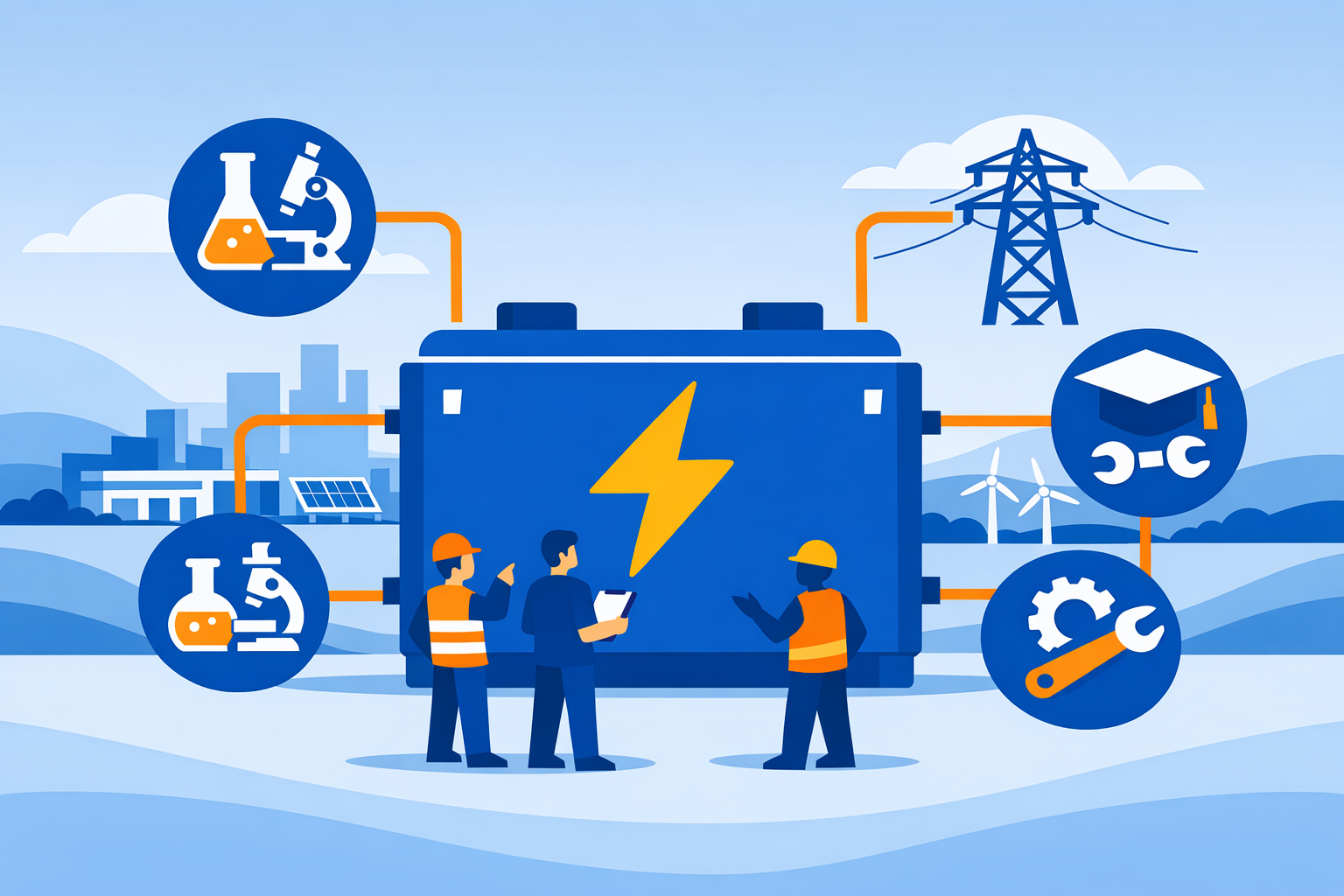
The U.S. National Science Foundation (NSF) Upstate New York Energy Storage Engine has advanced to its second phase, signaling momentum for grid-scale storage deployment through increased funding, standards development, and workforce initiatives. Led by Binghamton University, the program began in May 2022 under the CHIPS and Science Act to enhance battery component development, safety testing, pilot manufacturing, and storage integration in the region. NSF Engines foster regional innovation by combining applied research, commercialization, and workforce training. During Phase One, SuperBoost grants helped companies such as Sionic Energy accelerate battery technology advancements.
Background
The NSF Engines initiative was created to form regional innovation hubs that integrate scientific research, applied outcomes, and workforce development in a single framework. SuperBoost grants supported early commercialization for battery material and manufacturing firms; in April 2025, Sionic Energy received $200,000 to develop its silicon-anode lithium-ion platform. These grants demonstrated initial translation of laboratory breakthroughs into market-ready products and established the Engine's operational model. Phase One prioritized building collaborations among universities, industry, and regional stakeholders, consistent with NSF's direction for Engines to address localized needs.
Details
Phase Two generally involves scaling activities and accessing larger funding allocations. While specific funding figures and recipients for this phase of the Energy Storage Engine remain undisclosed, the NSF model allows Phase One (Type-1) recipients to apply for Type-2 awards worth up to $160 million over ten years. Participants expect Phase Two to drive standards development, pilot-scale demonstrations, and workforce training for roles in battery testing, manufacturing, and grid integration. Ateios Systems recently presented advances in dry electrode manufacturing during an R&D review, reflecting technology developed through Engine support.
Outlook
Over the next 12 to 24 months, utilities, manufacturers, and policymakers are expected to respond to NSF's call for Type-2 Engine funding, potentially directing significant resources toward infrastructure, standards, and specialized workforce pipelines. Regulatory changes supporting harmonized testing protocols and safety standards may follow as pilot projects yield data. The Energy Storage Engine's progress into Phase Two indicates greater regional integration and deployment of energy storage technologies.