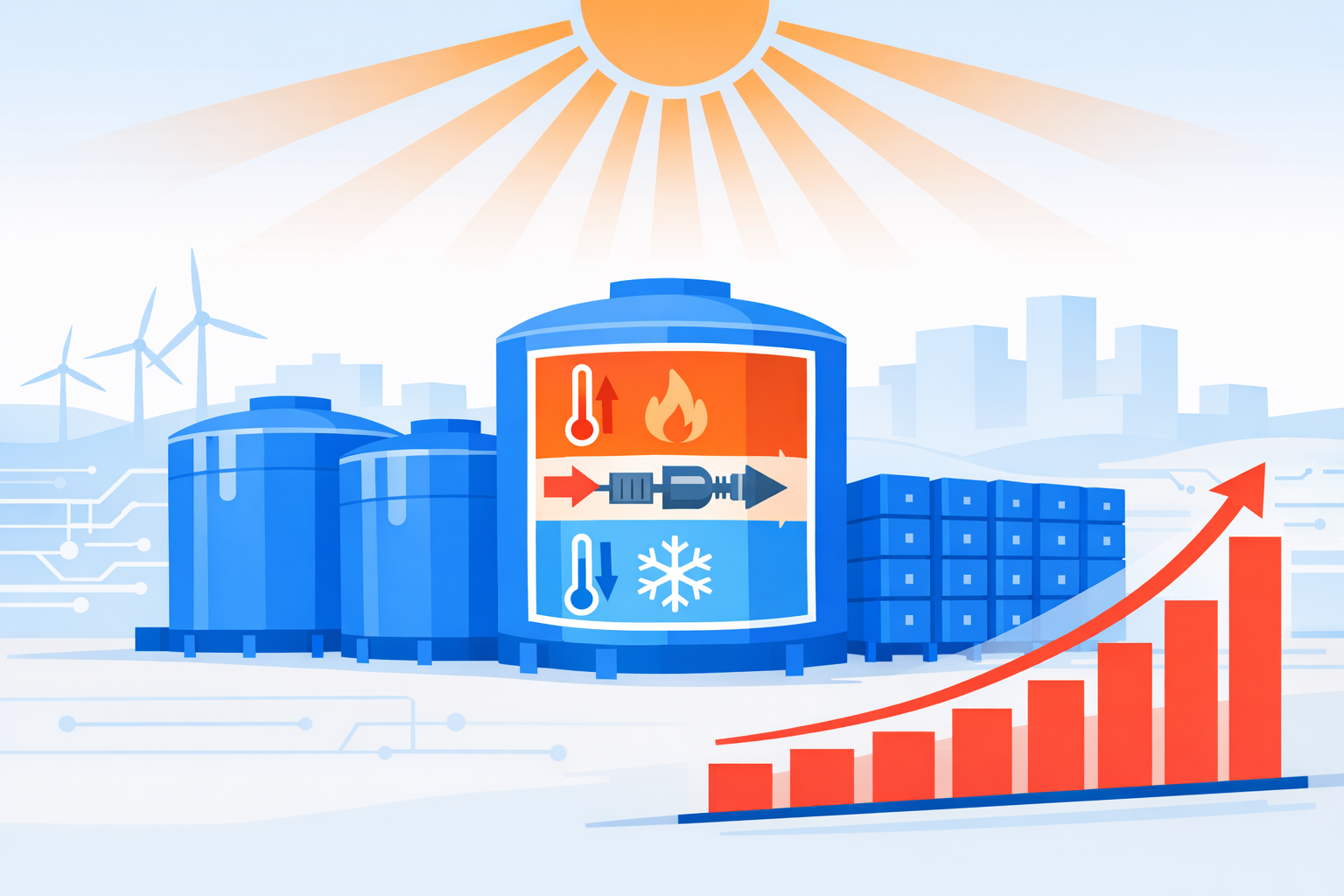
Thermal energy storage (TES) is gaining momentum as a scalable grid resilience solution during heatwaves, driven by declining costs and evolving policy support. Industry analyses indicate that TES is becoming increasingly competitive for long-duration energy shifting, supported by lower capital costs, favorable lifecycle metrics, and advancing regulatory frameworks.
Background
Thermal energy storage encompasses sensible, latent, and phase-change technologies, enabling energy shifting from hours to months by storing heat or cold in media such as water, earth, or salts. TES systems support storage durations ranging from hours to seasonal scales for district or regional applications.[1] Specialized variants, such as pumped thermal electricity storage (also known as Carnot batteries), use low-cost storage media and have been under active development in Germany since 2014[2].
Details
TES is emerging as a cost-effective alternative to lithium-ion batteries for long-duration applications. Lifecycle assessments show TES systems typically achieve environmental payback within 1-2 years, compared to 3-5 years for battery systems[3]. TES manufacturing emissions are 50-80% lower, and design lifespans of 25-30 years surpass the 10-15 year replacement cycles of many batteries[3].
Capital cost comparisons highlight TES's competitive edge. Molten salt TES systems can cost $15-25 per kWh, with phase-change materials ranging $50-150 per kWh, whereas battery systems are priced at several hundred dollars per kWh[4]. Global average capex for TES is $232/kWh, with batteries remaining more expensive, particularly for long-duration storage[5].
A study optimizing hybrid steam-electric systems in Norway and Germany reported current investment costs favor steam accumulator TES over battery energy storage for industrial flexibility. Participation in frequency containment reserve markets and utilizing surplus heat further reduced overall energy system costs[6].
Forecasts from the Long-Duration Energy Storage Council and EPRI estimate TES capital costs could decline 16-47% by 2030, driven by technical improvements and scale-up, though projections vary due to the technology's early-stage maturity[7].
Outlook
With heatwaves increasing grid stress, TES can enhance reliability by discharging during demand peaks. Its long-duration capabilities, low costs, and reduced environmental impact make TES a strategic complement-or, in some cases, an alternative-to lithium-ion batteries. The rate of sector-wide adoption will depend on further cost reductions, pilot project deployment, and integration into industrial and district heating systems.
TES scaling may require supportive procurement models, regulatory incentives for long-duration storage, and innovative financing mechanisms. Grid operators and developers are expected to assess TES operational integration alongside battery systems to optimize resilience and cost-efficiency.