Lithium currently trades at more than 80 times the raw material cost of iron - a disparity that researchers at China's Institute of Metal Research have moved to exploit at grid scale. A new all-iron flow battery developed by a team at the Chinese Academy of Sciences (CAS)[1] has demonstrated 6,000 charge-discharge cycles with no measurable capacity loss, a performance threshold that directly challenges both vanadium redox flow batteries (VRFBs) and lithium-iron phosphate (LFP) systems in long-duration storage applications. The findings, published in Advanced Energy Materials, have sparked immediate industry discussion about whether a new cost benchmark for grid-scale storage is within reach.
What the CAS Team Actually Did
The research team at the Institute of Metal Research formulated a new electrolyte that sustains thousands of charge-discharge cycles in an all-iron flow battery.
The core problem with earlier all-iron designs was electrochemical instability on the negative side of the cell. The anolyte often degraded, causing active materials to break down and leak across the membrane, reducing battery life and efficiency.
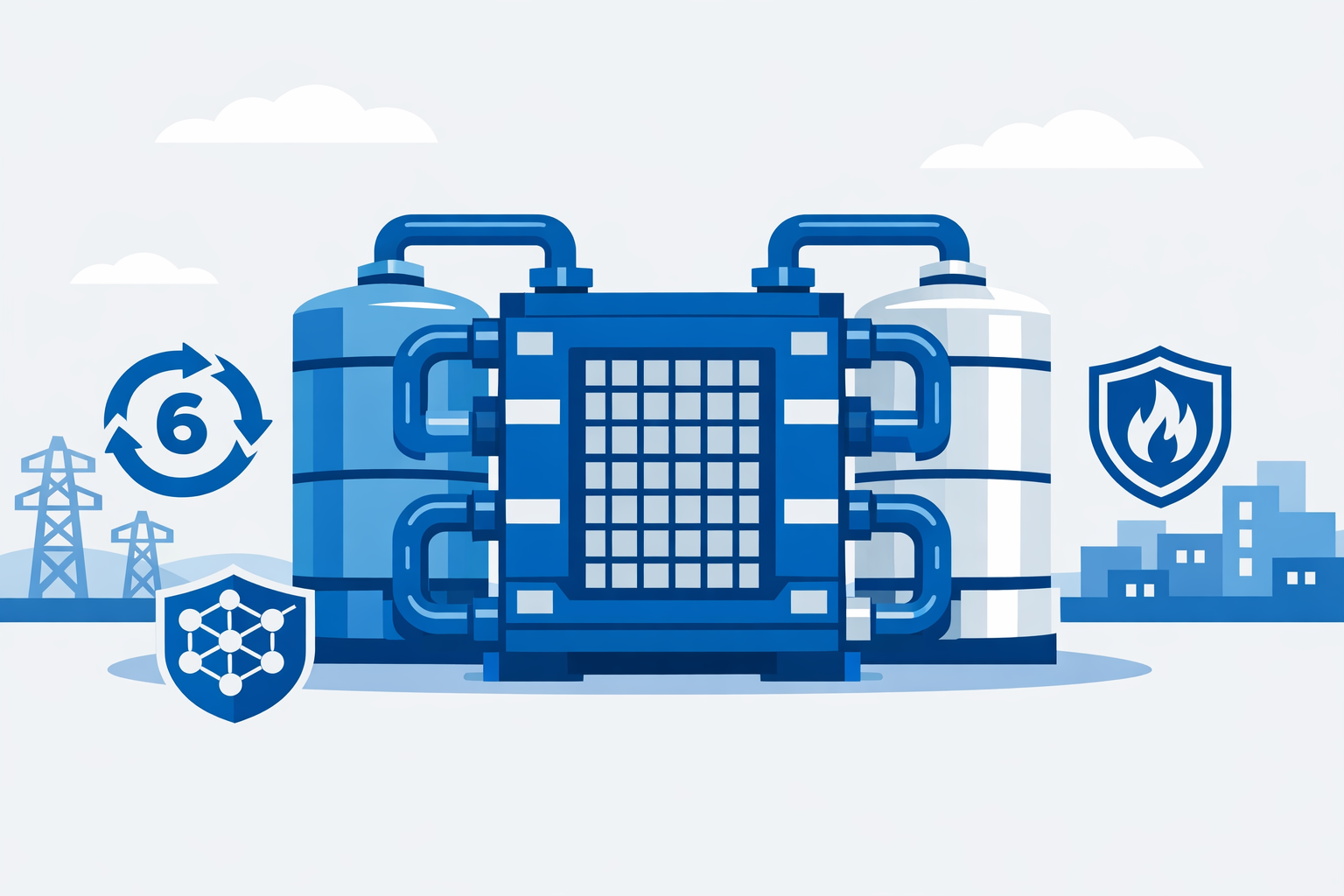
To address this, the team employed a "synergistic design" strategy at the molecular level. They developed a new iron complex that acts as both a structural shield and an electrostatic barrier - its rigid framework prevents harmful hydroxide ions from attacking the iron center, while its dense negative charge repels similarly charged particles and blocks material leakage across the membrane.
After 6,000 cycles, CAS reported no precipitation, no harmful by-products, and a fully stable battery structure. The team's alkaline chemistry and molecular shield design aim to bypass dendrite formation problems that affect some existing iron-based designs.
The Cost Calculus: Iron vs. Vanadium vs. Lithium
The strategic significance of this chemistry lies less in any single performance metric than in the raw material cost structure it unlocks.
According to the researchers, lithium can cost more than 80 times as much as iron when measured as a raw industrial material, underscoring the potential economic advantage of iron-based systems. Vanadium, while cheaper than lithium per kilogram, carries its own supply chain risks - global vanadium trading volume surged 230% in 2023, reflecting supply chain volatility and geographic concentration.
The VRFB market has made cost progress. All-vanadium flow battery system costs dropped from approximately $600/kWh in 2018 to $350/kWh by 2023, a decrease of around 42%. Yet VRFB project costs, while projected to fall by over 30% by 2034, will remain about 240% higher than lithium-iron phosphate battery projects for four-hour duration applications. "The dramatic cost reductions lithium-ion achieved over the past decade will be difficult for emerging LDES technologies to replicate," according to Wood Mackenzie research manager Priya Shrivastava.
All-iron chemistry's cost advantage stems from its reliance on the world's most abundant structural metal. That fundamental material cost edge is one lithium-based systems cannot match. However, total system cost involves far more than raw electrolyte material - balance-of-plant components, membranes, pumping systems, power conditioning, and manufacturing scale all factor into the final installed cost per kilowatt-hour.
Technology Benchmarking: Where Iron Flow Fits
Traditional lithium-ion batteries, while well suited to short-duration applications of two to four hours, become prohibitively expensive for storage needs beyond eight hours. This structural weakness creates the market gap that flow chemistries - including all-iron - are positioned to fill.
Flow batteries store energy in external liquid tanks rather than in solid-state cells, allowing capacity to scale simply by expanding storage volume. This decoupling of power and energy is architecturally significant: in long-duration scenarios, costs do not scale linearly with duration, unlike lithium-ion.
Iron-based systems carry no risk of thermal runaway or fires, making them significantly easier to permit and install - an increasingly material consideration as grid developers face stricter fire safety standards in the U.S., EU, and Australia.
The table below summarizes key differentiators across the three primary storage chemistries relevant to utility-scale procurement decisions:
{{component:COMPARISON_PLACEHOLDER}}
Long-Duration Storage: A Market Under Pressure
The CAS breakthrough arrives at a moment of structural tension in the LDES market. Global LDES installations exceeded 15 GWh in 2025, a 49% year-on-year increase - yet the sector faces growing challenges from declining investment and intensifying competition from lithium-ion batteries, according to Wood Mackenzie.
Compressed air energy storage (CAES), thermal storage, and VRFBs accounted for 45%, 33%, and 21% of 2025 installations respectively. China continues to dominate, representing 93% of cumulative global deployment, driven by strong policy support including the Special Action Plan for Development of New Energy Storage (2025-2027).
In North America, the U.S. grid is estimated to need 225 to 465 gigawatts of long-duration energy storage capacity by 2050, requiring a net investment of $330 billion. Procurement at that scale will demand technologies that demonstrate cost competitiveness across the 8-to-12-hour discharge window - exactly the niche where all-iron chemistry is most promising.
In the United States, Oregon-based ESS Tech is already deploying iron flow systems for customers including Google, indicating domestic interest in iron-based storage predates the CAS announcement. The new results could accelerate funding for next-generation iron-flow pilot programs in North America and Europe, where LDES procurement frameworks are still taking shape.
{{component:CALLOUT_PLACEHOLDER}}
The Path to Commercialization: 12-24 Months Are Pivotal
Scaling from a stable lab chemistry to a commercial grid storage product takes time. The technical milestones ahead are well defined: the CAS design must demonstrate equivalent performance at utility-scale voltages and current densities, under realistic grid-service duty cycles - including frequency regulation, capacity firming, and multi-day seasonal storage - and across the full range of ambient temperatures in target markets.
Commercialization challenges remain. Experts estimate that rebuilding production capacity and scaling manufacturing could take several years. For policymakers in the U.S. and EU, where storage procurement criteria and safety testing regimes are under active revision, the CAS results present both an opportunity and a challenge: whether to expand LDES pilot programs to include all-iron chemistry or to await further independent validation before adjusting incentive structures.
The CAS team's work not only demonstrates a performance breakthrough but also establishes systematic molecular design principles and evaluation methods for iron-based electrolytes, advancing all-iron systems toward higher reliability, longer service life, and lower levelized cost of electricity. That methodological contribution may prove as significant as the cycle-life headline, providing a reproducible framework for third-party validation.
Interactive LCOS Explorer
The widget below illustrates projected levelized cost of storage (LCOS) across storage durations for all three technologies. All-iron flow projections are based on raw material cost differentials and are not yet commercially validated.
{{widget:WIDGET_PLACEHOLDER}}
Key Takeaways for Grid Developers and Procurers
- Monitor pilot pipelines closely. The next 12 to 24 months will determine whether CAS results translate into utility-scale pilots in China and whether licensing or joint-venture structures open the technology to non-Chinese developers.
- Reassess LDES duration thresholds. If all-iron chemistry meets cost targets at 8 to 12 hours, it could alter the breakeven analysis that currently favors lithium-ion in the four- to eight-hour segment.
- Supply chain resilience is now a procurement criterion. Iron's geographic ubiquity removes a key geopolitical risk embedded in both vanadium and lithium supply chains - a factor gaining weight in IRA-aligned and EU Critical Raw Materials Act-compliant procurement frameworks.
- Safety permitting advantages are real. Aqueous iron electrolytes face significantly lower fire-safety barriers than lithium-ion, which could accelerate siting approvals in dense or environmentally sensitive locations.
- Independent replication is the immediate gating factor. Until third-party labs and pilot operators confirm the 6,000-cycle stability data at scale, procurement teams should treat all-iron flow as a high-priority technology to track - not yet a decision-ready alternative to established VRFB or LFP systems.
The broader pivot toward long-duration storage chemistries is already reshaping capital allocation across the battery manufacturing sector. The CAS breakthrough adds a credible new contender to that competition - one built on the most abundant metal in the Earth's crust.