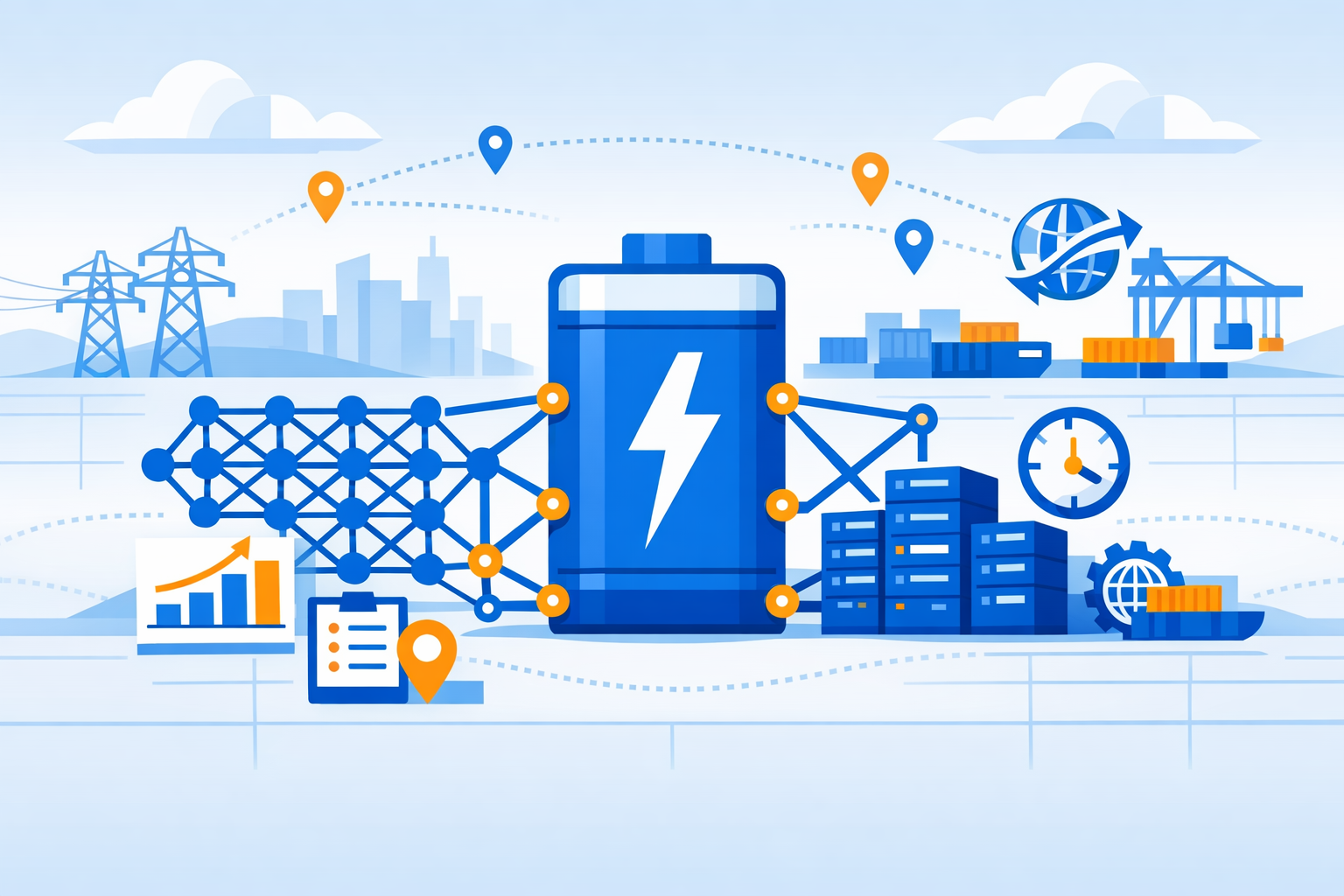
Battery storage developers are deploying artificial intelligence across forecasting, dispatch, and asset management at an accelerating pace, even as multi-year grid interconnection queues and a China-concentrated supply chain constrain the industry's ability to scale. The tension between AI-enabled operational gains and persistent structural bottlenecks is reshaping project economics and timelines for utilities, independent power producers, and grid operators worldwide.
Background
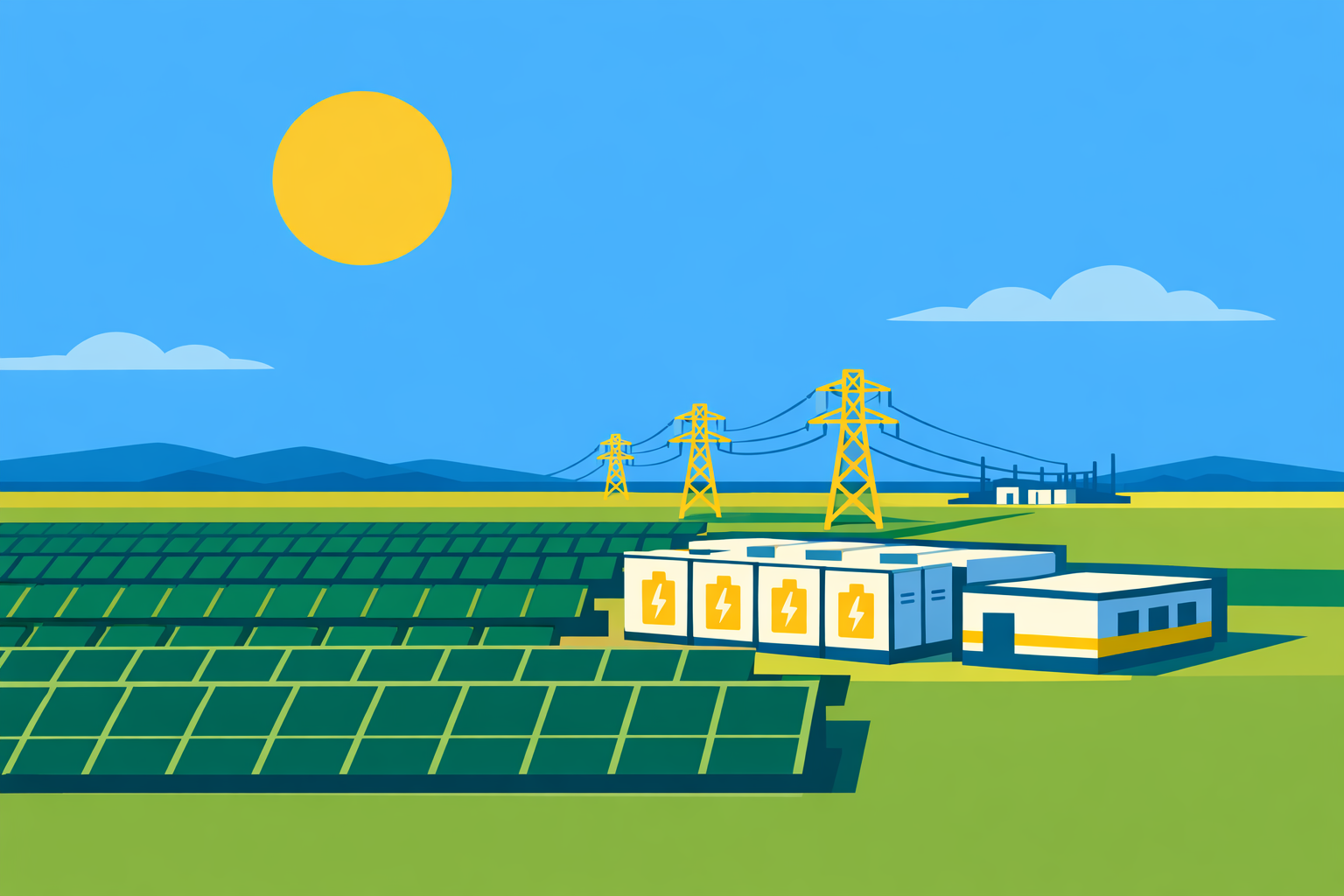
The U.S. added a record 57.6 GWh of new battery energy storage capacity in 2025, according to the Solar Energy Industries Association (SEIA), bringing total deployed capacity to 166.1 GWh. SEIA projects that annual battery storage deployments will reach 110 GWh by 2030, with a significant share driven by data center demand. This rapid build-out has made dispatch quality and asset optimization increasingly consequential to grid operations. California's installed battery capacity grew from roughly 500 MW in 2018 to more than 16,900 MW by mid-2025, illustrating the scale at which AI-driven coordination is shifting from a site-level feature to a system-level necessity.
Grid infrastructure required to absorb this capacity has not kept pace. The median time from a preliminary interconnection request to commercial operation has steadily increased to over five years, according to research published by the Power Systems Computation Conference. "Were it not for multi-year interconnection queues, we could deploy a utility-scale battery storage system in under a year to meet the needs of the electric grid," said one industry executive cited by Reuters.
Details
AI platforms now span several distinct storage use cases. Advanced energy management systems coordinate battery state-of-charge, forecasted demand, real-time tariffs, and system constraints to optimize dispatch-moving beyond fixed-timer charge-discharge cycles. According to the Department of Energy's AI for Energy overview, optimization of grid operations and energy systems represents a primary current application, while NREL's 2025 battery-diagnostics work demonstrates how improved battery-state estimation supports more informed operational decisions.
In wholesale markets, AI algorithms predict electricity price spikes, renewable generation patterns, and demand profiles to optimize energy arbitrage-charging during low-price periods and discharging during high-price periods. Research testing such models against New York ISO price data found that AI-based arbitrage approaches can capture up to 90% of the profit achievable under perfect price foresight.
On the supply chain side, the picture remains strained. More than 90% of battery storage applications rely on lithium iron phosphate (LFP) batteries, which are almost exclusively supplied from China, according to the International Energy Agency. The IEA has warned that "nearly all batteries used for power grids rely on China for at least one step of their supply chain," a dependency compounded by Chinese export controls on key battery components introduced since 2023. In 2025, battery pack prices in China were 30% lower than in the U.S. and 35% lower than in Europe, according to IEA data, further entrenching this geographic concentration.
"Supply chain constraints and interconnection queues are two of the most important barriers," said Harvest-Time Obadire, senior power and renewables analyst with BMI, a unit of Fitch Solutions. While data centers can be built in 18 to 24 months, connecting to the grid can take three to seven years in parts of the U.S., Obadire noted.
Prolonged interconnection timelines are already redirecting capital. Hyperscale data center developers are co-locating generation and storage to avoid interconnection queues, with some developers prioritizing sites where private transmission lines run directly from solar facilities to data centers-removing projects from public interconnection queues entirely, according to Wood Mackenzie.
Policy responses are emerging. In 2025, Texas passed Senate Bill 6, which redefines the interconnection process for large electrical loads exceeding 75 MW within the ERCOT grid, requiring financial commitments to cover transmission infrastructure costs. A RAND Corporation analysis identified short-term remedies including temporary staffing, queue rationing, and outsourcing, alongside medium-term reforms such as surplus interconnection service and energy-only service pathways. Hybridizing all solar and wind resources with storage could unlock up to 30 GW of additional capacity between 2025 and 2030, RAND estimated.
Outlook
Analysts and operators are watching whether pending interconnection reforms in the U.S. and Europe translate into measurably shorter queue timelines before 2027. Data governance and cybersecurity frameworks for AI-managed storage fleets remain underdeveloped, creating regulatory uncertainty that independent system operators have flagged as a prerequisite for wider AI integration. The global AI data center energy storage market is projected to reach $4.1 to $6.0 billion in annual revenue by 2030, growing at a 28 to 38% compound annual growth rate from approximately $1.2 billion in 2025, according to market research-a trajectory that will test whether infrastructure policy can keep pace with technology deployment.