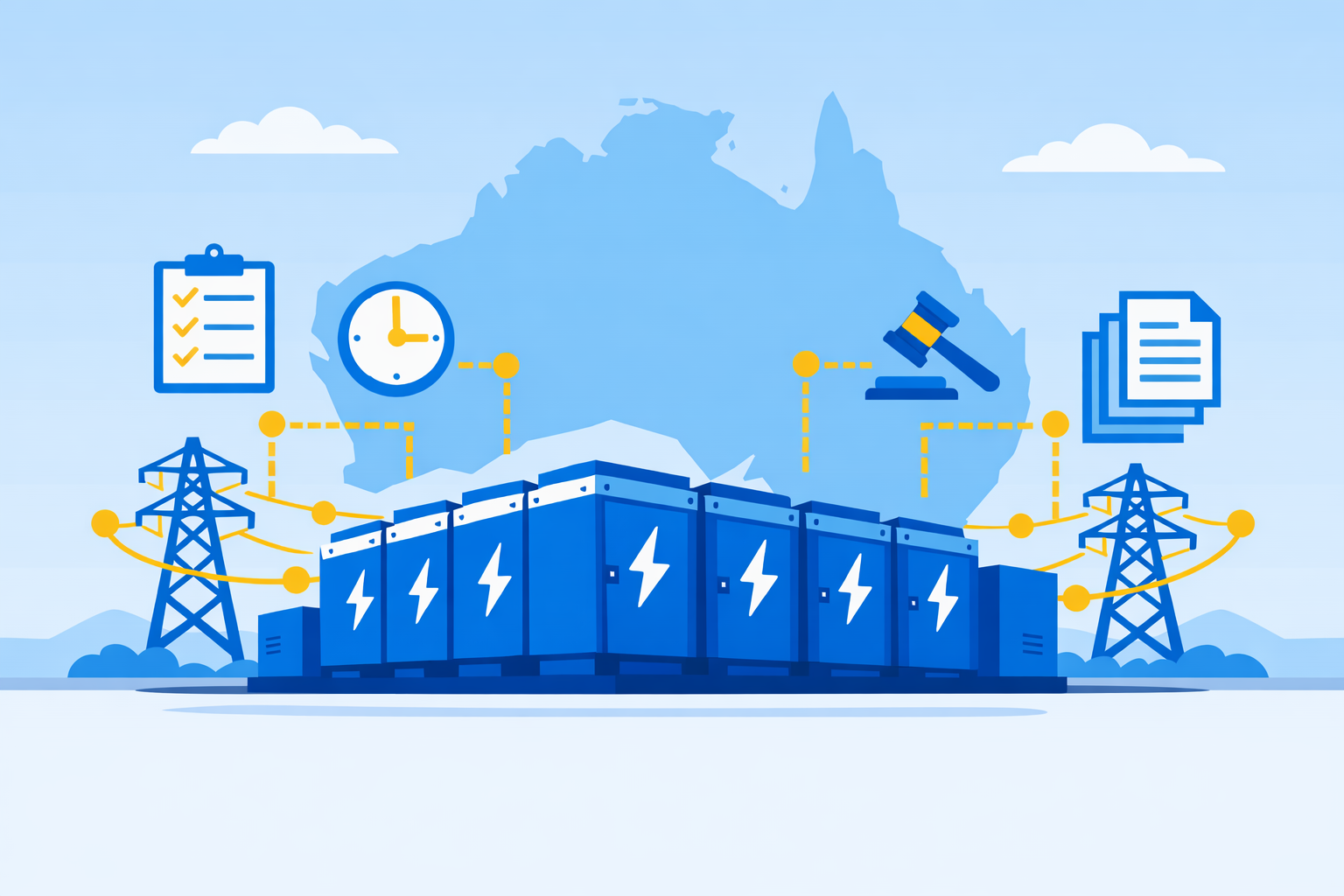
Australia has cemented its position as the world's third-largest utility-scale battery storage market, but developers warn that regulatory complexity and permitting bottlenecks are slowing project delivery at the precise moment the grid needs new capacity most.
Background
Australia recorded a 233% rise in large-scale battery capacity and became the third-largest utility-scale battery market globally in 2025, surpassing the United Kingdom, according to the Clean Energy Council's 2026 Clean Energy Australia report. The rapid expansion is driven by coal plant retirements, rising renewable penetration, and price volatility across the National Electricity Market (NEM)-the interconnected grid spanning Queensland, New South Wales, Victoria, South Australia, Tasmania, and the Australian Capital Territory. Renewable energy generated 43% of Australia's electricity in 2025/26, up from 39% in 2024, while 90 unscheduled coal outages left an average 25% of coal capacity offline during the same summer.
Against that backdrop, BloombergNEF projected in its 2025 Australia Energy Storage Update that utility-scale BESS capacity could expand eightfold to 18 GW by 2035, up from 2.3 GW in 2024. AEMO's draft 2026 Integrated System Plan (ISP) set an even more demanding target: grid-scale battery storage reaching 24 GW by 2030, with major transmission delays pushing storage to shoulder a larger share of system flexibility than previously anticipated.
Details
Developer interest is evident in the connections queue. Australia's standalone battery storage pipeline reached 33.2 GW in Q1 2026, a 62% increase from the 20.5 GW recorded in Q1 2025, with utility-scale BESS now comprising 49% of the total 67.3 GW of projects progressing through the NEM connection process, according to AEMO's latest Connections Scorecard. Projects entering the application stage-where project design performance is assessed-increased 51% over the past year, from 19.7 GW to 29.8 GW, with 18 projects totaling 5.5 GW entering in the March 2026 quarter alone, according to AEMO group manager for onboarding and connections Margarida Pimentel.
Yet the gap between proposals and commissioned assets remains a critical risk. Clean Energy Council CEO Jackie Trad stated that "regulatory challenges, a lack of bipartisan support and delays to critical infrastructure are holding back billions of dollars being invested in regional communities." Just 2.3 GW of new renewable energy generation projects reached financial close in 2025, one of the lowest levels in a decade, according to the Clean Energy Council.
Federal environmental assessment under the Environment Protection and Biodiversity Conservation (EPBC) Act is a recognized chokepoint. Potentia Energy's 125 MW / 500 MWh Blanche BESS near Mount Gambier in South Australia faced formal opposition from a local council, delaying construction commencement to the end of 2026 and pushing commercial operations back to late 2028 at an estimated cost of AUD 220 million. Across states, two BESS projects-TagEnergy Australia's 150 MW Kincraig system and Australian Solar Enterprises' 400 MW / 2,000 MWh Tumuruu project-received federal environmental clearance as "not controlled actions" under the EPBC Act, clearing a pathway without further federal assessment. Meanwhile, Iberdrola Australia submitted its 270 MW / 1,080 MWh Kingswood BESS near Tamworth, New South Wales, to the EPBC Act referral process for assessment.
State-level approaches diverge significantly. Victoria's Development Facilitation Program (DFP) has emerged as a model for expedited approvals: the Victorian government approved two BESS projects totaling 700 MW through the DFP, including Atmos Renewables' 300 MW / 1,140 MWh system in Heywood and Akaysha Energy's 400 MW / 1,600 MWh system in Glenrowan, both connecting to AusNet terminal stations.
On the grid connection side, AEMO and the Clean Energy Council (CEC) established the Connections Reform Initiative (CRI) in 2021 to address delays and complexity. The CRI's R1 workstream resulted in new rules to improve investment certainty by clarifying performance standard assessments and removing barriers to revisions; a draft Automatic Access Standards guidance document is undergoing industry consultation in early 2026.
The revenue landscape for operational assets is shifting equally fast. Battery storage revenue has migrated away from Frequency Control Ancillary Services (FCAS)-the fast-response grid stabilization services that underpinned early project economics-toward wholesale energy arbitrage. According to Q4 2025 data cited by Wärtsilä, 87% of total battery storage revenue in the NEM comes from the energy market, with FCAS revenues reaching their lowest annual level in 2025 due to market saturation from increased BESS and demand-side response capacity. The shift is not uniform: batteries in South Australia drew over 50% of their annual revenue from FCAS contingency events in 2025, while FCAS revenues for assets in New South Wales and Victoria have become negligible, according to Modo Energy.
The Capacity Investment Scheme (CIS) continues to provide federal revenue underwriting. CIS Tender 8, launched by the Department of Climate Change, Energy, the Environment and Water in November 2025, targets 4 GW / 16 GWh of dispatchable capacity in the NEM, the second tender specifically focused on dispatchable storage. The previous CIS Tender 3 selected 16 projects delivering 4.13 GW / 15.7 GWh of renewable dispatchable capacity, all lithium-ion BESS ranging from 100 MW to 450 MW in generation capacity.
Industry participants have flagged the need for clearer technical dispatch standards. AEMO's 2025 Transition Plan for System Security identified 10 grid-forming BESS sites in operation with a combined output of 1,070 MW, alongside a development pipeline of 94 projects comprising 78 standalone battery systems and 16 hybrid installations, with grid-forming inverter technology now featured in 74% of the NEM battery pipeline. Grid-forming inverters enable batteries to autonomously regulate grid voltage and frequency, replicating the system strength previously provided by coal- and gas-fired synchronous generators. Industry stakeholders noted in December 2025 that AEMO's future guidance on inertia, system security, and Network Support and Control Ancillary Services (NSCAS) technical requirements would be critical to ensuring pipeline projects are optimally configured.
Outlook
AEMO's draft 2026 ISP projects that major coal retirements-including Origin Energy's Eraring power station, now slated for an April 2029 closure-create a growing reliability gap that grid-scale BESS must partially fill, with 11 GW of mostly coal-fired generation due to exit the NEM over the next decade. Developers and market observers expect that closing the proposal-to-construction gap will require further streamlining of both federal environmental referral timelines and state planning pathways, alongside clearer network access rules reflecting BESS's multi-function role in ancillary services, energy arbitrage, and system strength. The Nelson Review's final recommendations, agreed in principle by federal and state energy ministers in December 2025, are expected to shape the next phase of contracted revenue frameworks for utility-scale storage-though Queensland did not join the agreement.