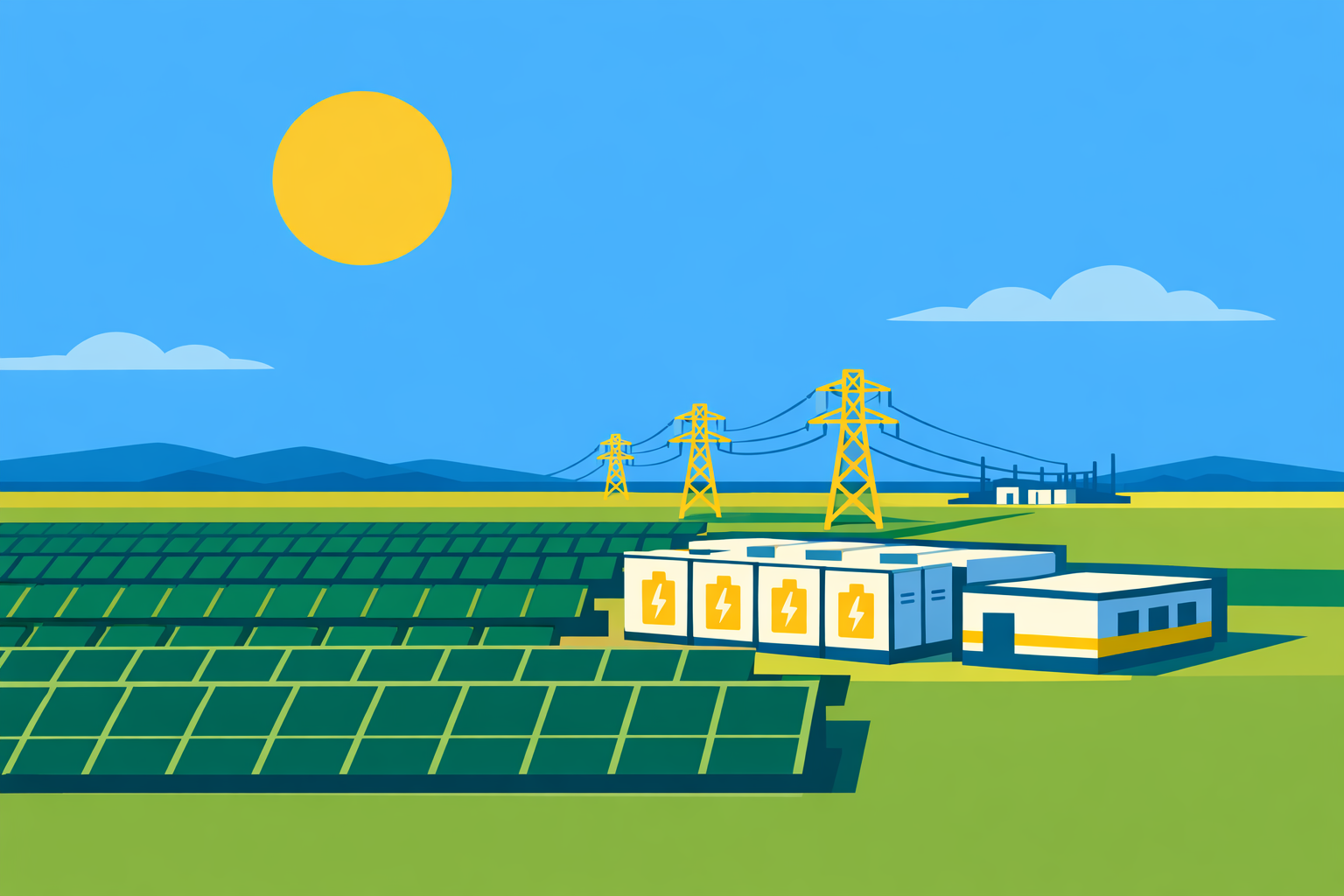
The Finney County Commission approved special use permits for a co-located 400 MW solar facility and 400 MW battery energy storage system in southwestern Kansas, marking one of the largest utility-scale solar-plus-storage proposals to clear county-level permitting in the Great Plains.
The commission's 4-0 vote on June 1, 2026-with one commissioner recusing himself-cleared the path for Sherlock Solar LLC and Sherlock Energy Storage LLC to proceed under Article 36 of Finney County's Zoning Regulations. Construction is not authorized by the special use permits; developers must still satisfy environmental, water, and road-use agreements before a targeted spring 2027 groundbreaking.
Background
The Sherlock Solar project spans approximately 6,150 acres and is rated at 400 MW AC, while the co-located Sherlock Energy Storage project is a 400 MW, four-hour battery energy storage system occupying approximately 54 acres, according to county permit documents. Both fall under the broader Home Range Clean Power initiative, which project representatives said could ultimately serve a future data center or advanced manufacturing facility in the region.
A separate proposal, Lone Bison Solar LLC, is simultaneously under county review. Lone Bison Solar is proposed as a 330 MW AC commercial solar energy conversion system covering approximately 3,853 acres, according to Finney County planning records. The Planning Commission recommended approval of Lone Bison in March 2026 and the two Sherlock applications in April 2026, ahead of the commission's final consideration.
The approvals arrive as the national market for paired solar and storage accelerates sharply. By October 2025, U.S. operating storage capacity reached 37.4 GW, up 32% year to date, with another 19 GW under construction through 2026 and a 187 GW pipeline projected by 2030, according to Deloitte's 2026 Renewable Energy Industry Outlook. Over half of the utility-scale storage coming online by 2026 is paired with solar, the same report noted.
Details
Finney County sits within the Southwest Power Pool (SPP) balancing area, a regional transmission organization where the interconnection queue has expanded dramatically. SPP's total interconnection queue has topped approximately 150 GW-roughly five times its 2013 level-with solar and wind comprising nearly 41% of all queued capacity and standalone battery storage exceeding 31 GW in the queue, according to an April 2026 analysis by CES. The southern and central portions of SPP, including Kansas, have emerged as particularly active zones, driven by favorable grid access and development economics.
Interconnection timelines in SPP have historically ranked among the longest of any U.S. grid region. The median duration from interconnection request to commercial operation date in the SPP region was 56 months for projects completing between 2018 and 2023, according to a peer-reviewed analysis published in Joule. Nationally, that median duration now approaches five years and has increased 70% since 2010, the same study found.
SPP has moved to address the backlog. SPP's Consolidated Planning Proposal was filed with FERC in November 2025 and accepted by FERC on March 13, 2026, with an effective date of March 1, 2026, according to CES. The framework links transmission planning directly with the interconnection process and has been characterized by the Solar and Storage Industries Institute as "game-changing interconnection reform." SPP's first Interconnection Cluster Study queue window is expected to open 30 days after the effective date, with the initial study process expected to conclude in 2028.
During the commission meeting, Sherlock Energy Storage representatives confirmed that the lithium-ion battery facility requires no water for daily operations and that emergency response plans will be developed in coordination with local fire departments-key points of public concern alongside revegetation requirements for the Sandhills landscape.
Outlook
The Finney County projects must clear interconnection studies and execute grid agreements with SPP before financing can be finalized and construction can begin. From initial land identification to grid delivery, a utility-scale solar project typically takes three to seven years in total, with interconnection studies, environmental reviews, and financing among the longest phases, according to SolarInfoPath's 2026 analysis. SPP estimates that 10 GW of storage deployed across its footprint could avoid $2.2 billion in system costs over the next decade, according to Deloitte-an economic rationale expected to sustain developer interest in the Kansas pipeline even as permitting and queue timelines extend toward 2028 and beyond.