Australia commissioned more utility-scale battery energy storage capacity in 2025 than in the previous eight years combined, according to the Clean Energy Council, establishing the country as a global benchmark for policy-driven storage deployment at scale. A total of 11 storage projects totaling 1.9 GW and 4.9 GWh were commissioned during the year, surpassing the combined output of all projects brought online between 2017 and 2024. A federal residential subsidy program also crossed 400,000 home battery installations, adding 11.2 GWh of distributed capacity to the grid.
Background
Australia's storage surge reflects years of layered policy intervention across federal and state levels, timed to absorb the accelerating retirement of coal-fired generation. AEMO forecasts that at least 11 GW of coal capacity will close over the next decade, including the 2.8 GW Eraring plant in New South Wales, the 1.4 GW Yallourn station in Victoria, and Queensland's 700 MW Callide B. To bridge that gap, Canberra introduced the Capacity Investment Scheme (CIS), a federal underwriting mechanism, while New South Wales deployed Long-Term Energy Services Agreements (LTESAs)-both designed to reduce revenue uncertainty for storage investors. According to the Clean Energy Council, those two instruments were the primary policy drivers behind the 2025 commissioning surge.
In 2025, Australia surpassed the United Kingdom to rank third globally for utility-scale battery storage by installed capacity, behind only China and the United States. The country now leads the world in per-capita utility storage, exceeding 1 GWh per million people-more than double the United Kingdom's figure and more than twice the per-capita levels of China and the United States.
Details
The largest single project commissioned in 2025 was the 600 MW / 1.6 GWh Melbourne Renewable Energy Hub in Victoria, a joint development between Singapore-based Equis's Australian subsidiary and the Victorian government's State Electricity Commission, using 444 Tesla Megapack units. Q4 2025 alone accounted for nearly half the year's total, with four projects contributing 1 GW and 2.3 GWh. On 29 December 2025, the National Electricity Market (NEM) set a new peak battery discharge record of 2,885 MW-45% above the previous record set just one quarter earlier.
Policy design extended beyond utility scale. The federal Cheaper Home Batteries Program, launched on 1 July 2025, offers approximately 30% discounts on systems up to 100 kWh by funding the purchase of small-scale technology certificates (STCs), with no additional cost passed to consumers through retailers. In December 2025, the Australian Government expanded the program from an initial AU$2.3 billion to an estimated AU$7.2 billion through 2030, projecting more than 2 million household installations by that date.
Grid integration has advanced in parallel. Ten grid-forming battery energy storage sites are operational in the NEM with a combined output of 1,070 MW, according to AEMO's 2025 Transition Plan for System Security, with a further 94 projects comprising 78 standalone and 16 hybrid systems in the development pipeline. Grid-forming inverters-which provide synthetic inertia, system strength, and frequency control analogous to synchronous generators-have moved from pilot-scale to commercial deployment. Neoen's Western Downs Battery in Queensland was upgraded to grid-forming mode in March 2025 with AU$21 million in ARENA funding, and by September 2025 its capacity had doubled to 540 MW / 1,080 MWh, making it the largest operating grid-forming battery in the Southern Hemisphere.
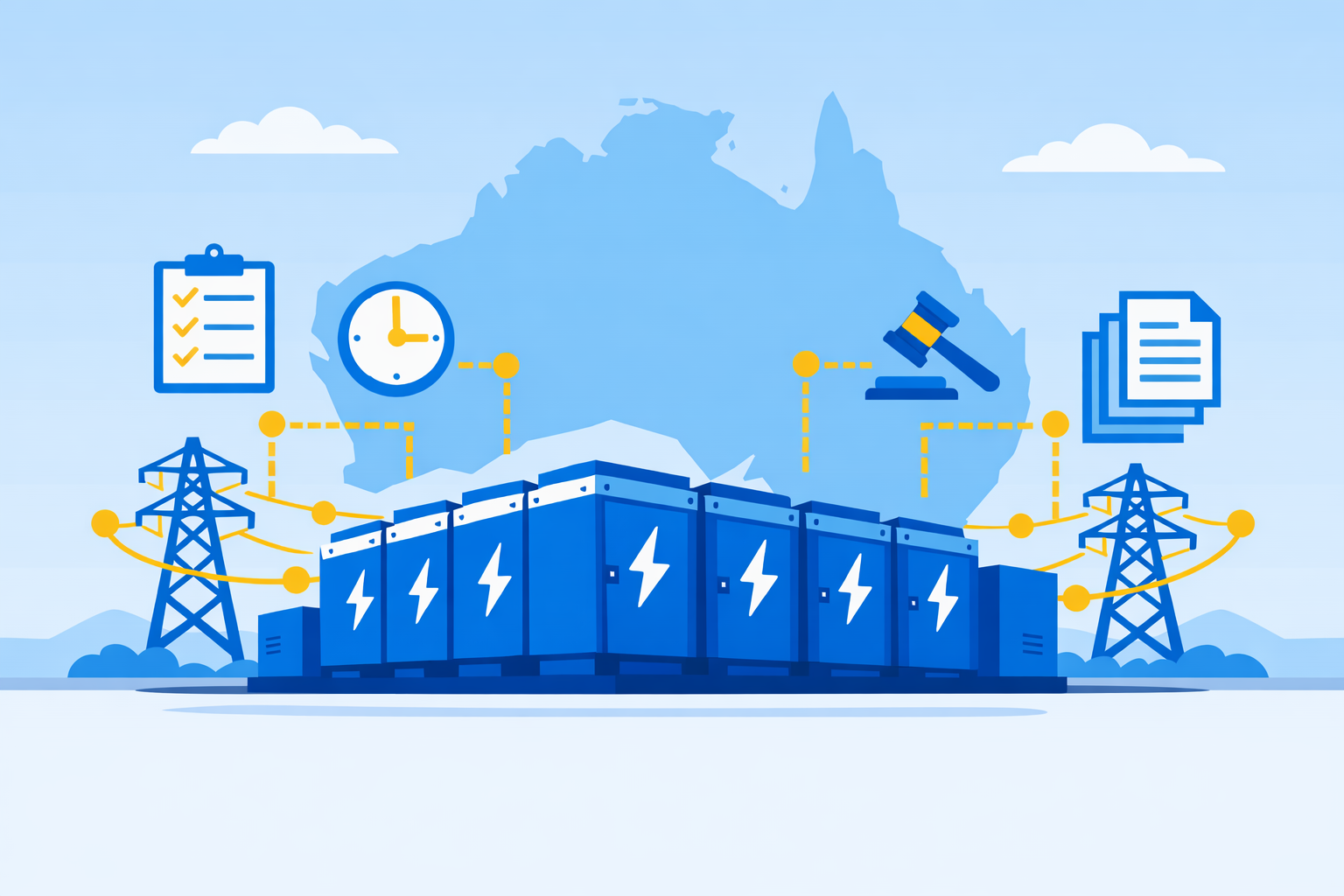
Permitting frameworks have not kept pace uniformly. Prior to December 2025 regulatory reforms, battery storage facilities in Queensland were assessed against 77 different sets of rules depending on the requirements of individual local government planning schemes. Queensland's Planning (Battery Storage Facilities) and Other Legislation Amendment Regulation 2025, effective 12 December, introduced a single State Code 27 and appointed the State Assessment and Referral Agency as the assessment manager for facilities of 50 MW or more. The reform aligns BESS approvals with the regulatory framework applied to other renewable energy projects, though developers acknowledge the transition will create interim delays for projects not yet approved.
Supply-chain constraints have compounded permitting pressure. The rapid pace of residential installations had already pushed installer wait times to at least three months by late 2025, with the Clean Energy Regulator processing approximately 8,000 home battery applications per week and noting that industry capacity was "about full." At the utility scale, Akaysha Energy CEO Nick Carter noted that testing and commissioning the 850 MW Waratah Super Battery-the single largest connection point in the NEM-presented a challenge "that has never been done before in any grid globally."
Outlook
As of Q4 2025, 75 utility-scale storage projects were either financially committed or under construction in Australia, representing 13 GW of power output and 34.7 GWh of capacity. Investment in new storage capacity by 2030 is expected to exceed AUD 21 billion, supported by the CIS. AEMO CEO Daniel Westerman stated that timely delivery of storage alongside generation and transmission retirements "remains critical," pointing to a decade-long investment pipeline that regulators and developers must navigate against tightening connection queues and evolving grid-forming standards.