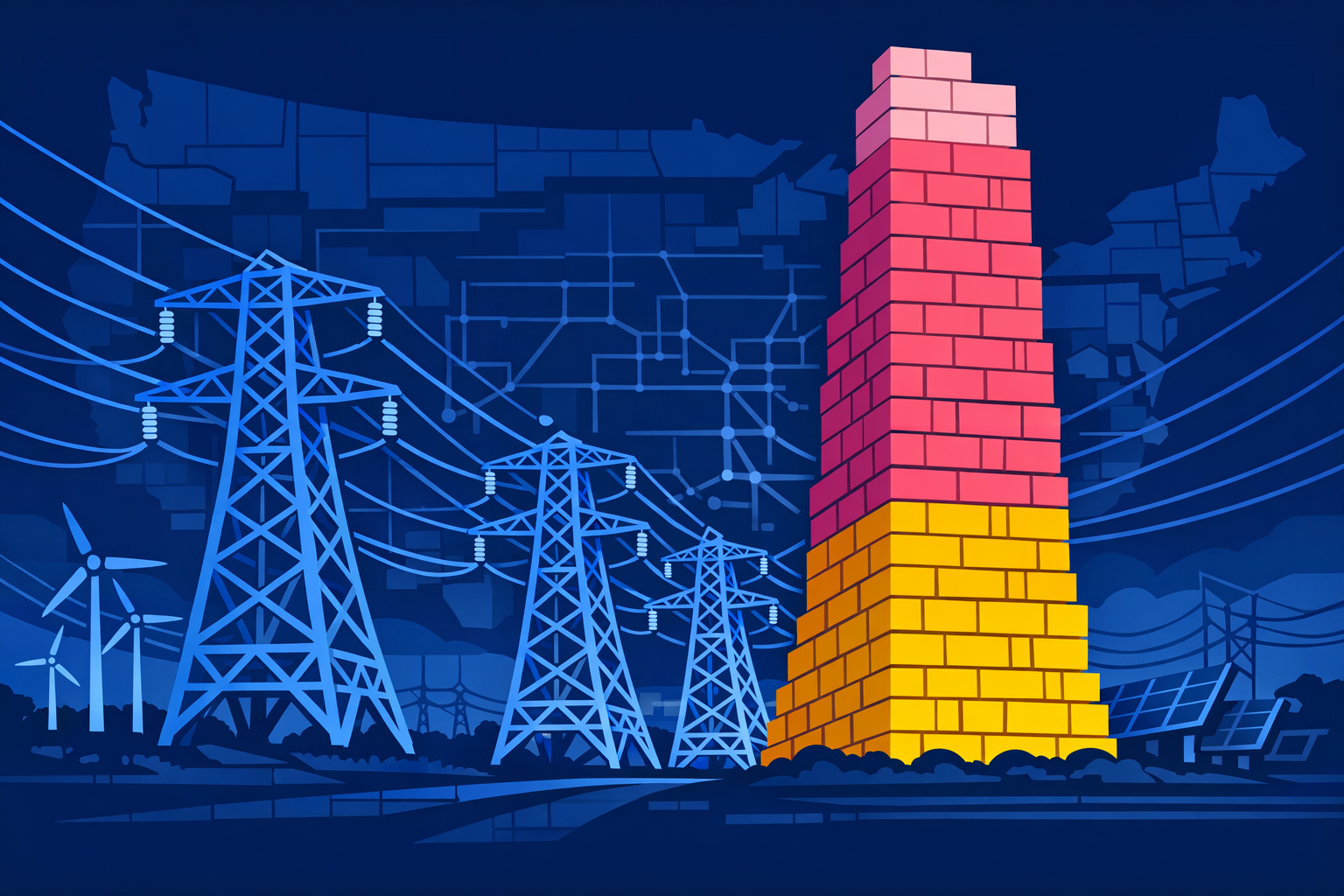
More than 2,060 gigawatts (GW) of generation and storage capacity remained waiting to connect to the U.S. transmission grid as of the end of 2025, according to Lawrence Berkeley National Laboratory (LBNL). The backlog now dwarfs the country's entire installed power fleet and has emerged as one of the sharpest structural constraints on the clean energy build-out. Even after a year of elevated project withdrawals, the cumulative queue continues to exceed demand growth forecasts and strain the study capacity of grid operators nationwide.
Background
The scale of the U.S. interconnection queue has grown dramatically over the past decade. The backlog of new power generation and energy storage seeking transmission connections grew to nearly 2,600 GW at the end of 2023, with active capacity increasing nearly eight-fold over the prior decade - more than twice the total installed capacity of the existing U.S. power plant fleet. Between 2000 and 2010, the U.S. averaged 500 to 1,000 new annual transmission interconnection requests, corresponding to 150 to 200 GW of proposed generation each year. Over the last decade, new requests rose to 2,500 to 3,000 per year, representing 400 to 900 GW of proposed capacity - a three- to six-fold expansion.
Multiple demand-side forces have driven the surge in applications. The explosive growth of artificial intelligence, reshoring of heavy industry, increasing electrification, and planned retirement of aging generation facilities have all intensified pressure to bring new capacity online. The U.S. Department of Energy found that domestic data center energy consumption is expected to double or triple by 2028, while a 2025 International Energy Agency report estimated that U.S. data center energy use could account for nearly half of electricity demand growth between now and 2030.
The interconnection queue refers to the pipeline of proposed power plants - primarily solar, wind, and battery storage facilities - that must undergo a series of technical impact studies by grid operators, known as ISOs and RTOs, before receiving approval to connect to the high-voltage transmission system. These studies determine what new transmission equipment or upgrades are needed and assign the associated costs to developers.
Details
After a decade of near-continuous growth, interconnection queues saw their first significant volume decrease in 2024, though approximately 2,290 GW of capacity remained active - nearly twice the capacity of the current U.S. power plant fleet. Historic withdrawal rates alongside relatively fewer new requests produced a 12% decrease in total active queue volume compared to the prior year. However, LBNL cautioned that the contraction did not reflect meaningful efficiency gains. Record amounts of large-scale solar (31 GW) and battery storage (11 GW) completed interconnection and began operating, but new solar and battery storage capacity entering the queue declined sharply - solar fell 47% and battery storage 32%. A record 112 GW of combined solar and storage capacity withdrew from the queue due to political uncertainty, high interest rates, tariffs, and local permitting challenges.
By the end of 2025, over 2,060 GW of total generation and storage capacity remained actively seeking connection to the grid, according to Lawrence Berkeley National Laboratory data published in May 2026. The queue's composition has also shifted. Active natural gas capacity rose 72% year-over-year to 136 GW in 2024, while solar fell 12% to 956 GW, storage fell 13% to 890 GW, and wind dropped 26% to 271 GW.
Processing timelines continue to lengthen. The typical project reaching commercial operation in 2024 spent an average of 55 months - or 4.5 years - in the queue, one of the most concerning metrics for grid engineers. As of the end of 2024, 408 GW of capacity held a draft or executed interconnection agreement but had not yet reached commercial operations. Completion rates remain structurally low: just 19% of projects that requested interconnection between 2000 and 2019 had reached commercial operations by the end of 2024.
The capacity bottleneck is generating direct cost consequences at the market level. PJM capacity auction prices for the 2025-2026 delivery year surged to approximately $270 per MW-day across most of the region, up from around $29 per MW-day for the prior delivery year. Prices for the 2026-2027 delivery year hit the FERC cap of $329 per MW-day across the entire PJM footprint. Analysis by Aurora Energy Research, commissioned by GridLab, concluded that if just 10% of the 107 GW of land-based renewables in the PJM queue before 2024 had been built in time for the 2026-2027 auction, it would have added 1.5 GW in net supply.
According to Texas-based energy research firm Enverus, interconnection queues remain one of the most significant barriers to bringing new generation capacity online. The firm's 2026 interconnection outlook report identified new load demands and shifting utility priorities as factors complicating an already-backlogged process. Utilities are increasingly moving away from a place-in-queue approach to interconnection studies in favor of projects judged likely to deliver the most reliably dispatchable energy as soon as possible.
The primary drivers of today's bottleneck are legacy, time-intensive study processes and transmission capacity constraints that lead to highly uncertain and growing interconnection costs for developers. These are compounded by understaffed transmission and interconnection planning teams, permitting challenges, and supply chain constraints. Regional disparities are pronounced: in Texas, ERCOT's connect-and-manage approach has proved particularly effective, yielding the highest success rates and fastest interconnection approvals, with an average timeline of just over one year. That compares to multi-year waits across parts of PJM and the non-ISO West, where serial study processes remain common.
On the financing side, developers and investors face growing pressure to assess interconnection risk earlier, as late-stage delays and cost escalation continue to challenge project economics. Interconnection costs reported between 2019 and 2023 were 44% greater than during the preceding five-year period, according to LBNL research.
Outlook
The policy response has intensified. The Federal Energy Regulatory Commission issued Order No. 2023 in July 2023 to reform procedures for integrating new generating facilities into the grid, with the stated goal of reducing backlogs, improving certainty, and ensuring access for new technologies. FERC ordered PJM - the largest U.S. grid operator - to make significant changes to its interconnection study process in July 2025, acting on the last major pending Order 2023 compliance plan. In 2024, regional grid operators processed 33% more interconnection agreements than the previous year, while a 9% decline in new project entries and a 51% increase in withdrawals of non-viable projects helped reduce queue backlogs. Interconnection agreements reached historic highs in 2024, with 75 GW of secured capacity.
Grid Strategies' November 2025 report projected that the U.S. will require more than 150 GW of additional generation capacity within five years, by 2030, to meet anticipated electricity demand growth. Taken together, speculative queue volume, low completion rates, and elongating timelines are resulting in lower renewable capacity deployment than needed to achieve decarbonization targets, despite significant developer interest. Permitting legislation, including the SPEED Act currently advancing in Congress, could provide additional relief if interconnection and transmission reforms are incorporated into the final bill, according to industry observers.
For further reading on how interconnection and siting delays are playing out at the project level, see our earlier report on the Trego 200 MW BESS approval near Reno.