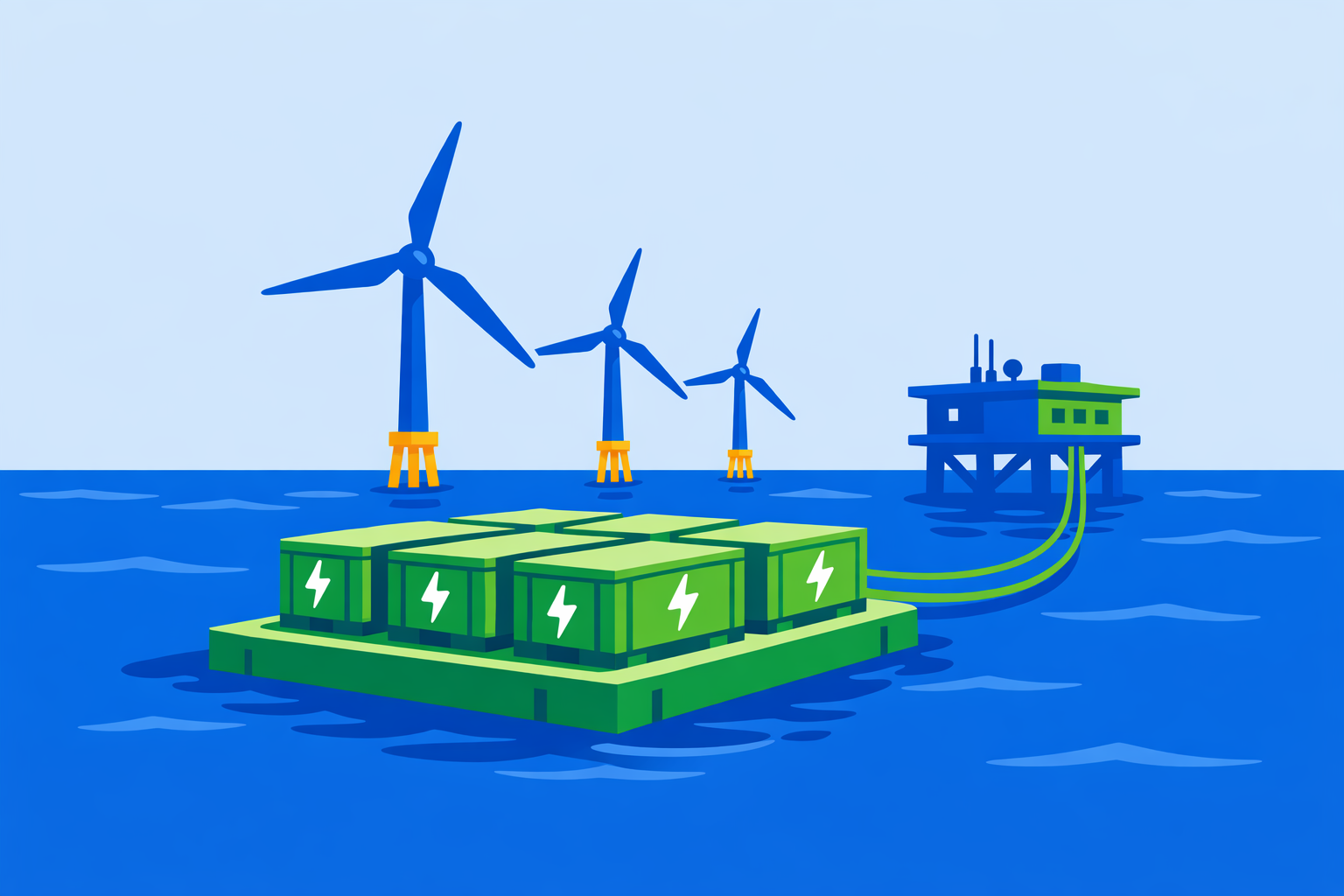
A major battery manufacturer has announced plans to deploy offshore grid-scale energy storage to support the growing offshore wind sector. The company aims to install systems either on the seabed or on offshore converter platforms to enhance grid stability amid increasing intermittent renewable generation.
The manufacturer is conducting a pilot project in the North Sea, with final site selection scheduled for the third quarter of 2026. According to a regulatory filing, the storage solution will employ lithium iron phosphate (LFP) batteries and grid-forming inverters, enabling robust integration with offshore wind farms and transmission infrastructure. Deployment could begin in 2028, pending both maritime permitting and safety approvals.
Background
Rising offshore wind capacity has intensified the need for storage solutions to manage variable output. For example, Ørsted's Hornsea 3 project utilizes Tesla Megapack batteries-300 MW/600 MWh at the onshore converter station-demonstrating the benefits of large-scale battery storage in offshore wind systems[1]. In contrast, offshore deployments require new regulatory frameworks for marine logistics, vessel access, and compatibility with subsea cables.
Details
Company representatives noted in the filing that grid-forming inverters are essential for maintaining frequency and voltage stability offshore, reducing dependence on conventional synchronous generation. According to the announcement, battery modules will be containerized to allow deployment from specialized maritime service vessels.
Regulatory experts stated that offshore projects must adhere to both national and international safety conventions, including SOLAS (Safety of Life at Sea) and MARPOL (Marine Pollution) standards. Northern European port authorities are already assessing capacity needs for containerized battery systems and are seeking standardized connections for offshore electrical infrastructure.
Industry analysts report that offshore battery projects increase capital expenditures by about 20% relative to onshore installations because of added structural, transport, and certification demands. However, analysts project potential for offshore storage to lower the levellised cost of energy (LCOE) from offshore wind by up to 10% over the medium term, chiefly by reducing curtailment and enhancing grid services.
A senior energy consultant noted that integrating offshore storage may reshape regional clean energy supply curves, dampening price volatility during peak generation periods and facilitating new merchant revenue streams through energy arbitrage and ancillary services.
Outlook
The company plans to finalize pilot system design and secure pre-development funding by early 2027. If the project advances as projected, it could lay the groundwork for broader adoption of offshore-integrated storage, with implications for marine logistics and the dynamics of regional energy markets.