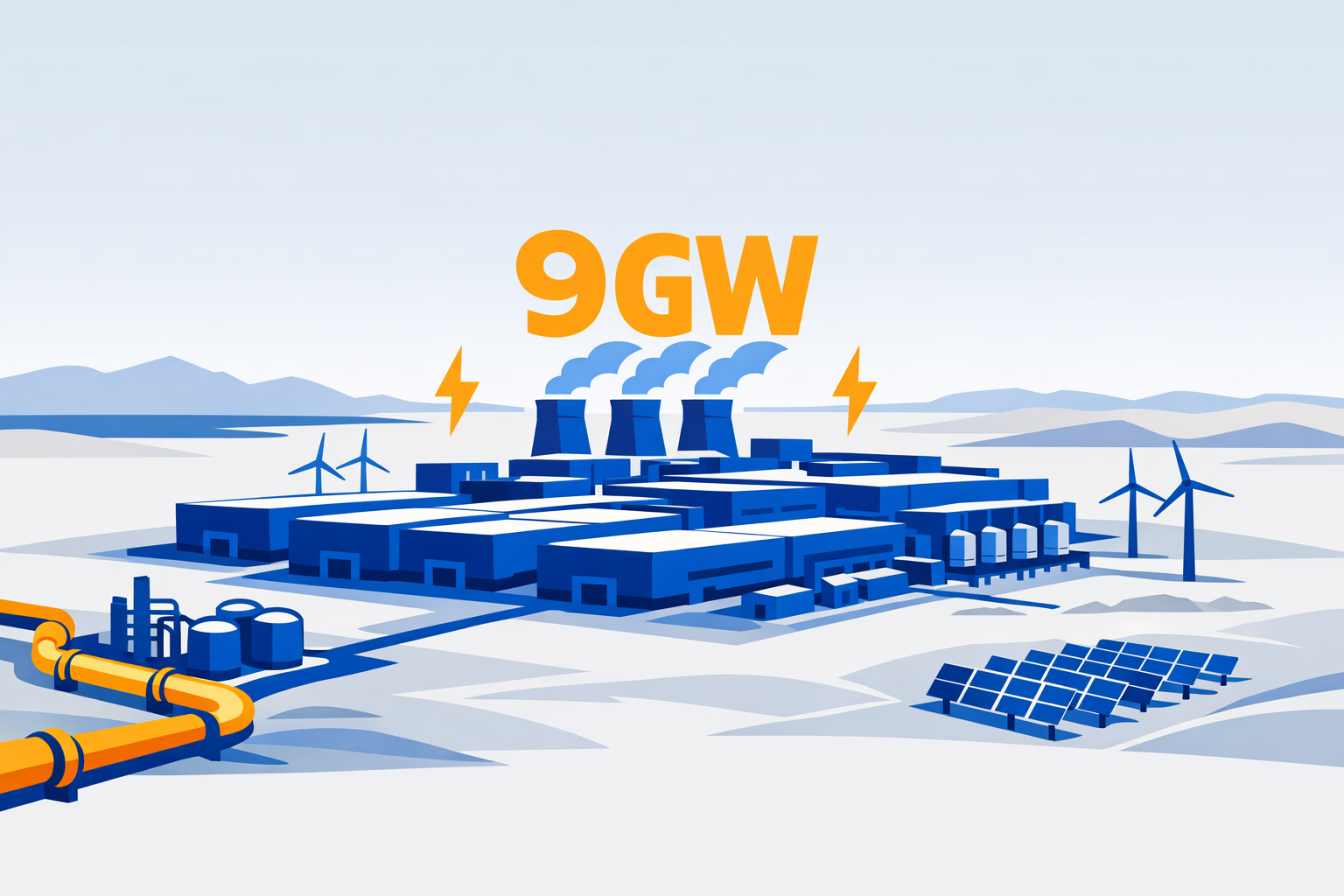
Box Elder County commissioners unanimously approved the Stratos Project - a proposed 9-gigawatt hyperscale AI data center campus in western Utah - setting a precedent that will resonate far beyond rural Utah for years to come. The vote, held amid booing from hundreds of protesters, clears the final local hurdle for what could become one of the largest data center developments ever built.
For utility executives, grid operators, policy advisors, and project developers tracking the intersection of AI demand growth and energy infrastructure, the outcome raises foundational questions about siting governance, off-grid power models, fiscal design, and the pace at which public institutions can absorb mega-scale load decisions.
The Project: Scale That Redefines the Conversation
The Stratos Project[1], also marketed as "Wonder Valley," is being developed by O'Leary Digital - the infrastructure arm of investor Kevin O'Leary - in partnership with West GenCo LLC and Utah's Military Installation Development Authority (MIDA). The campus is planned across roughly 40,000 acres of private land plus 1,200 acres of military and state-owned property in Hansel Valley, Box Elder County, Utah.
The power numbers set this project apart from anything previously approved in the United States. Phase 1 targets approximately 3 gigawatts of generation capacity - nearly matching Utah's average statewide electricity demand of roughly 4 gigawatts. At full buildout, the campus would reach 9 gigawatts, more than double the state's current average grid load. For context, all 48 existing Utah data centers combined draw approximately 920 megawatts - Stratos Phase 1 alone would dwarf that by a factor of three.
Globally, the project ranks among the most ambitious AI infrastructure builds underway. SoftBank's planned Ohio campus targets 10 GW[2], while Meta recently committed to funding seven new natural gas plants for a 7 GW facility in Louisiana.
| Parameter | Detail |
|---|---|
| Project Name | Stratos / Wonder Valley |
| Developer | O'Leary Digital + West GenCo LLC |
| State Authority | Utah MIDA |
| Location | Hansel Valley, Box Elder County (Golden Spike District) |
| Site Area | ~40,000 acres private + 1,200 acres military/state |
| Phase 1 Capacity | ~3 GW |
| Full Buildout Capacity | 9 GW |
| Utah's Current Avg. Demand | ~4 GW |
| Power Source | On-site natural gas via Ruby Pipeline |
| Energy Use Tax | 0.5% (down from standard 6%) |
| Property Tax Rebate to Developer | 80% |
| Projected County Revenue (Phase 1) | $30M/year |
| Projected County Revenue (Full Build) | $100M+/year |
| Projected Permanent Jobs | ~2,000 |
The "Shadow Grid" Model: Off-Grid Power as a Strategic Choice
The Stratos Project's energy architecture marks a deliberate, structurally significant departure from conventional data center development. Rather than drawing from the public utility grid, the campus will generate its own power through a direct connection to the Ruby Pipeline, a 680-mile interstate natural gas line crossing northern Utah on its route from Wyoming to Oregon. MIDA Executive Director Paul Morris stated that the facility "will not take one electron" from the existing grid, with the possibility of feeding surplus power back to utilities once operational.
This "Shadow Grid" approach - vertically integrating power generation with compute capacity - is enabled by Utah's SB 132 (2025)[3], which permits private companies with energy demands of 100 megawatts or more to build their own generating stations off the public grid. The legislation represents a notable pivot in state energy policy, effectively creating a parallel infrastructure track for mega-consumers.
The off-grid model offers clear advantages for project timelines. Traditional interconnection queues for utility-scale loads stretch for years; building dedicated generation avoids that bottleneck entirely. Developers say they will begin raising capital within 60 days and aim to initiate construction on initial phases within months.
However, the approach also concentrates risk. A campus generating and consuming 9 GW through a single natural gas pipeline connection introduces single-point-of-failure vulnerabilities that the vertically integrated operator - rather than utilities - must manage. Reliability standards, contingency capacity, and backup protocols will be critical design parameters in subsequent engineering phases, but none have been made public.
"Our homeland is no longer a sanctuary." - Paul Morris, MIDA Executive Director, on the national security rationale for the project
Grid and Infrastructure Implications for the Region
Even with an off-grid generation model, a campus of this magnitude does not exist in an infrastructure vacuum. The project site sits on the northern shore of the Great Salt Lake, adjacent to transmission corridors and pipeline infrastructure serving broader regional needs. Any surplus power injection into the utility grid - as developers have suggested is possible at full buildout - would require formal interconnection agreements, grid-forming capability assessments, and coordination with PacifiCorp, the incumbent utility serving northern Utah.
State energy planners and regulators will also need to account for indirect load growth. The 2,000 permanent jobs and associated economic activity projected for the region will generate secondary electricity demand on the public grid not yet quantified in publicly available integrated resource planning documents. PacifiCorp's 2025 Integrated Resource Plan[4] places Utah retail electricity sales at approximately 27.7 terawatt-hours in 2026. Planners will need to update forward-looking load forecasts to reflect Stratos-related population and commercial growth even if the campus itself remains off-grid.
Fiscal Architecture: Tax Incentives and Revenue Projections
The tax structure underpinning the Stratos Project reflects how aggressively MIDA has competed to attract hyperscale tenants - and raises legitimate questions about long-term fiscal adequacy for local services.
MIDA reduced the standard 6% energy use tax to 0.5% for the project and agreed to rebate 80% of property tax revenue back to O'Leary Digital. Utah's existing data center incentive program also provides 100% personal property tax relief on qualifying equipment - servers, cooling infrastructure, and switchgear - for facilities exceeding 150,000 square feet.
Despite those concessions, MIDA projected that Box Elder County would receive approximately $30 million annually in property tax revenue during Phase 1, rising to more than $100 million at full buildout. MIDA itself is estimated to collect approximately $49 million per year in property taxes once fully built. Developers also project $250 million in annual state sales tax generation.
The fiscal projections, however, rest on unverified assumptions. No hyperscale tenant has been publicly announced. Timelines remain projections. The 80% property tax rebate to the developer substantially reduces near-term county receipts - a trade-off commissioners appear to have accepted in exchange for guaranteed baseline revenue and job commitments.
"Without those guarantees ... they could have done a lot of things a lot worse than what we get by going with the guarantees." - Commissioner Lee Perry
Siting, Environmental Review, and Community Opposition
The speed of the approval process became a central flashpoint at county commission meetings. The Box Elder County Commission Chair noted publicly that commissioners were "brought this in the last hour" and expected to decide quickly on a project of generational consequence. The commission delayed one meeting by a week under that pressure before approving the interlocal agreement on May 5, 2026.
Community and scientific objections center on several distinct concerns:
Water Resources The project site sits in a hydrologically constrained region. Chance Baxter, general manager of the Bear River Water Conservancy District, stated that groundwater in the project area is "naturally salty and highly mineralized" and that usable groundwater in the valley is "very limited and not replaceable." Developers have stated they plan to purchase approximately 3,000 acre-feet of water rights initially, with up to 10,000 acre-feet under contract near Snowville if needed. Project leaders say the facility will use closed-loop cooling systems designed to minimize continuous water draw.
Air Quality The project site sits technically outside the northern Wasatch Front EPA nonattainment zone, but atmospheric modeling has not been made public. Utah State University's Robert Davies, a professor of physics, warned that natural gas combustion at the scale required for 9 GW of generation could substantially increase the state's total carbon footprint. State officials dispute those characterizations.
Transparency and Environmental Review As of the county vote, no project-specific environmental impact study had been publicly released. Formal protests have been filed with state engineers, and environmental litigation remains a possibility. County Attorney Stephen Hadfield confirmed that MIDA is not exempt from air quality standards and must obtain air quality permits with public comment periods. Water systems and discharge permits also require compliance with the Safe Drinking Water Act and Clean Water Act.
The Precedent Question: What Comes After Stratos?
The most consequential long-term implication of the Box Elder vote may not be the Stratos Project itself but the governance framework it establishes for future mega-scale data center decisions.
Utah's use of MIDA - a quasi-governmental body created to assemble military-linked project areas - as the primary development authority for a private commercial data center represents an unconventional regulatory pathway. MIDA is a body formed in 2007 that assembles project areas containing at least some military land, then oversees development and infrastructure projects designed to generate tax revenue; it functions effectively as a local government within its project areas. Critics have questioned whether that structure appropriately insulates a 40,000-acre commercial development from standard local land-use review processes.
For project developers, grid operators, and policy advisors watching from other states, the Stratos case surfaces questions that will need answers before similar proposals can advance elsewhere:
- How should interconnection queues and grid-forming standards adapt for campuses that intend to self-generate but may eventually export to the grid?
- What environmental review thresholds are appropriate for facilities at this energy and land-use scale?
- How should rate design account for secondary load growth from mega-project-adjacent development?
- What fiscal guarantees are sufficient to protect public services from the risk of delayed or cancelled project phases?
The AI-driven surge in data center energy demand has been reshaping utility planning assumptions across North America for several years. The Stratos approval accelerates that dynamic into genuinely new territory.
Key Takeaways for Energy and Grid Professionals
- Off-grid generation as a site-selection strategy is maturing. Utah's SB 132 legalizes it explicitly. Other states may face similar legislative pressure as hyperscalers seek to bypass interconnection queues.
- Fiscal structures that front-load risk to developers - via guaranteed minimum tax payments - may become a template for rural jurisdictions evaluating mega-scale industrial projects.
- Environmental review timelines will be a persistent flashpoint. The absence of a published EIS at the point of county approval is a vulnerability that invites litigation.
- State energy regulators should begin revising IRP load forecasting methodologies to account for off-grid hyperscale demand and potential grid reintegration scenarios.
- Water rights due diligence is non-negotiable for data center siting in the arid West. The Stratos case illustrates the gap between developer commitments and available hydrological evidence.
Commissioner Perry's post-vote statement - "Today's vote is not the end of the process - it is the beginning" - captures both the opportunity and the uncertainty now defining the Stratos Project. What happens next in permitting, capital raising, and tenant acquisition will determine whether this vote marks a watershed moment in AI infrastructure development or a cautionary tale about governance gaps that emerge when project scale outpaces regulatory frameworks.
Frequently Asked Questions
Will the Stratos Project draw power from Utah's public electricity grid? According to developers, the campus will generate all of its own electricity on-site through natural gas sourced via the Ruby Pipeline. MIDA officials stated the facility "will not take one electron" from the existing grid. Surplus generation could eventually feed back to utilities, which would require formal interconnection.
What regulatory hurdles remain after the county vote? County approval clears the final local consent requirement, but state and federal processes remain. The project must obtain air quality permits from Utah regulators. Water discharge permits require compliance with the Safe Drinking Water Act and Clean Water Act. Formal protests have been filed with state engineers, and environmental litigation remains a possibility.
What tax incentives has Utah offered for the Stratos Project? MIDA reduced the standard 6% energy use tax to 0.5%. The development agreement includes an 80% rebate of property tax revenue to O'Leary Digital. Utah's data center incentive program also provides 100% personal property tax relief on qualifying equipment for large qualifying facilities.
How does Stratos compare to other planned mega-campuses globally? At 9 GW full buildout, Stratos would rank between SoftBank's planned 10 GW Ohio campus and Meta's recently announced 7 GW Louisiana facility - placing it among the largest planned AI infrastructure sites globally.
What are the primary community concerns? Residents and scientists have raised concerns about water consumption in a water-stressed region, air quality impacts from natural gas combustion, noise, land-use changes across 40,000 acres, the pace of the approval process, and the absence of a publicly released project-specific environmental impact study.