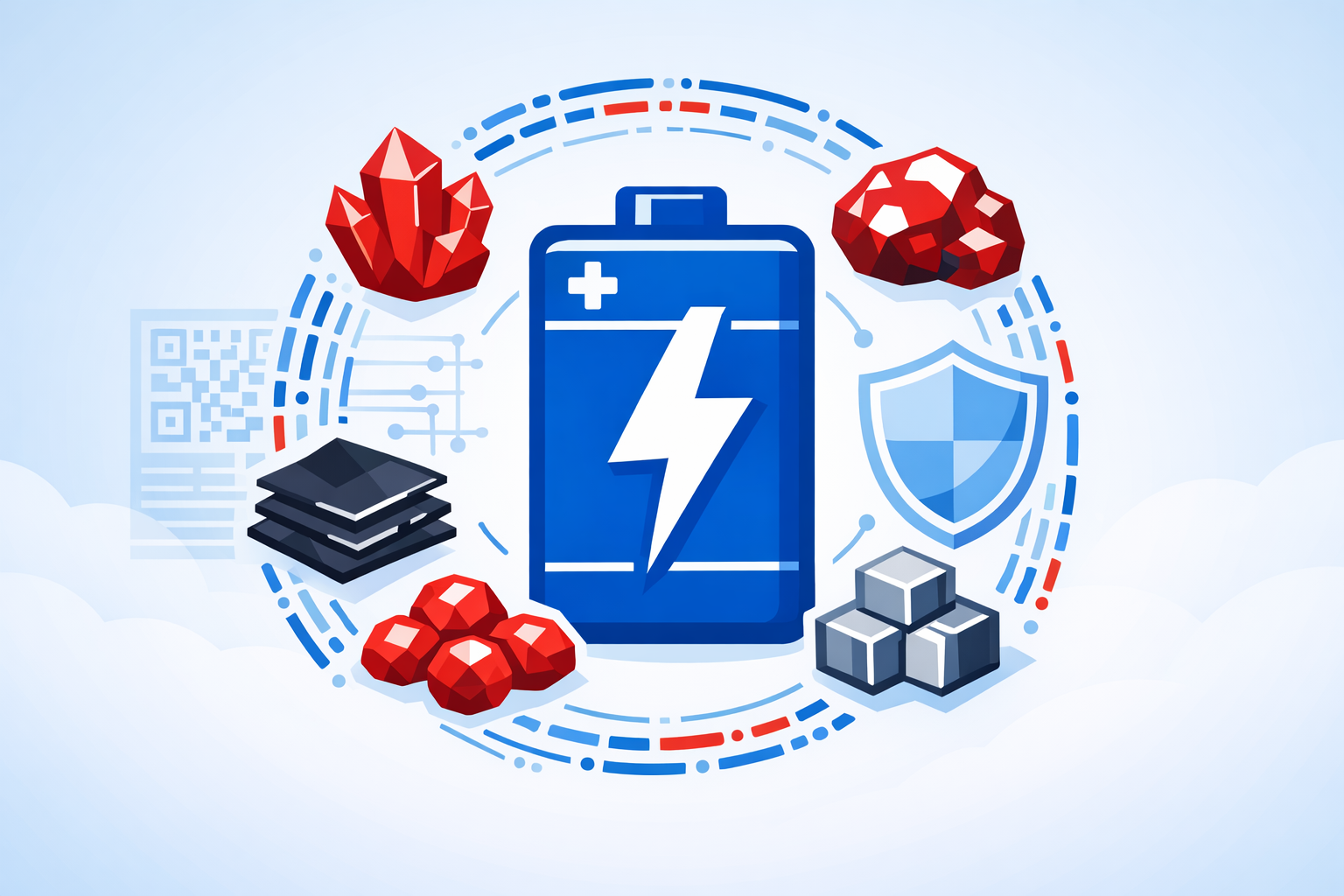
Canada is accelerating a comprehensive battery mineral transparency regime, building on its 2025 G7 presidency commitments and a domestic critical minerals strategy that explicitly requires supply chain traceability for key battery materials. The measures span lithium, cobalt, nickel, graphite, and manganese - the core inputs for lithium-ion batteries used in electric vehicles and stationary storage - and carry direct compliance implications for manufacturers and downstream users operating in and with Canada.
Background
Canada's Critical Minerals Strategy, published in 2023, lists 31 minerals as strategically critical and expressly commits the federal government to deploying traceability technologies to prevent products linked to conflict, child labour, or unsustainable practices from entering supply chains, according to Natural Resources Canada. The strategy positioned Canada as a full-lifecycle battery supply chain leader, from mining and processing through battery component manufacturing and recycling.
In June 2025, at the G7 Leaders Summit in Kananaskis, Canada announced the G7 Critical Minerals Action Plan, committing all seven members to transparency, diversification, security, and sustainable mining as principles for resilient supply chains, according to the official G7 communiqué. The plan tasked relevant ministers with developing a roadmap to advance standards-based markets for critical minerals. On October 31, 2025, G7 Energy and Environment Ministers met in Toronto and released that Roadmap to Promote Standards-Based Markets for Critical Minerals, which established that traceability and transparency systems are "necessary to demonstrate and verify high-standard production and responsible and reliable supply chains."
Canada also supports international alignment through the Global Battery Alliance's Battery Passport initiative and the International Organization for Standardization, according to legal analysis published by Gowling WLG. In August 2024, the Canadian-based Accelerate Alliance published the Canadian Battery Innovation Roadmap with funding from Natural Resources Canada, calling for increased investment in transparency and traceability tools to verify the origin and ethical standards of battery materials.
Details
The G7 Roadmap commits member governments - Canada among them - to publish pilot study results testing data collection requirements, identify interoperability gaps between digital credentials, and propose a G7-wide data governance framework for digital traceability tools, according to the official roadmap document. G7 members further committed to progressively increase supply chain traceability "including through the use of interoperable traceability systems."
Between 2020 and 2024, Canada reduced its net import reliance for 38% of critical minerals that had been net import reliant between 2018 and 2022, according to Natural Resources Canada's February 2026 progress update. As of February 2026, Canada had established new formal mechanisms for critical mineral cooperation with Germany, Australia, and additional allied nations, according to the same update. Through the Critical Minerals Production Alliance announced in October 2025, Canada unlocked 26 new investments and partnerships expected to accelerate $6.4 billion in critical minerals projects, according to Natural Resources Canada.
On the domestic legislative front, Canada's Extractive Sector Transparency Measures Act already requires companies engaged in commercial mineral development to report certain payments to governments, according to Norton Rose Fulbright. The Canadian Securities Administrators are also advancing a major overhaul of National Instrument 43-101, the country's primary mining disclosure standard. On June 12, 2025, the CSA formally released a Request for Comment on proposed amendments to NI 43-101 - the first significant revision in over a decade - which includes enhanced environmental, social, and governance disclosures, according to Bennett Jones.
Separately, SAE International introduced the J3327 Surface Vehicle EV Battery Global Traceability standard in September 2025, described as the first industry-wide framework to document and track critical minerals used in EV batteries from extraction through end-of-life. The standard supports country-of-origin verification and is designed for compatibility with ISO protocols and the EU's Digital Product Passport for batteries, according to SAE.
Legal experts at Gowling WLG note that while Canada has not yet fully codified battery-specific traceability requirements comparable to those in the United States or the European Union, "the trend is in that direction." The EU's Battery Regulation already mandates a digital battery passport covering material origin, carbon intensity, and recycled content. The U.S. Inflation Reduction Act imposes traced-qualifying value tests requiring manufacturers to verify that battery materials originate in the U.S. or trusted trading partner countries.
Outlook
Canada's 2025 G7 Roadmap commits to publishing pilot study results and a formal G7 data governance proposal as near-term deliverables - outcomes expected to directly shape any future domestic regulation. Natural Resources Canada is also preparing for the IEA Ministerial Meeting and PDAC Conference in 2026, where critical minerals supply chain transparency is expected to feature prominently. Companies sourcing battery materials into or through Canada - including North American manufacturers seeking to satisfy U.S. IRA requirements - face mounting pressure to implement traceability systems now, ahead of the legislative codification that analysts and legal advisors broadly anticipate.