Researchers at the Institute of Metal Research under the Chinese Academy of Sciences (CAS) have demonstrated an all-iron flow battery electrolyte that sustained 6,000 charge-discharge cycles with no measurable capacity loss, according to results published in the peer-reviewed journal Advanced Energy Materials. The development relies on a raw material whose cost is more than 80 times lower than lithium as an industrial commodity and addresses a long-standing chemical instability that has blocked all-iron flow batteries from reaching commercial deployment.
Background
Grid-scale energy storage has expanded rapidly behind lithium iron phosphate (LFP) battery packs, which have become the default for utility-scale installations as cell prices fell. LFP batteries typically deliver 3,000 to 6,000 cycles at 80 percent depth of discharge, making them competitive for four- to eight-hour applications. Flow batteries, which store energy in liquid electrolytes held in external tanks, occupy a different segment: capacity scales with tank volume rather than electrode mass, making them structurally suited to longer durations where cost per kilowatt-hour outweighs energy-density requirements.
Within the flow battery market, vanadium redox flow batteries held a 61.5% revenue share in 2025, according to Grand View Research, supported by commercial deployments in China, Europe, and the United States at the 100-MWh scale. Vanadium's dominance is not without constraint: the vanadium segment's installed system cost stands at approximately $491/kWh, and the supply chain is geographically concentrated. All-iron chemistries have long been proposed as an alternative, but prior designs were undermined by hydrogen evolution at the negative electrode-a reaction that depletes active material and shortens cycle life.
Details
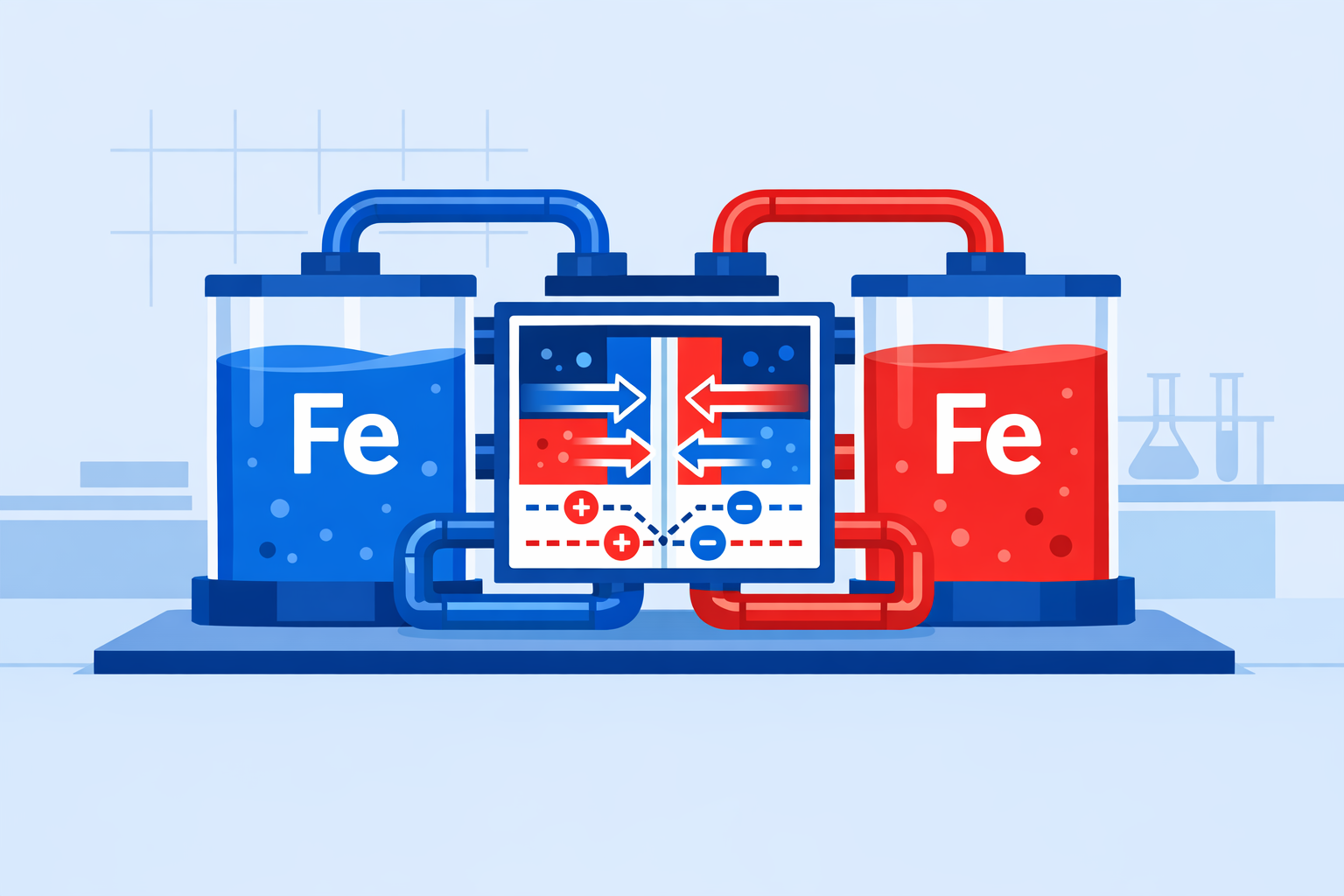
The CAS team, based in Shenyang, tackled the hydrogen evolution problem through molecular engineering. According to findings reported in Advanced Energy Materials, the researchers developed a dual-ligand synergistic chelation strategy that stabilizes the iron complex anolyte through two concurrent mechanisms: a large-space molecular structure that physically blocks unwanted reactions, and a negatively charged layer that creates electrostatic repulsion to inhibit crossover through the membrane. The battery demonstrated stable operation at 80 mA/cm² current density with 100% capacity retention throughout 6,000 cycles, described by the institute as a record for the field.
The economic case centers on raw materials. Iron sulfate, the primary precursor for iron flow electrolytes, is an industrial byproduct available at a fraction of the price of lithium carbonate, which has traded between roughly $7,000 and $80,000 per metric ton over the past five years on commodity markets. Analysts have been quick to qualify the comparison, however. The 80-times cost differential refers to raw material cost per unit of stored energy, not the installed system cost, which also includes membranes, pumps, and power electronics. Iron flow systems have historically carried high balance-of-plant costs that narrow the material-cost advantage. If the new electrolyte reduces or eliminates the need for expensive ion-exchange membranes-a point the published research does not fully clarify-the total installed cost advantage could prove substantial.
The iron flow battery field extends beyond Chinese laboratories. In North America, ESS Tech Inc. announced progress on a long-duration iron flow battery deployment with Salt River Project (SRP) in Arizona in August 2025, according to Grand View Research. Case Western Reserve University researchers are targeting an iron-based flow battery cost of $30 per kilowatt-hour-well below the U.S. Department of Energy's $100/kWh storage cost goal. Iron flow systems face a structural disadvantage against LFP in high-density applications: flow batteries typically have lower energy density than lithium-ion systems and are unlikely to be suitable for electric vehicle applications.
All-iron flow batteries also carry a safety profile that differentiates them from lithium chemistries. Their aqueous electrolytes eliminate the thermal runaway risk associated with organic solvents in lithium-ion cells-a consideration increasingly prominent following a series of utility-scale LFP fire incidents.
Outlook
The Chinese Academy of Sciences has not announced a commercial partner or pilot-scale deployment timeline as of the date of publication. The 6,000-cycle figure was produced at laboratory scale, and flow battery performance at the kilowatt or megawatt level often diverges from cell-level results due to shunt currents, thermal management challenges, and membrane fouling. Independent verification of the electrolyte stability data represents the immediate next technical milestone. The global redox flow battery market, valued at $322 million in 2025, is projected to reach $1.30 billion by 2035 at a compound annual growth rate of 15%, according to Research Nester-a trajectory that could accelerate if an iron-based chemistry clears commercial validation hurdles within the next five years.