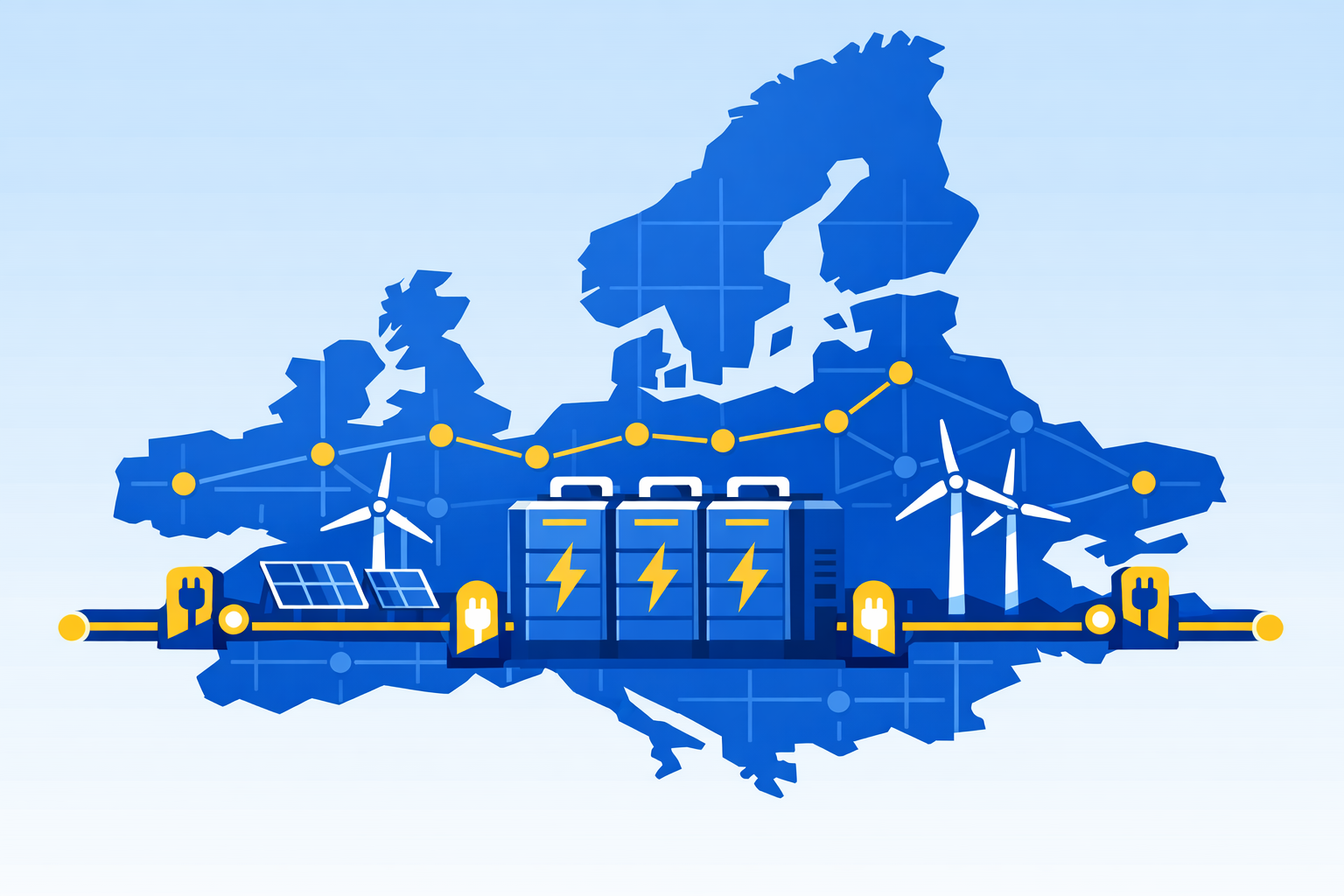
The European Commission's December 2025 European Grids Package represents the most significant overhaul of EU cross-border energy infrastructure rules in years. Energy storage is explicitly included in binding permitting reforms, and dedicated funding increases fivefold - developments that developers and grid operators say will reshape conditions for utility-scale storage projects across Europe.
The Commission presented the European Grids Package (COM/2025/1005) on 10 December 2025. It consists of a proposal to revise the TEN-E Regulation and a proposal to accelerate permit granting by amending the Renewable Energy Directive, the Electricity Market Design, and the Gas Directive. The package responds in part to a capacity deficit: approximately half of cross-border electricity transmission capacity needs by 2030 - some 32 GW of an identified 66 GW - currently have no matching investment planned, while several member states are not expected to meet the 15% interconnection target by 2030.
Background
The Regulation on Trans-European Networks in Energy (TEN-E) sets guidelines for cross-border energy infrastructure within the EU. The most recent revision entered into force in June 2022, triggered by the European Green Deal's amended climate and energy targets.[1] As of mid-2025, structural inefficiencies in European grids prevented the EU from fully benefiting from already-deployed clean energy capacity - some regions were overproducing renewable power while others faced insufficient supply and higher prices, with limited transmission capacity driving grid congestion.
With around 30% of Europe's distribution grids over 40 years old and cross-border transmission capacity needs set to increase, the European Commission estimates average annual investments of €85 billion in the power grid are required. The Commission estimates €1.2 trillion will be needed for electricity grids by 2040 alone, including €730 billion for distribution networks.
The storage sector entered 2026 with strong momentum. During 2025, more than 80 GWh of energy storage capacity was awarded across Europe through public procurement schemes, far exceeding the 25 GWh actually built during the same year. The largest volumes were allocated by Poland (20 GWh), the United Kingdom (18 GWh), Bulgaria (13.7 GWh), Italy (10 GWh), and Spain (9.4 GWh).
Details
The revised TEN-E Regulation establishes central scenario development by the Commission, mandatory consideration of non-wire and digital solutions, and streamlined permitting for Projects of Common Interest (PCIs) and Projects of Mutual Interest (PMIs), with a maximum of 42 months across the pre-application and statutory phases. According to the Commission, even PCI-designated projects have frequently taken five years or more to secure permits. The proposed Permitting Acceleration Directive therefore introduces, for the first time, binding EU-level time limits for permitting procedures covering grid infrastructure, renewables, battery storage, and EV charging stations.
On grid connections, the Commission has proposed replacing the "first-come-first-served" model with "first-ready-first-served." Energy Storage Europe senior policy officer Daniel Vig said the shift "will accelerate the deployment of mature assets and improve network efficiency." New Grid Connection Guidance includes specific consideration of energy storage assets for the first time, including co-located renewable energy-plus-storage plants.
Cost-sharing and financing provisions mark a departure from the prior framework. The revised rules require TSOs to ring-fence 25% of congestion income for PCI investments. Additional measures include clearer EU-wide principles for cost-benefit allocation, voluntary bundling of PCIs and PMIs to encourage cost-sharing, and new rules on the use of congestion income. On the funding side, the proposal earmarks a major increase in the Connecting Europe Facility for Energy budget, from €5.84 billion for 2021-2027 to €29.91 billion for 2028-2034.
Where cross-border infrastructure needs are identified but no suitable projects are proposed by TSOs or developers, the Commission could actively intervene - inviting project proposals and launching calls open to any promoter. The revised TEN-E also introduces new categories of eligible projects, including non-wire solutions such as grid-enhancing technologies and digitalisation, as well as cybersecurity and resilience upgrades for critical network elements.
TEN-E reforms also include a "gap-filling process" to identify and address cross-border electricity transmission planning gaps that national regulators lack jurisdiction to resolve - a mechanism analysts say is particularly relevant for storage projects sited at structurally congested border nodes.
Outlook
With the Commission's proposals now published, the European Parliament and the Council of the European Union will advance the package under the ordinary legislative procedure. The Grids Package appears in the Joint Declaration of the European Parliament, the Council, and the Commission as a priority file for 2026, indicating it is likely to be fast-tracked. ENTSO-E and TSOs have stated their commitment to working with the Commission, member states, the Parliament, and all stakeholders in the months ahead to ensure the package delivers on its ambitions.
Developers and legal analysts caution that the shift to "first-ready-first-served" grid access, while improving system efficiency, transfers risk to developers. They may need to incur higher upfront costs before securing firm grid access - a factor that could materially affect project financing structures and timelines, particularly for smaller or merchant-scale operators.