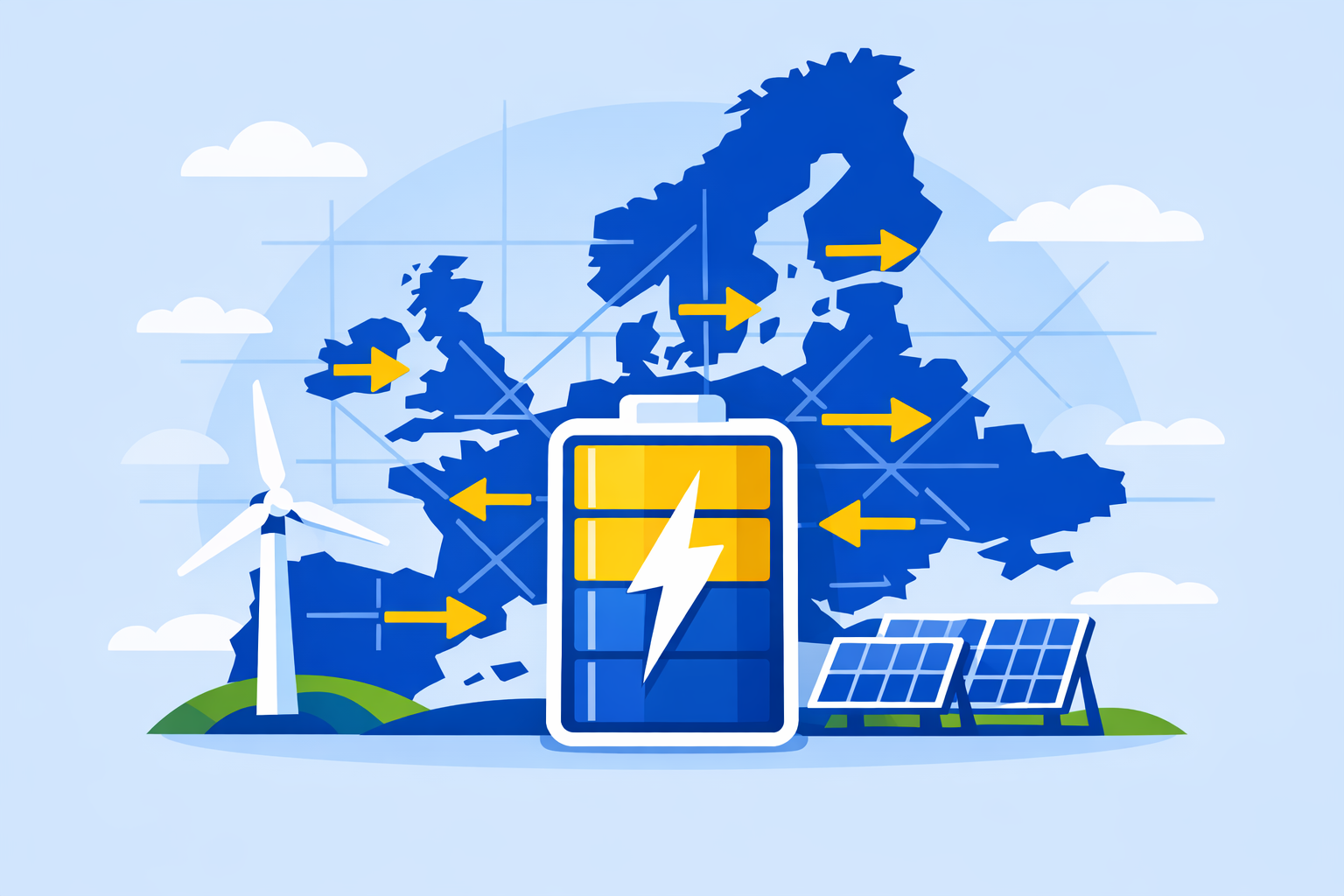
The European Commission has proposed a sweeping revision of its Trans-European Networks for Energy (TEN-E) regulation, placing energy storage and cross-border grid flexibility at the center of the bloc's strategy to meet 2030 climate and infrastructure targets.
Published on 10 December 2025 in Brussels, the European Grids Package contains legislative proposals and non-legal texts aimed at boosting grid investments, accelerating permitting, and coordinating network planning at EU level. The package directly addresses the role of energy storage within cross-border infrastructure planning for the first time, with implications for procurement structures, project financing, and power purchase agreement (PPA) design across member states.
Background
Timely, cost-efficient expansion and modernization of European energy infrastructure is one of the central challenges of the EU's energy transition. Grid development is essential to ensure energy supply security, strengthen the resilience of Europe's energy system, and integrate the rapid rollout of renewable energy sources. Cross-border infrastructure plays a vital role in connecting national energy networks.
The Commission notes that Europe is currently on pace for 41 GW of cross-border electricity transmission capacity by 2030-less than half of the 88 GW target. More than 500 GW of wind and solar capacity are awaiting grid connection across the EU, while some projects face permitting timelines of several years. A lack of harmonized frameworks, regulatory barriers such as double grid charges, and unclear ownership rules continue to complicate the deployment of diverse storage technologies.
The Action Plan for Affordable Energy, published in February 2025, stated that the European Grids Package would include legislative proposals to accelerate permitting for grids, storage, and renewables. The action plan links lower energy prices to faster deployment of renewable generation and energy storage, treating storage as a critical flexibility resource needed to reduce price volatility.
Details
The European Commission has introduced targeted permitting legislation for energy storage, enabling faster grid connections for battery storage-whether as hybrid plants paired with solar or as standalone facilities. SolarPower Europe described this as "a critical step toward 10x battery storage in Europe by 2030."
The TEN-E amendment creates new governance for network planning at EU level. For the first time, the European Commission will be responsible for ensuring that cross-border grid planning aligns with EU energy and climate goals. The proposal also earmarks a significant increase in the Connecting Europe Facility for Energy (CEF-E) budget, rising from €5.84 billion for 2021-2027 to €29.91 billion for 2028-2034.
On the market side, more than 80 GWh of energy storage capacity was awarded across at least ten European countries in 2025, according to data compiled by Energía Estratégica, with volumes drawn from capacity markets, state aid schemes, EU-funded programs, and innovative national initiatives. Among the largest volumes, Poland led with 20 GWh, followed by the United Kingdom with 18 GWh, Bulgaria with 13.7 GWh, Italy with 10 GWh, and Spain with 9.4 GWh.
A reform of France's capacity mechanism, expected to take effect in 2026, will introduce multi-annual contracts of up to 15 years for new projects, extend eligibility to cross-border capacity, and establish a centralized levy to finance the scheme. At EU level, the European Commission has highlighted the need for tariff structures that avoid double charging, reflect the cost impact of storage on the grid, and incentivize grid-friendly behavior and timely investments, as set out in its Notice on Guidelines on Future-Proof Network Charges published on 2 July 2025.
Corporate sustainability commitments have been the primary driver behind the rapid expansion of PPAs for solar and wind projects, though growth remains concentrated in a handful of European countries. Recent years have shown signs of stagnation in traditional PPAs, but hybrid structures combining generation and storage are gaining traction.
Outlook
The Grids Package remains at the proposal stage; the legislative elements-in particular the TEN-E Regulation revision and the new Permitting Acceleration Directive-must undergo the full EU co-legislative process. Both the European Parliament and the Council must adopt their respective negotiating positions. At the Transport, Telecommunications and Energy Council of 15 December 2025, EU Energy Ministers underlined the importance of addressing bottlenecks slowing grid development, particularly lengthy permitting procedures, investment and financing challenges, and insufficient coordination in planning. Analysts expect 128 GW of batteries to be deployed across Europe by 2030, a figure that will depend heavily on how quickly harmonized cross-border procurement rules and financing structures take hold across member states.
Related reading: EU Advances Grid-Forming Inverter Standards for Cross-Border Long-Duration Storage