The European Commission's proposed overhaul of the Trans-European Networks for Energy (TEN-E) Regulation aims to create structured financing and grid interconnection pathways for cross-border battery storage projects. However, industry groups have flagged gaps that could limit its near-term impact on large-scale deployments.
Background
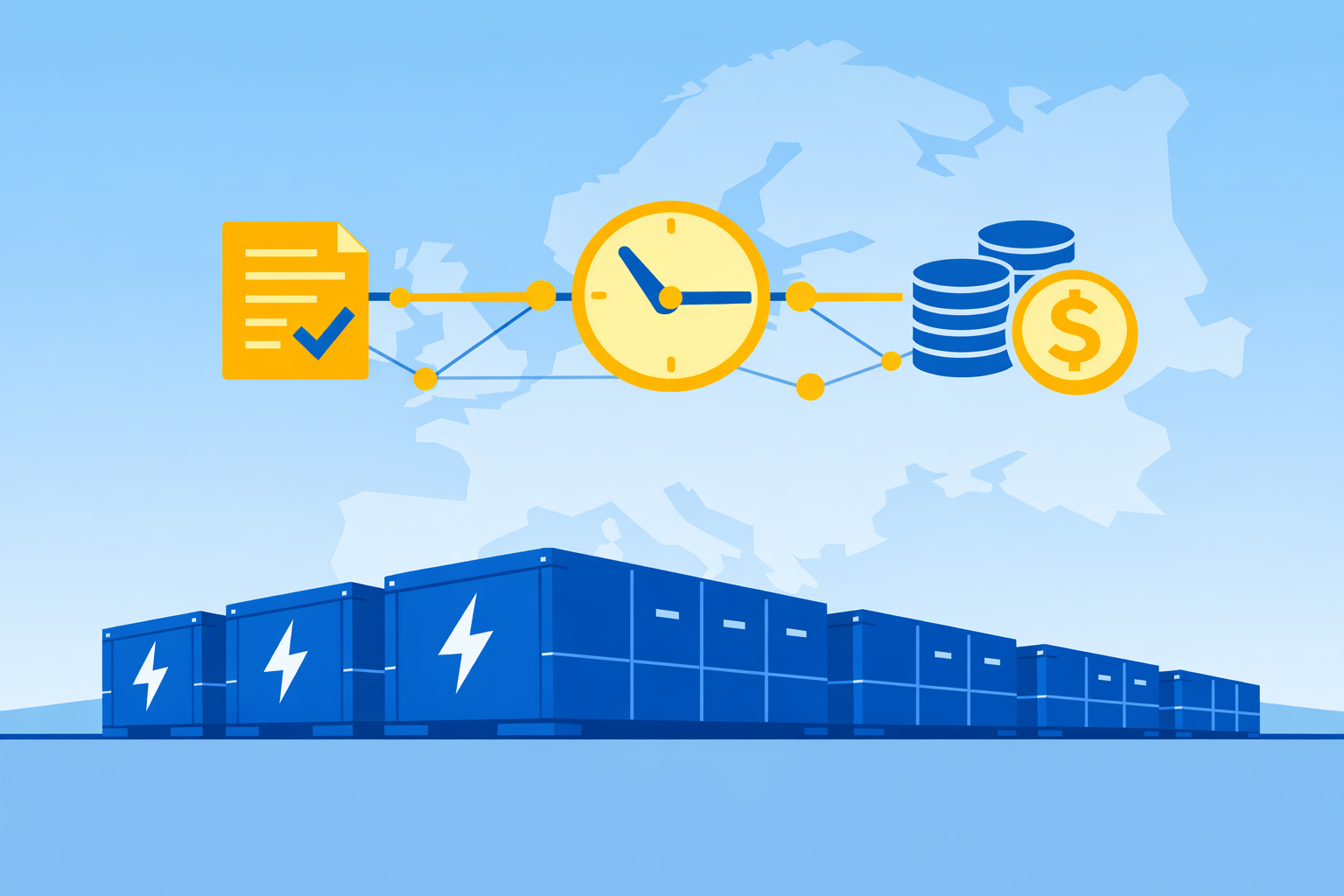
The European Commission published the European Grids Package on 10 December 2025, presenting proposals to revise the TEN-E Regulation (Regulation (EU) 347/2013), which governs cross-border energy infrastructure planning across Member States. The package-introduced alongside a directive to accelerate permit-granting procedures-responds to mounting structural pressure on the EU's energy system. Several Member States remain far from the long-standing 15% electricity interconnection target, while electricity prices remain highly fragmented across Europe. System congestion has increasingly forced curtailment of low-cost renewable generation, strengthening the case for reform.
The Grids Package has been designated a priority legislative file in the Joint Declaration of the European Parliament, the Council, and the Commission for 2026, indicating it is likely to be fast-tracked through the ordinary legislative procedure. Member States are currently discussing the proposals in the Council.
Key Provisions and Storage-Specific Implications
The revised TEN-E framework introduces several measures directly affecting battery storage deployment. New Grid Connection Guidance included in the package addresses energy storage assets specifically for the first time, including co-located renewable energy-plus-storage plants. The guidance shifts the prevailing "first-come, first-served" grid connection regime to a "first-ready, first-served" approach, under which connection rights are tied to demonstrable project maturity-including permitting progress and financial readiness.
On cost-sharing, the revised TEN-E requires transmission system operators (TSOs) to ring-fence 25% of their congestion income for investment in cross-border electricity infrastructure, including Projects of Common Interest (PCI) and Projects of Mutual Interest (PMI). The framework also introduces voluntary bundling of PCIs and PMIs to encourage cost-sharing among participating states, along with new rules on congestion income reinvestment.
For permitting, the proposed revision establishes a maximum of 42 months across the pre-application and statutory permitting phases for PCIs and PMIs. According to the Commission, even projects currently designated as PCIs frequently take five years or more to secure permits.
On funding, the Commission has proposed quintupling the Connecting Europe Facility (CEF) Energy budget from €5.8 billion to approximately €29.91 billion for the 2028-2034 Multiannual Financial Framework period. Since 2014, the CEF Energy instrument has provided €8.7 billion for flagship cross-border projects. A 2026 CEF call is scheduled for launch at the end of April 2026, with an application deadline at the end of September 2026. The revised TEN-E also introduces new categories of eligible projects, including non-wire solutions such as grid-enhancing technologies, digitalisation, and cybersecurity upgrades for critical network elements.
Outlook
Industry reception has been mixed. Energy Storage Europe, which has advocated for storage-focused grid connection reform, welcomed the shift away from "first-come, first-served" access. However, according to the association's policy team, the new proposal makes no changes that would alter the size thresholds for energy storage PCIs-which remain "prohibitively high"-and there is "still no tailored methodology to value storage's cross-border system benefits."
A reform of France's capacity mechanism, expected to enter into force in 2026, is set to introduce multi-annual contracts of up to 15 years for new projects and extend eligibility to cross-border capacity, illustrating the parallel national-level adjustments needed to complement the EU framework. The European Parliament and Council must now complete their legislative review before the TEN-E revision takes effect, leaving the timeline for storage-specific provisions subject to the broader negotiation process.