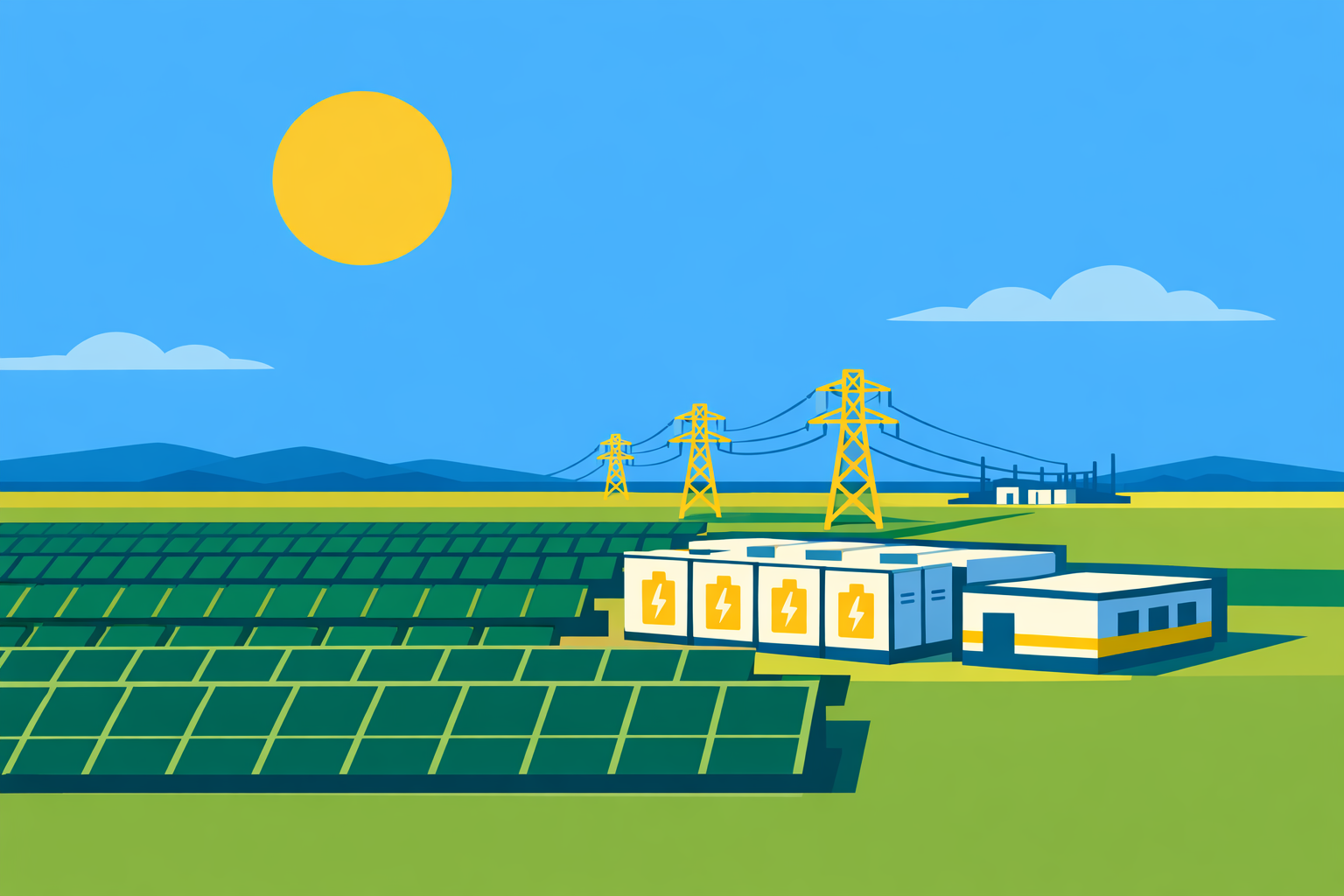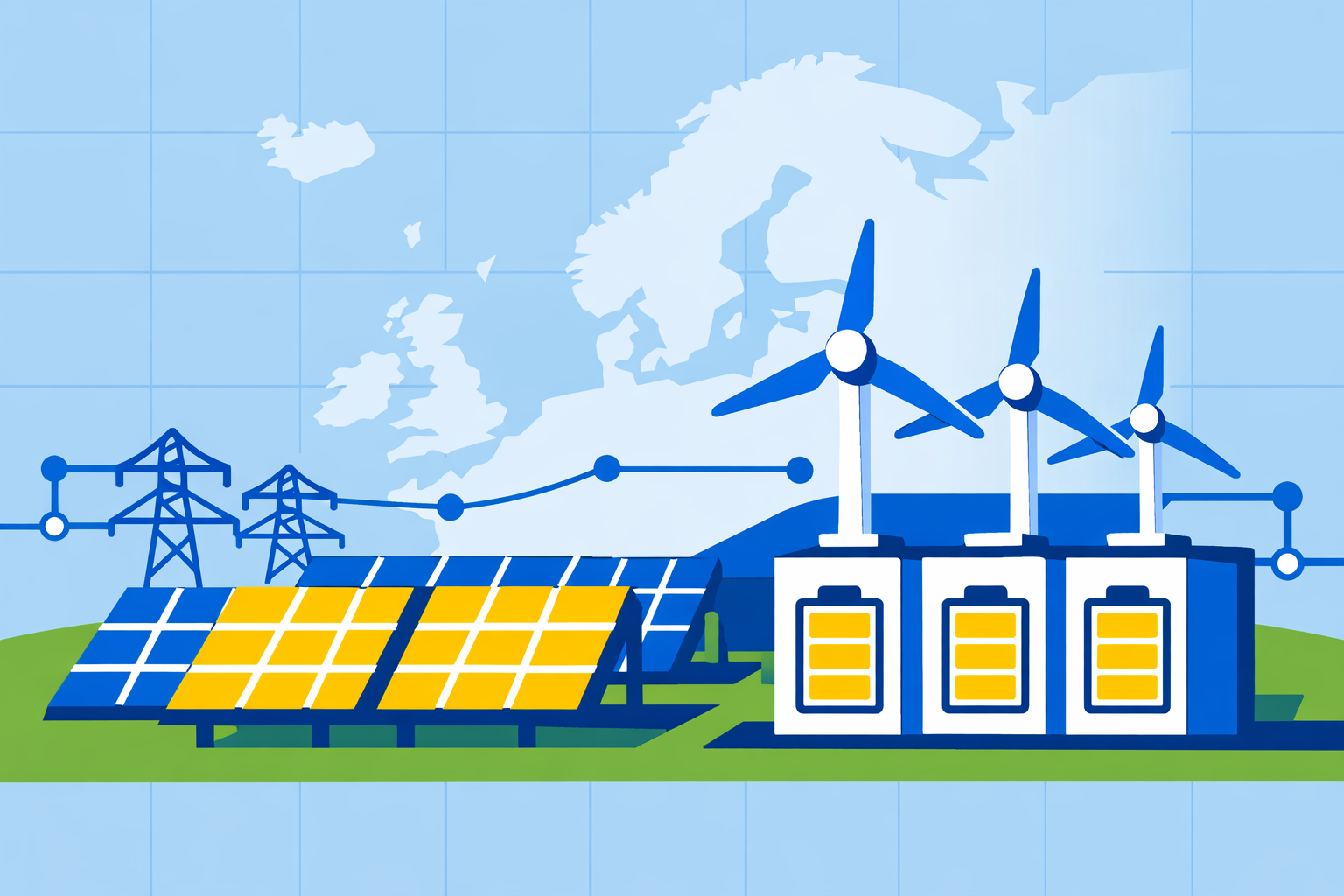
Europe's co-located renewable power and battery storage capacity is projected to grow more than 450% by 2030, driven by surging grid curtailment and negative electricity prices that are eroding the economics of unhedged renewable projects, according to a report by Aurora Energy Research published on Monday.
Co-located renewable-plus-battery installations are expected to surge from approximately 6 GW in 2025 to as much as 35 GW by 2030. Wind and solar projects across Europe are increasingly being paired with battery storage, allowing generators to store power rather than sell at a loss during periods of excess supply, then discharge when prices recover. The research examined developments across 20 European markets and identified Germany, Great Britain, and Bulgaria as the continent's most attractive co-location investment destinations.
Background
The acceleration in co-located storage reflects a structural deterioration in European power market conditions. Negative price hours surged in 2025, exceeding 2024 levels in most markets. Spain, the Netherlands, and Germany each recorded over 500 such hours, while Belgium, France, and Poland logged more than 450.
Curtailment-when renewable output is curbed to protect the grid during oversupply-is forecast to rise from over 10 TWh in 2024 to around 33 TWh by 2030, the report said. More than 1,000 GW of renewable energy capacity is currently awaiting grid connection approval across Europe, with Italy accounting for roughly 370 GW of the pipeline.
In 2025, the EU installed 27.1 GWh of new battery storage capacity-another record year for the sector-though the pace of expansion still needs to accelerate to meet flexibility requirements by 2030, according to SolarPower Europe's EU Battery Storage Market Review 2025. To meet flexibility demand, Europe's total installed battery fleet will need to reach around 750 GWh by the end of the decade, the association said.
Details
Aurora Energy Research identified Germany as the most attractive co-location market, citing higher expected returns on investment. Great Britain and Bulgaria jointly ranked second. Great Britain benefits from substantial installed capacity and a project pipeline backed by contracts for difference that could help offset grid connection delays. Emerging markets in Eastern and Southeastern Europe, including Bulgaria, are attracting attention due to rising demand for grid-balancing infrastructure and supportive regulatory frameworks. Spain, Hungary, and France were flagged as markets to watch amid ongoing regulatory reform.
Europe's co-located renewable capacity reached 6.3 GW in 2025, led by solar-plus-storage, which accounted for over 60% of deployments, the report said.
"Co-location is no longer a niche solution: it is increasingly critical to protecting project economics and sustaining investment momentum," said Sameer Hussain, Research Senior Analyst at Aurora Energy Research. Aurora's Jörn Richstein, Research Lead for Pan European Power Markets, Policies and Technologies, noted that investment drivers differ across the continent: "In some markets it is driven by merchant upside, in others by subsidy-supported stability, and elsewhere by the need to overcome grid constraints and limit curtailment."
A key trend in 2025 was the rising dominance of large-scale stationary storage: 55% of newly added EU battery capacity came from utility-scale projects-a significant structural shift. Residential installations, by contrast, declined 6%, reflecting a continued slowdown driven by lower electricity prices and reduced support schemes.
On the supply side, Europe has built a solid midstream industrial base with 252 GWh of nominal battery cell production capacity in 2025 but faces significant structural gaps. Over 90% of existing cell capacity is geared toward electric vehicles rather than stationary storage.
Outlook
Aurora estimates Europe will need approximately €1.5 trillion in cumulative investment by 2050 to support renewable energy expansion, with capacity expected to more than triple between 2026 and 2050. Nearly €600 billion of that total will be required by the end of this decade alone. Two-sided contracts for difference are expected to remain the primary support mechanism across most European markets, with 162 GW of renewable capacity already announced for auction procurement by 2030. However, Aurora warns that the success of these auctions hinges on design, competition levels, and policy certainty.