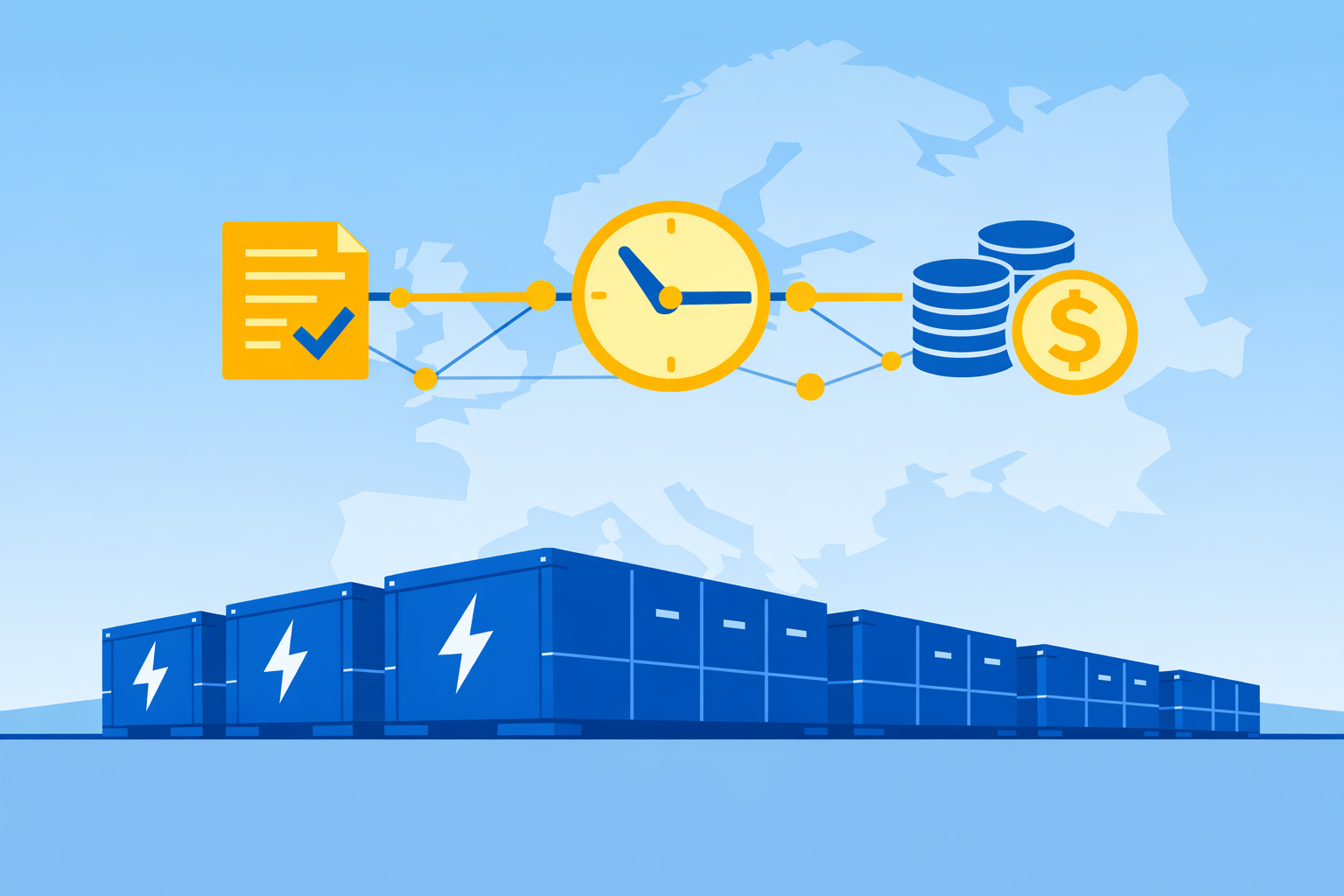
The financial architecture of utility-scale battery storage is undergoing a structural shift. Where debt-heavy capital expenditure models once dominated, a new generation of deal structures - anchored in tolling agreements, performance-linked service arrangements, and multi-stream revenue stacking - is gaining rapid ground. The transition is no longer theoretical: Europe's BESS financing market tracked over 80 financing deals across 13 countries in 2025, more than triple the 25 recorded in 2024, with disclosed debt rising from EUR 1.4 billion to EUR 6.1 billion, according to Modo Energy[1].
For project developers, lenders, and insurers, the implications span deal timelines, insurance pricing, and how grid reliability commitments are contractually defined.
Why the Capex Model Is Losing Ground
Traditional project finance for battery storage relied on straightforward logic: secure a long-term power purchase agreement (PPA) or capacity contract, size senior debt against those contracted cashflows, and close. That framework made sense when storage assets played a single, defined role.
The market has grown more complex. Between 2020 and 2024, cumulative global battery storage capacity soared from just 12 GWh to over 176 GWh, achieving a compound annual growth rate of 95%, according to BloombergNEF's 1H 2025 Energy Storage Market Outlook[2]. That growth has simultaneously saturated some ancillary service markets. The volume-weighted average clearing price for ancillary services in ERCOT fell to $7.03 per MW per hour in 2024 - roughly one-third of the 2022-2023 average, per the same Macquarie/BNEF analysis[2].
The response from developers and lenders has been to adopt structures that capture multiple revenue streams simultaneously - and transfer operational and performance risk more precisely to the parties best positioned to bear it.
Revenue Stacking: The Multi-Layer Economics of Modern BESS
Revenue stacking (also called value stacking) refers to a battery asset monetizing more than one market simultaneously. The principal layers are:
- Energy arbitrage - buying power at low prices, discharging at peaks
- Ancillary services - frequency regulation, spinning reserves, voltage support
- Capacity payments - resource adequacy contracts with utilities or system operators
- Tolling / SLA fixed fees - contracted floor revenue paid by an off-taker for battery access
Profitability in energy storage increasingly depends on value stacking[3] - capturing multiple revenue streams across market layers - and advanced dispatch optimization to meet target internal rates of return. In markets such as the UK, Australia, and Germany, system design now explicitly targets duration and stacking capability. In most European markets, two-hour systems have become standard, with several markets moving toward four-hour configurations to expand access to wholesale arbitrage, intraday trading, and diversified revenue stacking, as DNV notes in its analysis of European BESS bankability[4].
However, stacking also creates financing complexity. Unlike traditional project financings where assets serve a narrow purpose, an energy storage system must retain the flexibility to operate across a variety of service roles[5]. Loan covenants must expressly permit the various uses a battery is intended to serve, and lenders must model cashflows across competing, volatile revenue lines - a materially harder underwriting task than a single-offtake structure.
SLA-Based Structures and the Rise of Tolling
The structural response to merchant revenue volatility has been a rapid proliferation of Flexibility Purchase Agreements (FPAs) - tolling agreements, price floors, and financial swaps - that create a contracted revenue floor sufficient to support debt service.
A tolling agreement for a BESS asset is a fixed-price capacity offtake arrangement[6]: the asset owner makes all or a portion of battery capacity exclusively available to a third-party off-taker in exchange for a regular, fixed payment. The off-taker assumes primary market risk; the asset owner receives revenue predictability.
The bankability implication is direct. Many banks now decline to finance BESS assets without at least 50% of revenues secured through a bankable tolling agreement[6], or otherwise charge high interest premiums or offer very low loan-to-cost ratios. In Europe, BESS Flexibility Purchase Agreements - such as tolling agreements, swaps, or revenue floors - can provide the revenue predictability lenders require before extending debt[7].
Deal data reflects this shift. Standalone tolling agreements in European BESS project finance rose from 3 in 2024 to 15 in 2025, with tolling featuring in 19 transactions overall - making it the fastest-growing revenue structure in European BESS, per Modo Energy's 2025 European BESS Financing Report[1]. The UK delivered Europe's largest BESS project finance close in 2025 at 1.4 GW, the Thorpe Marsh project. Market segmentation by contract type has also emerged: revenue floor agreements dominate in the UK, tolling in Germany, and PPAs / contracts for difference in Spain and Italy[1].
A recent landmark example is the seven-year tolling agreement between Shell and Penso Power for the 100 MW/330 MWh Bramley BESS project in the UK[8] (August 2024), demonstrating that investment-grade energy majors are willing to commit to long-duration capacity leases as a route-to-market strategy.
Performance Guarantees and Degradation-Informed Metrics
A complementary shift is occurring in how operational risk is allocated. As lenders have grown more sophisticated in BESS diligence, performance guarantees tied to degradation profiles have become standard financing prerequisites.
Project companies can mitigate degradation concerns by securing performance guarantees, equipment warranties, and/or operations and maintenance agreements to ensure equipment will be replaced or maintained at minimum capacity[9]. These mechanisms shift technology risk from the project company to the vendor - a key requirement for lenders modeling cashflow adequacy across a 10-15 year battery warranty period.
Key metrics now embedded in SLA-based structures include:
- Round-trip efficiency (RTE) degradation curves, typically modeled at 85% baseline per NREL ATB assumptions
- Depth of Discharge (DoD) limits, capping cycling intensity to preserve warranty compliance
- Availability guarantees - uptime commitments that directly underpin tolling payment calculations
- Augmentation provisions - obligating vendors to replace or top up capacity if degradation breaches contractual thresholds
Where battery systems previously carried 10-15-year performance guarantees, many suppliers now provide 15-25-year warranties, driven by improved LFP cell chemistry stability and tighter thermal management systems, according to DNV's bankability analysis[4]. This warranty extension has directly expanded the horizon over which lenders model contracted cashflows.
⚠️ LENDER WATCH POINT: Many European commercial banks now require at least 50% of projected BESS revenues to be secured through a bankable tolling agreement or equivalent contracted floor before extending senior debt. Projects relying solely on merchant revenues face reduced loan-to-cost ratios and wider interest margins.
Financing Structure Comparison
The table below contrasts traditional debt-heavy structures with emerging opex / SLA-based models across key deal dimensions:
| Feature | Traditional Capex / Debt-Heavy | Opex / SLA-Based Financing |
|---|---|---|
| Primary funding mechanism | Senior secured debt + tax equity | Tolling fees, SLA payments, performance-linked revenue |
| Revenue basis | Fixed PPA or merchant spot exposure | Contracted floor + stacked ancillary / capacity / arbitrage |
| Degradation risk holder | Project company / equity | Operator / vendor via performance guarantee |
| Lender cashflow visibility | Low-moderate (merchant) to high (PPA) | High: tolling or floor agreement provides debt-service floor |
| Loan-to-cost ratio | 50-70% (merchant); higher for contracted | Potentially higher with strong-credit toller counterparty |
| Insurance complexity | Standard property + business interruption | Performance warranty coverage; longer BI riders |
| Project finance timeline | 6-12 months (established PPA) | Can extend due to SLA / toller counterparty diligence |
| Grid reliability signal | Asset availability | SLA uptime / availability KPIs embedded in contract |
Implications for Project Finance Timelines and Insurance Pricing
The shift toward SLA-based structures is not cost-free. Insurance will likely be necessary for market access on many BESS deals, affecting pricing and project timelines[10]. Developers must account for insurance premiums and allow extended timelines for insurers to complete technical due diligence on novel contract structures.
Lender timelines are also affected on the revenue side. A bankable BESS project requires cashflows secured by a strong counterparty: a financially stable, creditworthy entity with a robust balance sheet[6]. Counterparty credit assessment - particularly for newer entrants to the tolling market - adds diligence steps that can extend financial close by several months relative to a standard utility PPA structure.
Portfolio financing offers a partial mitigation. Developers may pursue portfolio financing as an alternative to single-project financing: lenders are not wholly dependent on a single project, though portfolio structures add complexity from a diligence and structuring standpoint[11]. For larger developers with multi-GW pipelines, this approach is increasingly common.
Regulatory Signals Shaping the Transition
Regulatory frameworks are a key enabler - or constraint - of the opex transition.
In the United States, the Inflation Reduction Act's standalone storage investment tax credit (ITC) has materially altered deal economics, making direct transfer structures viable alongside traditional tax equity. Standalone BESS deal structures in the first half of 2025 were split nearly evenly between tax equity (49.5%) and direct transfer deals (46.5%), per Crux Climate's mid-year market intelligence report[10]. The passage of the One Big Beautiful Bill Act in July 2025 preserved ITC eligibility for standalone storage, sustaining the investment case despite broader policy uncertainty[11].
In Texas, some energy storage projects use hedge agreements providing a revenue floor, together with market reports on future power prices[11], as a substitute for capacity market mechanisms available in other regions. In California, resource adequacy contracts provide a contracted revenue stream that underpins project finance structures for storage assets.
In Europe, each major market has converged on different contracted forms: tolling in Germany, revenue floors in the UK, CfDs in Italy and Spain. Regulatory clarity on ancillary service market access and grid code compliance requirements for storage - including FERC Order 841 equivalents in EU markets - continues to evolve, creating both opportunity and structural uncertainty for cross-border portfolio developers.
Key Takeaways
- Revenue stacking is now standard, but it introduces underwriting complexity that pure-merchant or single-offtake structures do not. Developers must model and contract cashflow layers explicitly.
- Tolling and SLA-based structures are the fastest-growing bankability mechanism in BESS project finance, with European deal volume tripling in 2025. Lenders increasingly require contracted coverage for at least half of projected revenue.
- Performance guarantees tied to degradation-informed metrics - cycle limits, RTE curves, augmentation obligations - are no longer optional; they are prerequisites for competitive financing terms.
- Insurance and counterparty diligence extend timelines. SLA-based deals require longer preparation periods than established PPA structures. Developers should budget accordingly.
- Regulatory environments remain fragmented, with the US ITC framework, European capacity mechanisms, and ancillary market design each creating different optimal deal architectures by geography.
The storage sector's financing evolution mirrors the technology's own maturation: from a simple backup asset to a multi-service grid infrastructure play. Developers and capital allocators who can structure, model, and contractually manage that complexity will access deeper, cheaper capital - and stronger positioning as the sector continues to scale.