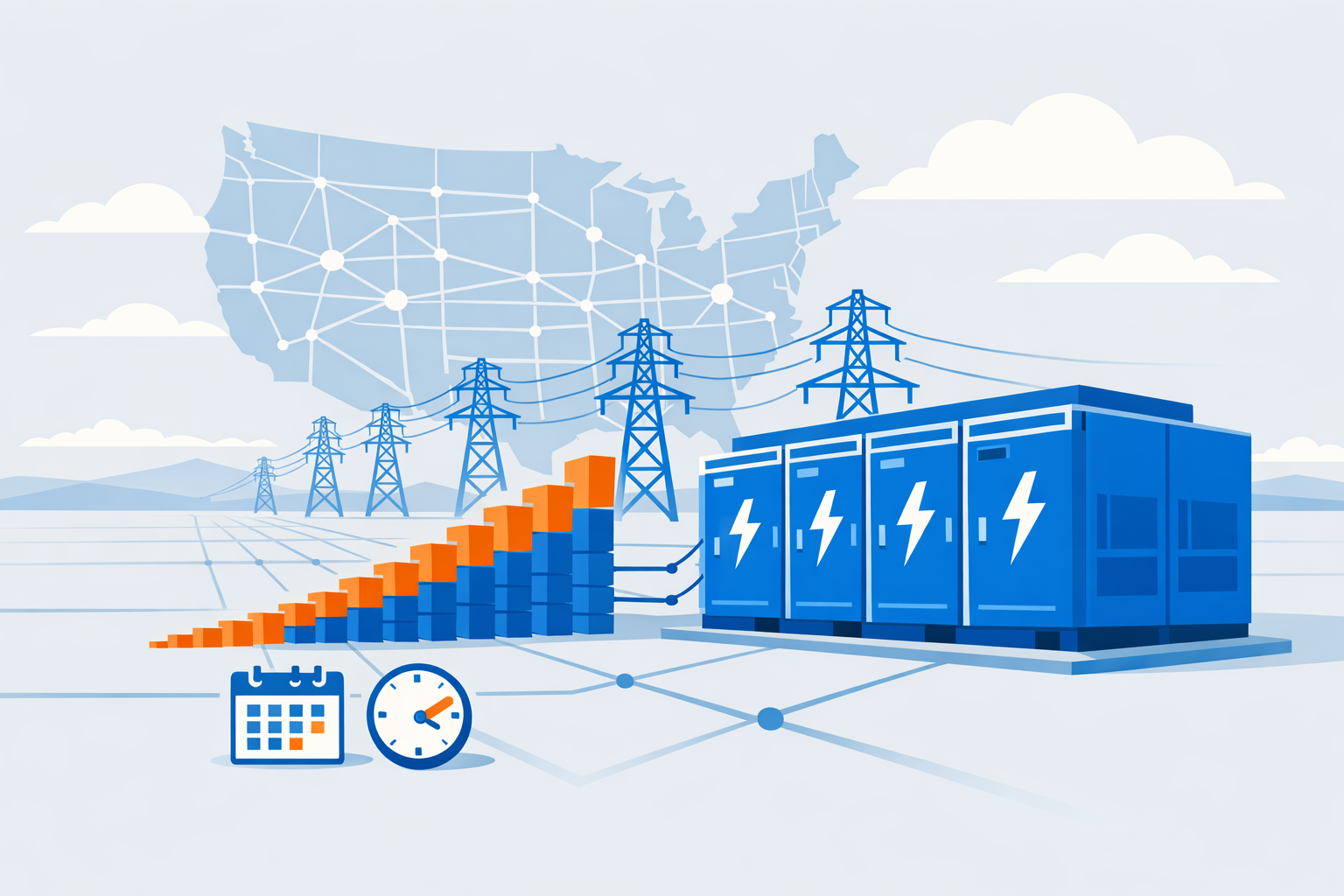
As of the end of 2024, approximately 2,300 gigawatts (GW) of total generation and storage capacity were actively seeking connection to the U.S. grid - more than twice the country's current installed generating fleet. Despite a modest decline from the 2023 peak of 2,600 GW, the aggregate figure masks a deepening structural problem: for battery energy storage system (BESS) developers, interconnection queues[1] remain among the most consequential risk factors in project development, compressing margins, deterring capital, and - in the worst cases - killing otherwise viable projects.
The queue backlog is not merely an administrative inconvenience. It is reshaping developer strategy, utility procurement plans, and the near-term trajectory of grid reliability across every major regional transmission organization (RTO) in the country.
Scale of the Backlog: What the Data Show
Lawrence Berkeley National Laboratory's Queued Up: 2025 Edition[1] provides the clearest census of the crisis. As of the end of 2024, there were approximately 10,300 projects actively seeking grid interconnection in the U.S., representing 1,400 GW of generation and approximately 890 GW of storage capacity. Battery storage and solar together account for roughly 80% of the total queue.
The attrition rate is severe. Only 13% of capacity that submitted interconnection requests between 2000 and 2019 had reached commercial operations by the end of 2024; 77% of that capacity had been withdrawn and 10% remained active.
Wait times are also lengthening. The median duration from interconnection request to commercial operation date (COD) has doubled - from under two years for projects built between 2000 and 2007, to over four years for those built between 2018 and 2024. In the most congested regions, the picture is far worse: projects that became operational in PJM in 2025 spent an average of eight years in the queue waiting to connect.
The 2024 queue data showed the first year-over-year decline in total queue size in at least a decade. However, that reduction was driven largely by two forces that offer little comfort to developers: a record number of withdrawals - 112 GW of combined solar and storage capacity withdrew from the queue in 2024 - and a sharp drop in new entrants, with 47% less solar and 32% less battery storage capacity entering the queue[2] compared to 2023.
Regional Disparities: A Market-by-Market View
The bottleneck is unevenly distributed across ISOs and RTOs. Each region's congestion profile reflects local transmission constraints, policy environments, and the pace of reform implementation.
| Region | BESS Queued | Median Timeline to COD | Historical Withdrawal Rate | Key Reform |
|---|---|---|---|---|
| PJM | 46+ GW approved, not yet built | ~8 years (2025 projects) | ~77% of all capacity | FERC Order 2023 compliance (Jul 2025); cluster studies |
| CAISO | Large hybrid share (~40 GW solar+storage) | 3-4+ years | High; record 2024 withdrawals | 2025 Prioritization Process (effective Jun 2025) |
| NYISO | ~19 GW proposed; 2 GW Fast Track | 6.5 years average | ~91% historically | Two-phase cluster study, launched Aug 2024 |
| SPP | >50 GW BESS | Multi-year; CPP targets 10 months | High (~70-90%) | Continuous Planning Process opens Apr 2026 |
| ERCOT | ~100 GW renewables + storage | Fastest of all ISOs | Moderate | Internal transparency and dropout-rate reforms |
| MISO | ~50 GW BESS in 650 GW total queue | MISO South ~9 months faster than North | Very high | DPP reforms: doubled deposits, auto-withdrawal penalties |
PJM presents the starkest challenge. Serving over 67 million people across 13 states and Washington, D.C., the RTO has become - as the Rocky Mountain Institute and others have noted - a cautionary example of how interconnection gridlock compounds reliability risk. FERC issued a compliance order in July 2025 directing PJM to revise its interconnection procedures under Order 2023[3], mandating cluster study adoption, improved energy storage modeling assumptions, and evaluation of grid-enhancing technologies (GETs). The grid operator has paused review of new interconnection requests while it processes the existing backlog and expects to open its reformed process to new submissions in 2026.
CAISO moved assertively in mid-2025, implementing a new Interconnection Prioritization Process[4] effective June 25 that scores projects on readiness, permitting progress, financing evidence, and alignment with state decarbonization goals. If the framework delivers on its promise, it could serve as a model for other congested queues. California's ability to meet its renewable portfolio standards hinges on whether this scoring mechanism translates into actual project throughput.
NYISO's backlog has doubled from 176 projects in 2018 to 350 in 2025[5]. The ISO launched its first cluster study in August 2024, and projects entering in Q3 2024 are expected to begin construction roughly 50% faster than under the prior serial process. Still, with only five BESS projects totaling 100 MW having exited NYISO's queue to date[6] and approximately 19 GW in various stages of study, the gap between pipeline and output remains enormous.
SPP holds over 50 GW of BESS in its interconnection queue[7], with Modo Energy's outlook projecting only 10.7 GW could be operational by 2030 under realistic completion assumptions. A new Continuous Planning Process (CPP) opening in April 2026 aims to reduce study timelines to under 10 months using pre-screened points of interconnection and standardized fees.
ERCOT, while outside FERC's direct jurisdiction, is not immune. As of May 2025, the Texas ISO had more than 2,000 active interconnection requests[8], and its "connect and manage" approach - while faster than most FERC-jurisdictional ISOs - is producing its own congestion management challenges as the volume of queued storage and renewables expands.
Project Finance: The Hidden Cost of Delay
The timeline problem is fundamentally a capital efficiency problem. Extended interconnection timelines directly increase carrying costs on development-stage capital.
Under MISO's reformed Definitive Planning Process, a 200 MW battery project now commits approximately $1.9 million before Phase 1 studies even begin[9] - with up to $1.6 million at risk of forfeiture during Generator Interconnection Agreement negotiations.
Lenders are responding. Debt structures for BESS projects in congested queues increasingly include milestone-linked drawdown provisions and delay-event covenants. Interconnection cost uncertainty - arising from restudy triggers when neighboring projects withdraw - remains one of the most difficult risks to underwrite, as cost estimates can shift materially between initial study and final interconnection agreement.
For merchant developers, the implications extend to revenue modeling. A project delayed two to three years beyond its original COD may miss the capacity market cycle that justified the original investment thesis. In PJM, where capacity auction prices set another record with a 22% jump in July 2025[10], the urgency of bringing new storage online is acute - yet the queue itself blocks the resource adequacy it seeks to ensure.
Utility procurement is adjusting as well. Integrated resource planners increasingly incorporate interconnection delay scenarios into capacity procurement models, extending solicitation windows and exploring backstop procurement mechanisms that allow utilities to contract for storage capacity without a guaranteed COD.
Regulatory Action: FERC Order 2023 and What Comes Next
FERC Order 2023[3], issued in July 2023, represents the most significant structural reform to the interconnection process in decades. It mandates a shift from serial, "first-come, first-served" review to a cluster-based, "first-ready, first-served" approach; establishes study deadlines with penalties for missing them; and requires transmission providers to adopt stricter project readiness screens - including site control, permitting progress, and financial deposits - to filter speculative applications.
However, it will take several more years for grid operators to process the existing backlog and fully adopt new interconnection processes, and stakeholders broadly agree that Order 2023 alone is insufficient.
The rule does not adequately address the need for comprehensive regional transmission planning and funding[2]. Proactive transmission investment - building infrastructure ahead of interconnection requests rather than in response to them - remains the critical missing link. Initiatives such as MISO's Long-Range Transmission Plan (LRTP) and SPP's portfolio highway projects represent multi-year efforts to expand transmission headroom, but their benefits will not materialize within the timeframe relevant to most projects currently in queue.
In December 2025, FERC took an additional step, directing PJM to reform its co-location and behind-the-meter generation rules[11] to accommodate large loads - including data centers - and creating three new transmission service tiers to manage demand from AI infrastructure without displacing grid-connected supply. The order is widely expected to provide a framework that other RTOs will be asked to replicate.
A separate advance notice of proposed rulemaking (ANOPR) - issued by the Department of Energy in October 2025 and directed to FERC - targets standardization of interconnection procedures for large loads greater than 20 MW, citing AI-driven demand growth as a driver requiring federal-level coordination. FERC is expected to act on this ANOPR by April 2026[12].
Near-Term Pathways: What Developers and Utilities Are Watching
Given the structural constraints, several near-term strategies are gaining traction:
- Queue prioritization reforms: Cluster studies with strict readiness screens are filtering speculative projects, improving queue quality even as they raise barriers for smaller independent power producers.
- Surplus interconnection programs: SPP's Surplus Cluster mechanism allows developers to reuse existing interconnection capacity at wind and solar sites for new storage additions, reducing study times and capital exposure.
- Grid-enhancing technologies (GETs): Dynamic line rating, power flow control devices, and advanced conductors can expand effective transmission capacity without new line construction - and FERC now mandates their evaluation within PJM's interconnection study process[10].
- Patient capital structures: Infrastructure funds and institutional investors with longer hold periods are increasingly attractive partners for BESS projects facing extended pre-COD development timelines. Contingent financing structures - with milestone-linked drawdowns rather than fixed-date obligations - are becoming standard.
- Backstop procurement: Several state utility commissions are exploring mechanisms that allow utilities to procure storage capacity on a conditional basis, providing revenue certainty to developers navigating multi-year interconnection timelines.
For a closer look at how these dynamics have played out at the project level, including a recent case from the Nevada market, see the Energy Tech News analysis of interconnection and siting hurdles for utility-scale BESS.
Outlook
The 2024 decline in total queue size is unlikely to signal a structural easing of the interconnection bottleneck. Demand growth - driven by electrification, reshoring of energy-intensive manufacturing, and the explosive expansion of AI data center load - is projected to require more than 150 GW of additional U.S. capacity within five years[13]. Battery storage is essential to meeting that need, yet its path to grid connection remains obstructed at every major RTO.
The gap between queue capacity and buildable capacity is, above all, a grid investment problem. Without proactive transmission expansion matched to interconnection reform, the "first-ready, first-served" paradigm will continue to sort winners from losers - but it cannot manufacture the transmission headroom that grid-scale storage ultimately requires to reach commercial operation at the pace the reliability outlook demands.