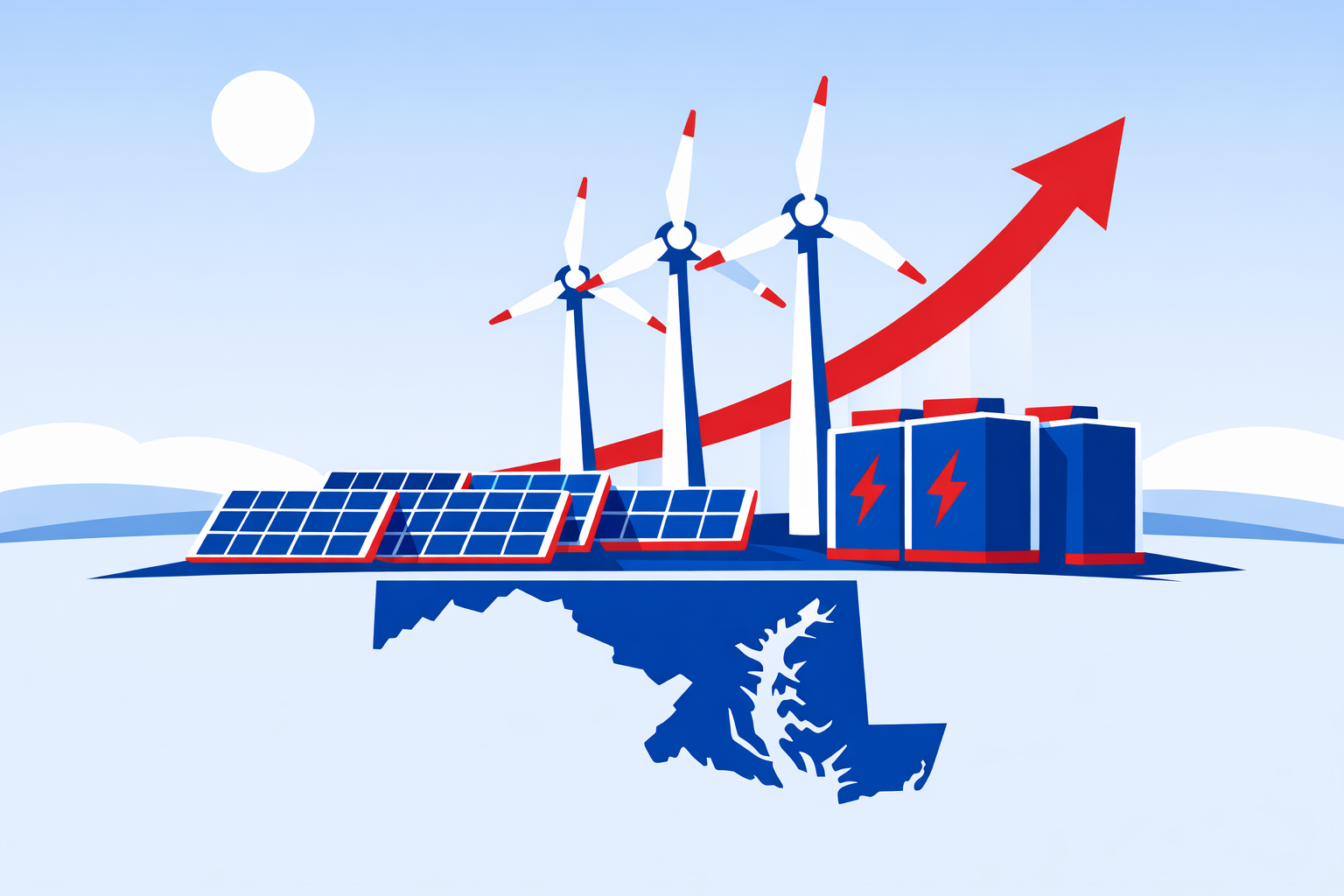
Capacity prices in Maryland's regional grid have risen roughly tenfold across three successive auctions. Against that backdrop, Governor Wes Moore's administration has launched a state-backed clean energy auction program intended to break the cycle - but the design choices that will define the program are still being negotiated.
The Crisis That Prompted Action
The urgency behind "Megawatts for Maryland" is rooted in a regional capacity market in freefall for ratepayers. Capacity prices have climbed from $29 per megawatt-day to the statutory cap of around $330 in just a few years, costing ratepayers some $46.7 billion over the past three auctions. The pressure has been particularly acute in Maryland. During the 2025/2026 auction, the Baltimore Gas and Electric zone cleared at $466.35 per MW-day - well above the broader PJM clearing price of $269.92.
The driver is well-documented. Monitoring Analytics, PJM's independent market monitor, estimated that data centers were responsible for 63% of the price increase in the 2025/2026 auction, translating to $9.3 billion in costs recovered from customers across PJM through higher electric rates. Capacity market prices are estimated to increase the average residential bill by $18 per month in western Maryland.
Maryland lawmakers responded with a sweeping omnibus measure. Unlike 2025, when the General Assembly enacted three major energy bills, 2026 produced a single comprehensive package: HB 1532, the Utility RELIEF (Reducing Energy Load Inflation for Everyday Families) Act. Governor Moore signed the legislation last week.
| Delivery Year | Clearing Price ($/MW-day) | Total Auction Cost | Key Driver |
|---|---|---|---|
| 2024/2025 | $28.92 | ~$2.2B | Pre-surge baseline |
| 2025/2026 | $269.92 (BGE zone: $466.35) | $14.7B | Data center demand spike; BGE zone constrained |
| 2026/2027 | $329.17 (capped) | $16.1B | Hit price cap; data centers drove 63% of increase |
| 2027/2028 | $333.44 (capped) | $16.4B | Third record in a row; 6,625 MW reliability shortfall |
Source: PJM Interconnection; Monitoring Analytics
What the Program Does
Governor Moore announced that the Maryland Energy Administration (MEA) has taken the first step toward launching the "Megawatts for Maryland" clean energy auction program by releasing a Request for Information seeking stakeholder input. The RFI is intended to accelerate deployment of large-scale renewable energy and energy storage projects while cutting long-term costs for Maryland ratepayers.
The program leverages $100 million from the Strategic Energy Investment Fund to establish an annual bidding process for local clean energy projects. Grants will be awarded to project developers to offset a portion of development and construction costs for large-scale renewable energy generation and energy storage facilities.
The program rests on the premise that in-state generation can reduce Maryland's exposure to PJM's wholesale price swings. Leading lawmakers and Governor Moore have argued that Maryland must generate more energy in-state to lower consumer bills, as power demand is projected to soar across the 13-state electric grid - driven chiefly by artificial intelligence and data centers.
The program's full parameters remain open. The MEA's RFI seeks preliminary input from project developers, contractors, financial investors, utilities, local governments, landowners, community organizations, Maryland residents, and other stakeholders. Final program parameters and application instructions will be included in a Funding Opportunity Announcement slated for Fall 2026.
Program Timeline: The Maryland Energy Administration's Request for Information (RFI) is open now for stakeholder input. Final program parameters and application instructions will be published in a Funding Opportunity Announcement expected in Fall 2026. Developers, utilities, investors, local governments, and community organizations are all eligible to submit input.
Auction Design: Where the Debate Begins
The RFI process will determine several design parameters with significant implications for project economics and competitive dynamics.
Local-Generation Thresholds and Bid Structure
A central question is how strictly the program will define "local" generation. Requirements mandating in-state siting, Maryland-sourced labor, or specific supply chain content could limit the pool of competitive bids, potentially raising the effective cost per megawatt-hour procured. Research on comparable international programs suggests that the effectiveness of such requirements is highly sensitive to market size, domestic industrial capacity, and the restrictiveness of the criteria themselves.
Including criteria beyond price - such as local content requirements or community benefit provisions - addresses social and economic equity concerns. However, tighter thresholds also compress the developer field, potentially reducing competitive pressure on price. Navigating this tension is a core challenge for program designers.
Price Discovery Mechanisms
Grant-based auction structures differ fundamentally from power purchase agreement (PPA) or contract-for-difference mechanisms used in programs such as the UK's T-4 capacity market, which recently awarded 1.8 GW of battery storage under 15-year contracts. In a grant format, the state does not directly set a long-term energy price signal; instead, it reduces upfront capital costs, leaving revenue certainty dependent on market conditions. This design choice affects developer financing, the types of projects likely to bid, and the long-term affordability guarantee available to ratepayers.
A key strength of auctions is their effectiveness as price discovery mechanisms - a well-designed auction reveals the true cost of the product. Whether Maryland's grant model produces equivalent price transparency will depend on how the MEA structures bid evaluation criteria and discloses clearing outcomes.
Energy Storage: An Explicit Mandate, an Expanded Ceiling
The Utility RELIEF Act's treatment of energy storage represents one of the program's most consequential provisions. Beyond the "Megawatts for Maryland" grants, the legislation materially alters the existing utility-scale battery procurement framework.
The Next Generation Energy Act of 2025 established a procurement pathway for utility-scale battery storage through the PSC, limited to 800 megawatts in 2026 and 800 megawatts in 2027. The Utility RELIEF Act clarifies that the PSC can procure more than 800 megawatts of battery storage in 2026 and 2027 if it determines the additional capacity to be cost-effective and in the interest of ratepayers.
This effectively removes any hard statutory upper bound on how much battery storage the PSC can procure. The Utility RELIEF Act also clarifies that front-of-the-meter energy storage devices qualify for this procurement process.
For developers and investors, the signal is clear: storage co-located with generation has a viable path to procurement, provided the PSC's cost-effectiveness determination is met. The interaction between the MEA's grant auction and the PSC's battery procurement process is a critical coordination issue that program governance will need to address.
Cross-Border Implications and Neighboring Markets
Maryland's push for locally sited capacity carries implications for neighboring states within the PJM footprint. If Maryland successfully onboards significant new in-state generation, the effect could reduce locational deliverability constraints in the BGE and Pepco zones - potentially moderating zonal price premiums that have historically exceeded the broader PJM clearing price.
Governor Moore has outlined specific demands to PJM: hold the Reliability Backstop Auction in September and provide 15-year price certainty for new energy resources; require data center companies to bear the costs of grid infrastructure; and accelerate the interconnection queue, particularly for storage.
The state-level program is therefore designed to complement - not replace - the regional market reform agenda. Developers from neighboring states with projects that could serve the Maryland zone are likely to watch the RFI process closely. Whether out-of-state projects qualify for grants under a Maryland-first program could shape cross-border procurement flows.
Risks and Opportunities for Utilities and Communities
For utilities such as Baltimore Gas & Electric and Pepco - which faced the most extreme capacity price exposure in recent auctions - the program offers a potential path to lower procurement costs through long-term bilateral agreements supported by state grants. However, the structure of cost pass-through, and whether grant-funded projects reduce utility capacity obligations under PJM rules, remains to be clarified.
Maryland faces significant near- and long-term energy challenges, and policymakers are clearly weighing how to balance reliability, affordability, speed of development, environmental considerations, and community input. Any future conversation about statewide siting policy will likely require careful consideration of both statewide energy goals and local realities.
For communities, the equity dimension is explicit in the program's framing. The MEA's RFI specifically solicits input from community organizations and residents, suggesting that community benefit provisions - such as local hiring commitments or bill-credit programs for low-income ratepayers - may be among the parameters under consideration.
What Developers Need to Watch
Several design elements remain unresolved that will materially affect project economics and bidding strategy:
- Eligible technology types: Whether offshore wind, onshore solar, standalone storage, and hybrid projects all qualify, or whether the program is narrowly scoped
- Local-content or in-state thresholds: How strictly Maryland residency or supply chain sourcing will be defined
- Grant sizing methodology: Whether awards are calculated on a per-MWh, per-MW, or total-project-cost basis
- Interconnection readiness requirements: Given PJM's persistent queue backlogs, whether projects must demonstrate a specific interconnection status to be eligible
- Interaction with PSC battery storage procurement: Whether storage projects can access both programs simultaneously
A large share of eligible projects currently in PJM's queue consists of solar paired with battery storage, suggesting the developer community is well-positioned to respond to a well-designed program.
Wind and solar resources still account for only 4% of PJM's supply, meaning PJM must continue to accelerate approvals of the 85 gigawatts waiting to connect. Adding more renewable energy and storage to the grid remains the most direct solution to higher energy prices, and states must address the siting and permitting challenges keeping PJM-approved projects from starting construction.
Conclusion
"Megawatts for Maryland" represents a substantive state-level intervention in a regional capacity market that has demonstrably failed to protect Maryland ratepayers from cost escalation. Its success will hinge on auction design choices still being finalized: local-content thresholds that balance equity with competitive price discovery, a grant structure that produces genuine long-term affordability signals, and an energy storage mandate flexible enough to absorb projects at scale. The Fall 2026 Funding Opportunity Announcement will be the first concrete test of whether program parameters match the policy ambition.
Frequently Asked Questions
What is the 'Megawatts for Maryland' program? It is a state-backed clean energy auction program established under Maryland's Utility RELIEF Act of 2026. The program leverages $100 million from the Strategic Energy Investment Fund to award annual grants to project developers, offsetting a portion of development and construction costs for large-scale renewable energy generation and energy storage projects.
Who is eligible to participate? The Maryland Energy Administration's RFI seeks input from project developers, contractors, financial investors, utilities, local governments, landowners, community organizations, Maryland residents, and other stakeholders. Formal eligibility criteria will be published in the Funding Opportunity Announcement in Fall 2026.
How does the program relate to PJM's capacity market? The program is designed as a state-level complement to PJM's regional capacity auctions, which have seen prices surge roughly tenfold in recent years. By incentivizing locally sited generation, Maryland aims to reduce its dependence on external capacity procurement and moderate the pass-through of high PJM capacity costs to ratepayers.
What role does energy storage play? The Utility RELIEF Act explicitly covers energy storage alongside renewable generation and removes the previous 800 MW annual cap on the Public Service Commission's utility-scale battery storage procurement. Front-of-the-meter devices are explicitly eligible, and there is now no statutory upper limit on PSC battery procurement subject to cost-effectiveness review.
What are the key risks for developers? Primary risks include uncertainty around final program parameters, the challenge of meeting potential local-generation or in-state-content thresholds, PJM interconnection queue delays, and cost pressure from tariffs on imported solar and storage components.