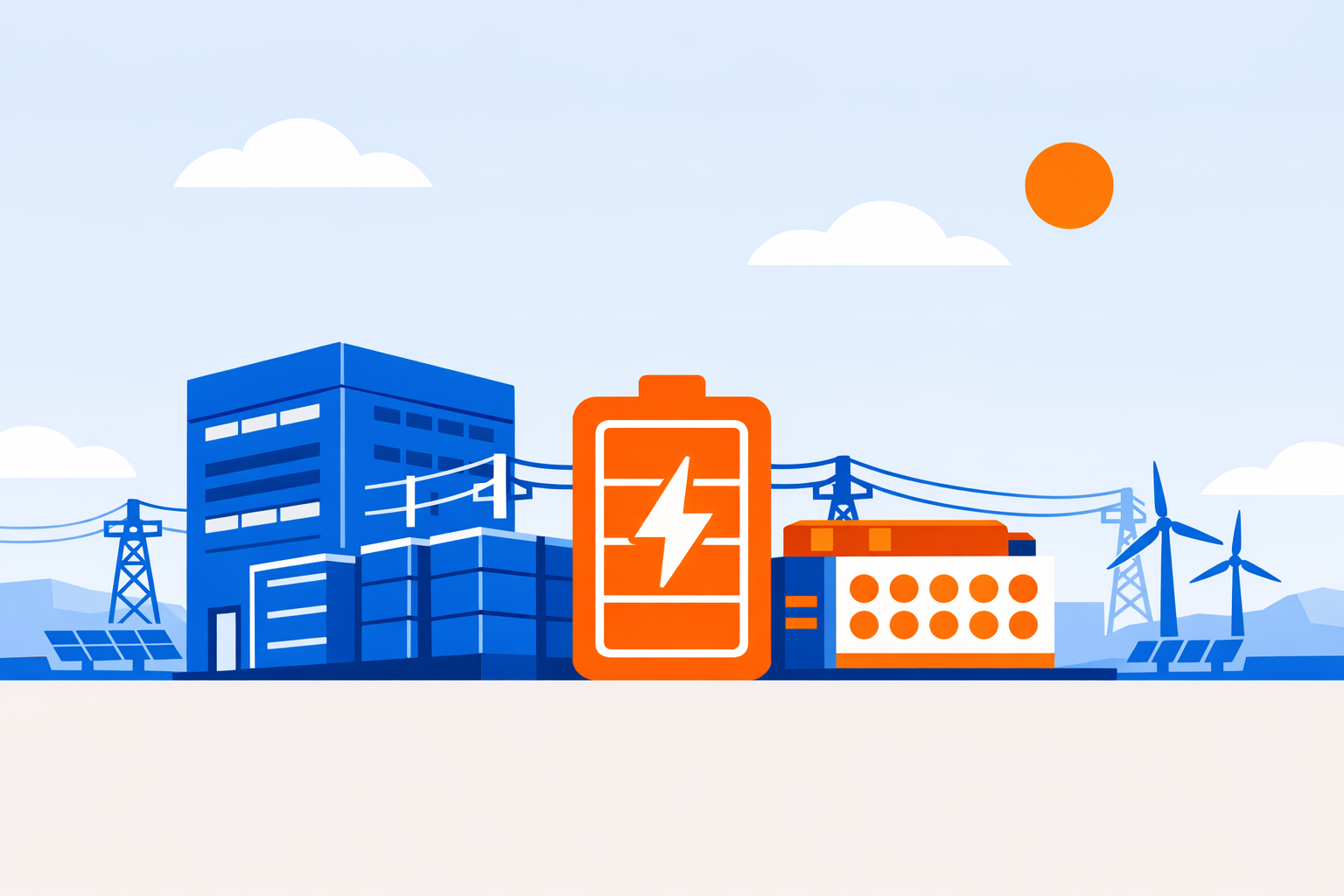
Meta Platforms and Noon Energy announced on April 21, 2026, a phased supply agreement for up to 1 GW / 100 GWh of ultra-long-duration energy storage (ultra-LDES) capacity, marking one of the largest corporate commitments to multi-day storage technology on record. The deal supports Meta's AI data center buildout by providing firm, renewable-backed power capable of operating through multi-day periods of low solar or wind generation.
Background
The agreement arrives as hyperscale data center operators face a widening gap between AI-driven load growth and available grid capacity. Data centers are projected to consume up to 12% of total U.S. electricity by 2028, according to Noon Energy, pressuring operators to develop on-site or co-located energy solutions independent of grid interconnection. Conventional lithium-ion battery storage, typically rated for 4-6 hours of discharge, cannot cover multi-day renewable generation shortfalls.
Meta signed a power purchase agreement with Zelestra for the Skull Creek Solar Plant in Texas in February 2026, reflecting the company's broader strategy of assembling renewable energy assets for its facilities. The Noon Energy deal extends that approach to storage, targeting firm power delivery around the clock rather than generation alone.
The ultra-LDES sector has drawn growing interest from hyperscalers. Google announced a strategic investment in Italian long-duration storage company Energy Dome in July 2025, while Form Energy began deploying its first commercial 100-hour iron-air batteries and subsequently signed a supply agreement with AI data center developer Crusoe. For more on how AI demand is reshaping long-duration storage deployment, see our earlier analysis: AI Demand Pushes Long-Duration Storage into Data Centers.
Details
The collaboration will begin with a 25 MW / 2.5 GWh project, scheduled for completion by 2028. Following a successful outcome from that initial phase, Noon will proceed with deliveries under the full 1 GW / 100 GWh supply contract.
Noon Energy's system is a modular, reversible solid oxide fuel cell (rSOFC) battery that stores energy using carbon and oxygen rather than lithium or other scarce metals. During charging, electricity converts carbon dioxide into solid carbon stored in a charge tank; during discharge, the system draws in ambient oxygen and recombines it with the stored carbon to generate electricity and reform carbon dioxide. The architecture decouples power capacity - defined by fuel cell stack size - from energy capacity - defined by carbon storage tank size - allowing duration to be extended at low marginal cost by adding tank modules.
Noon Energy's demonstration system, unveiled in January 2026 and partially funded by the California Energy Commission, operated for thousands of hours and achieved over 200 hours of discharge capacity at maximum output, exceeding the company's original targets. The company is targeting a storage system cost of $20 per kilowatt-hour, compared with utility-scale lithium-ion systems that can reach $300/kWh and flow batteries that can exceed $600/kWh, according to Latitude Media.
Noon Energy was founded in 2018 and has raised more than $45 million in venture capital and government grants, with backers including At One Ventures, Emerson Collective, Clean Energy Ventures, and Aramco Ventures, according to the company.
Nat Sahlstrom, VP of Energy and Sustainability at Meta, said: "Bringing data centers online faster requires rapid deployment of reliable energy sources. Our agreement with Noon advances that goal with a storage technology that delivers grid resilience and firm power."
Chris Graves, co-founder and CEO of Noon Energy, said the partnership would focus on "building production capacity and an ultra-LDES supply chain in the years ahead."
Outlook
Noon Energy said it will begin development of the initial 25 MW / 2.5 GWh project soon, though no detailed construction timeline has been disclosed. The company's next operational milestone is scaling from demonstration-scale systems to manufacturing-line production. Analysts and industry observers expect the Meta agreement to bolster capital market confidence in ultra-LDES technologies and potentially accelerate procurement discussions among other large industrial and data center operators evaluating alternatives to gas peaking capacity.