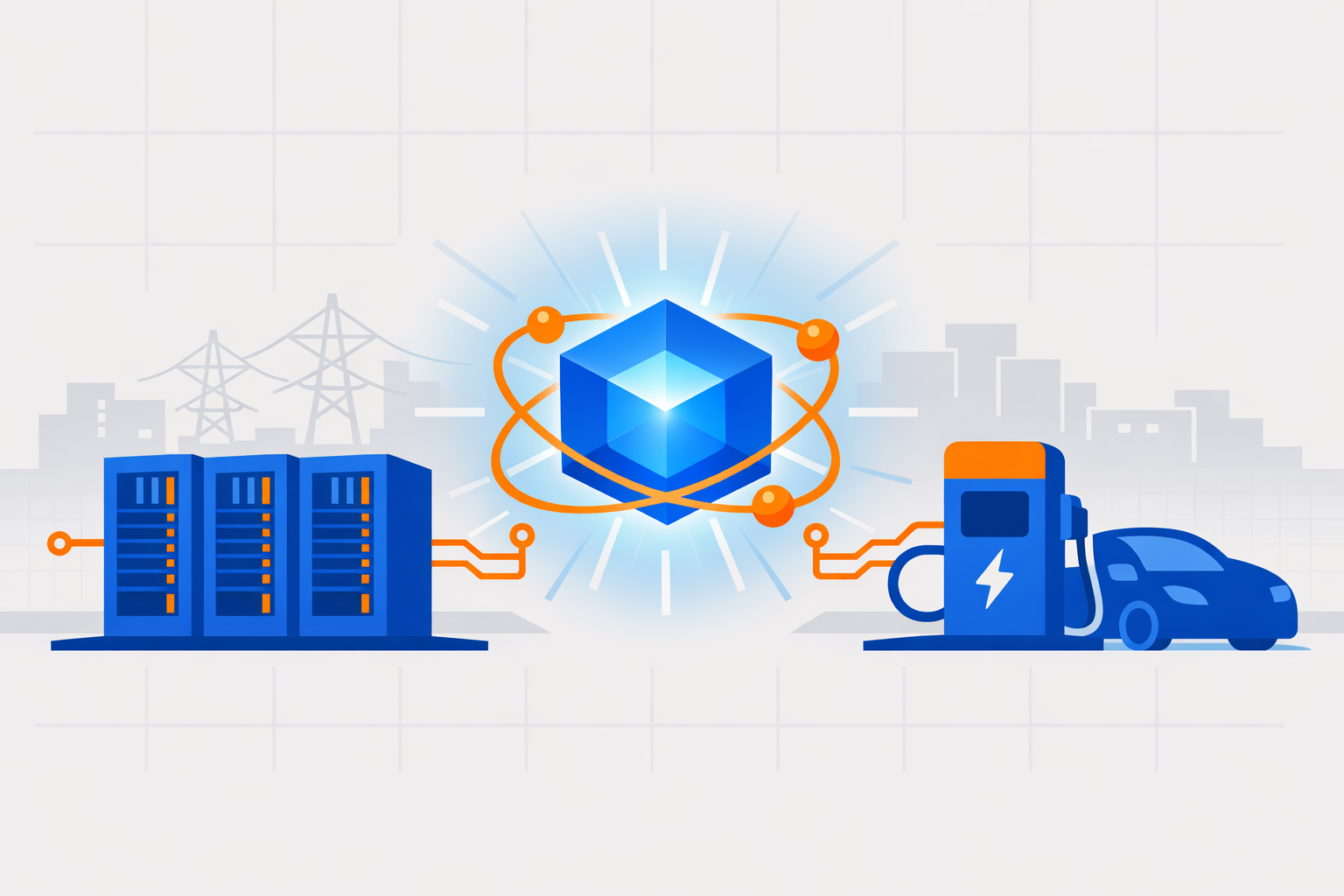
Quantum battery headlines suggest electric vehicles (EVs) with near-instant charging and data centers exempt from backup concerns. Laboratory advances are significant, with recent demonstrations of quantum charging in superconducting and photonic devices. However, quantum batteries remain a pre-commercial research area, while lithium-ion and solid-state batteries define current and near-term system planning for grids, data centers, and EVs.
Quantum batteries: capabilities and experimental progress
From chemical cells to quantum energy storage
A quantum battery stores energy in quantum states-such as arrays of two-level systems like qubits or molecular excitons-rather than through electrochemical potentials. Theoretical research shows that entanglement and collective effects like superabsorption can make charging power scale superlinearly with the number of cells, as opposed to the linear scaling seen in classical batteries.
In 2022, researchers demonstrated superabsorption in an organic microcavity, showing light absorption increases with the number of molecules, aligning with quantum battery models. Later experiments have extended this to more complete charge-discharge cycles and to other platforms, including superconducting circuits and solid-state systems.
Experimental milestones
Key findings shaping expectations include:
- A 2022 organic semiconductor microcavity experiment confirmed superabsorbing behavior in line with quantum battery models, exhibiting rapid charging at microscopic scales and cryogenic temperatures.
- In 2026, Hu et al. reported a "quantum charging advantage" in a superconducting quantum battery built from 2-12 transmon qubits, which charged faster than classical analogs under similar conditions.
- Room-temperature, molecular or solid-state devices have achieved energy retention lasting from nanoseconds to microseconds and, in some cases, full cycles of optical charging, storage, and electrical discharge.
While these results confirm that quantum characteristics can enhance charging and energy retention at microscopic scales, the demonstrated powers and capacities are far below those required for EVs, grid storage, or data center systems.
Commercial readiness: laboratory stage
Despite frequent coverage, expert reviews place quantum batteries at fundamental research levels:
- Review articles and specialist commentary consistently categorize quantum batteries at technology readiness levels 1-2, with no commercial products available in EVs, grid storage, or data center infrastructure as of early 2026.
- Current proof-of-concept devices rely on nanostructured materials or superconducting qubits in environments like optical cavities or dilution refrigerators, with capacities in the picojoule to microjoule range.
Energy-system planning, therefore, classifies quantum batteries as horizon 3 innovations-not a consideration for current infrastructure or product pipelines.
Benchmarking quantum, lithium-ion, and solid-state batteries
Present and near-term leaders: lithium-ion and solid-state
Lithium-ion batteries are established in EV, stationary storage, and data center applications due to mature supply chains, declining costs, and proven operational performance.
State-of-the-art lithium-ion cells for EVs provide energy densities of about 150-250 Wh/kg, with leading designs reaching 270-300 Wh/kg.
Solid-state batteries (SSBs) seek to replace liquid electrolytes with solid materials, allowing for lithium metal anodes and enabling higher energy density, safety, and fast charging:
- Multiple automakers, including Toyota and several Chinese manufacturers, plan to launch solid-state or semi-solid-state EV demonstration vehicles between 2026 and 2028, with energy density targets near 400-500 Wh/kg.
- Early production-ready SSB and semi-solid-state prototypes publicized in 2025-2026 report energy densities around 400 Wh/kg and fast charging in several minutes for small-to-medium packs, though cost, durability, and manufacturability challenges remain.
Comparative attributes: Li-ion, solid-state, quantum
| Attribute | Lithium-ion battery (NMC/LFP) | Solid-state battery (early prototypes) | Quantum battery (lab prototypes) |
|---|---|---|---|
| Primary energy storage | Electrochemical (ion intercalation) | Electrochemical (solid electrolyte, often Li metal) | Quantum states (excitons, qubits) |
| Gravimetric energy density | ~150-250 Wh/kg; premium up to ~270-300 Wh/kg | Target ~400-500 Wh/kg; some claims 400 Wh/kg | Not defined at device scale; microscopic volumes |
| Charging time | 20-40 min to ~80% at 150-350 kW for EVs; ms-sec for grid services | <10 min for small packs; megawatt-scale charging under study | Fast charging at micro/millikelvin or lab conditions; microscopic energy |
| Cycle life | 1,000-5,000 cycles | ≥1,000-2,000 cycles; higher claims under validation | Studied for coherence and metastability, not practical cycling |
| Operating environment | -20°C to ~50°C (with management) | Similar or slightly tighter; management essential | Often cryogenic or specialized cavities; room-temperature devices are prototypes |
| EV technology readiness | Commercial | Pilot/demo phase for late 2020s | No commercial EV programs |
| Grid/data center readiness | BESS, UPS standard | Early stationery pilots; active R&D | No grid/data deployments; research only |
This comparison highlights that, even amid scale-up challenges, solid-state batteries are already featured in manufacturer and policy roadmaps, whereas quantum batteries are confined to foundational science.
EV fast charging: quantum claims versus real-world limits
Fast-charging infrastructure trends
EV charging infrastructure is advancing toward power levels cited in quantum-battery discussions:
- IEA data shows global ultra-fast public chargers (≥150 kW DC) surpassed 77,000 units in 2024, a 60% increase from 2023; around one-fifth of EU units are rated above 350 kW.
- Multi-megawatt charging for heavy-duty vehicles, using the MCS standard, is moving from pilot stage to early commercial rollout.
At these power levels, grid capacity and demand charges dominate system planning. Substation limits, feeder ratings, and transformer capacity often dictate timelines more than battery acceptance rates.
Battery limits versus system constraints
Emerging solid-state and advanced Li-ion designs already support high C-rate charging, enabled by thermal and current-collection engineering:
- Modern EV packs utilize 800 V architectures to reduce current at high power.
- Charge rates are dynamically managed to protect battery life, with tapering based on cell temperature and state-of-charge.
Quantum battery theory suggests faster charging as system size scales. Yet at EV-pack scale, new system challenges emerge, including:
- Power electronics, connectors, and cabling must support higher instantaneous power.
- Grid distribution and transmission would see sharper peaks unless new buffering is added.
- Safety and thermal management remain critical engineering limits.
With late-2020s EV platforms centered on Li-ion and solid-state technologies, quantum batteries do not influence current designs for charging infrastructure or vehicles.
Near-term considerations for EV stakeholders
Decision areas for the next decade include:
- Advancing pack design and thermal controls to support 3-6 C charging for fleet applications, balancing performance and life.
- Integrating fast charging with local grid upgrades, storage solutions, and dynamic tariffs.
- Monitoring quantum battery research for long-term prospects, not near-term investment planning.
Quantum battery advancements may shape future charging solutions, but they do not negate immediate needs for grid upgrades, power-electronics development, or interoperability standards.
Data center power and onsite storage: timelines and prospects
Growing data center electricity demand
A surge in AI and cloud adoption is increasing data center electricity requirements:
- Global data center consumption reached ~620 TWh in 2024 and is projected at 945 TWh by 2030-just under 3% of global electricity demand per IEA's base-case.
- Some analyses suggest data centers could contribute 10% of global demand growth this decade, already impacting markets like Ireland and major U.S. hubs.
Operators emphasize:
- High availability ("five nines" or better).
- Short-term ride-through (seconds to minutes) during disruptions.
- Cost-effective, longer-term backup-typically using a mix of batteries, generators, and increasingly, renewables.
Li-ion-based UPS systems and BESS are standard, with incremental improvements prioritized over disruptive chemistry changes.
Potential value of quantum batteries
If future quantum batteries provide:
- Extremely high power density
- Ultra-fast cycling
- High efficiency
- Long cycle life
They could be used for:
- Sub-second power management and ride-through.
- Compact buffer storage between racks and UPS units.
- Specialized applications such as storage for quantum computing systems.
However, current experiments are many orders of magnitude short on required capacity and practicality (cooling, integration, complexity).
Planning approach for operators and utilities
Over the next decade, greater impact will come from:
- Improvements in IT and cooling energy efficiency.
- Scaling up Li-ion-based UPS/BESS.
- Integrating renewables, generators, and hydrogen-ready assets.
Quantum battery developments warrant monitoring as part of broader technology portfolios, but not for near- or medium-term grid connection, procurement, or BESS sizing priorities.
Grid-scale storage: quantum batteries' role in context
Rapid BESS expansion
Grid-connected battery energy storage systems (BESS) are growing rapidly to support power systems with higher renewable penetration.
IEA estimates global BESS additions topped 90 GWh in 2023, doubling year-on-year and raising total operating capacity above 190 GWh.
Lithium-iron phosphate (LFP) dominates, supported by manufacturing scale and proven reliability. Pumped hydro leads in total installed energy, but new storage growth is battery-driven.
IEA and IRENA scenarios anticipate multi-hundred-gigawatt stationary storage deployments by 2030, drawing on Li-ion, flow batteries, compressed air, and other maturing technologies. Quantum batteries do not feature in these frameworks, reinforcing their current status as an R&D subject.
System-level services: eventual opportunities
If scalable quantum batteries are realized, potential system roles could include:
- Ultra-fast frequency regulation and synthetic inertia: leveraging high power density and speed.
- Sub-second grid buffering: enhancing or replacing supercapacitor and flywheel roles.
- High-density storage for space-constrained sites: like offshore or urban substations, contingent on superior storage metrics.
Currently, these applications are hypothetical. For system planners, quantum batteries suggest new long-term design options but do not address today's deployment or flexibility challenges.
Policy and funding: supporting credible R&D and managing expectations
Current funding landscape
Quantum battery research is primarily financed as part of broad quantum science and technology initiatives, not energy deployment programs:
- The EU's Quantum Flagship-launched in 2018 with a projected €1 billion budget over ten years-supports quantum technologies across computing, communication, sensing, and thermodynamics, but not specific deployment.
- Regional programs in Europe, North America, and Asia fund quantum information, materials, and devices. Energy storage remains a potential outcome, not a near-term mandate.
In comparison, advanced battery chemistries like solid-state are supported through targeted industrial policies aimed at scaling pilots to factory-scale in the 2020s.
Policy principles for quantum battery engagement
For energy and cleantech stakeholders, prudent engagement involves:
- Separating basic research from deployment targets. Keep quantum batteries within early-stage research and avoid incorporating them into 2030 system plans.
- Tying support to milestones. Link public funding to verifiable progress-energy density, efficiency, stability-relevant to energy-sector needs.
- Investing in cross-cutting enablers. Support materials, cryogenics, and electronics benefiting multiple sectors, regardless of quantum battery timelines.
- Communicating realistically. Encourage accurate reporting on scale, engineering limits, and expected timelines to manage stakeholder expectations.
Utilities and regulators should track quantum battery R&D but exclude it from near-term resource adequacy or system-design planning.
Near-term priorities and actionable conclusions
For grid operators and utilities
- Treat quantum batteries as long-term prospects; do not adjust current grid investment or planning based on future capabilities.
- Focus on deploying proven BESS, grid-forming inverters, and non-wire alternatives to support renewables and electrification.
- Engage with quantum-technology research where it intersects with grid optimization and planning methods, rather than storage hardware.
For EV and charging infrastructure stakeholders
- Plan around lithium-ion and solid-state capabilities detailed in current OEM roadmaps.
- Prioritize interoperability, managed charging, and local storage to alleviate peaks from 350 kW+ and future megawatt-class chargers.
- Watch quantum batteries for future buffer or power-quality uses, not as alternatives to imminent grid investments.
For data center owners and operators
- Base electricity demand and infrastructure models on Li-ion UPS/BESS and conventional backup.
- Focus on incremental technology transitions, such as safer chemistries or higher-density modules.
- Consider quantum storage as a niche possibility for quantum-computing colocation rather than a Tier III/IV resilience solution.
For policymakers and public funders
- Continue supporting quantum battery research under broader programs, maintaining clear expectations on commercialization timelines.
- Avoid decarbonization policies or infrastructure mandates presuming major breakthroughs before 2035.
- Establish funding and communication processes encouraging rigorous benchmarks versus advanced Li-ion, solid-state, or other storage approaches.
Frequently Asked Questions
How soon could quantum batteries appear in commercial EVs or grid assets?
Available evidence places quantum batteries in early-stage research, far from the maturity needed for grid, EV, or data center deployment. Demonstrations involve small-scale, controlled setups-often at low temperatures. Scaling to practical devices requires several unproven steps in materials, manufacturing, and control. Current models and OEM plans do not anticipate quantum batteries in the 2020s.
Could quantum batteries eliminate the need for grid upgrades for ultra-fast EV charging?
Even with theoretical ultra-fast charging potential, infrastructure remains limited by conductor capacity, equipment ratings, and upstream system constraints. Today's ultra-fast hubs already confront these issues above 350 kW, driven by physical infrastructure-not by battery chemistry. Quantum batteries could alter vehicle or station energy buffering but would not replace network reinforcement and power-system planning.
How do quantum batteries differ from solid-state batteries?
Solid-state batteries are electrochemical devices that improve safety and performance by using solid electrolytes. Their operation relies on ion transport. Quantum batteries use coherent quantum states, including entanglement, for storage and transfer. Existing prototypes resemble quantum systems, not modules for direct application in battery packs or grids.
Should corporate net-zero strategies assume breakthroughs in quantum battery technology?
Current net-zero and decarbonization goals for 2030-2040 rely on proven or near-commercial options, including renewables, electrochemical storage, demand response, and efficiency. Quantum batteries remain at a fundamental stage; planning based on disruptive breakthroughs would add speculative risks. Quantum storage should be monitored for upside potential, but investments should rely on available technologies.
What early signals suggest quantum batteries are nearing practical deployment?
Key indicators include:
- Demonstrations at or near room temperature with stable operation over thousands of cycles.
- Independently verified power and energy densities relevant to real-world devices.
- Engagement by established battery manufacturers, such as pilot lines or joint ventures.
- Inclusion in formal industry or standards roadmaps (e.g., IEA, IRENA).
Until such signals appear, quantum batteries remain an active research area-not a driver of immediate decisions for grids, data centers, or EV charging.