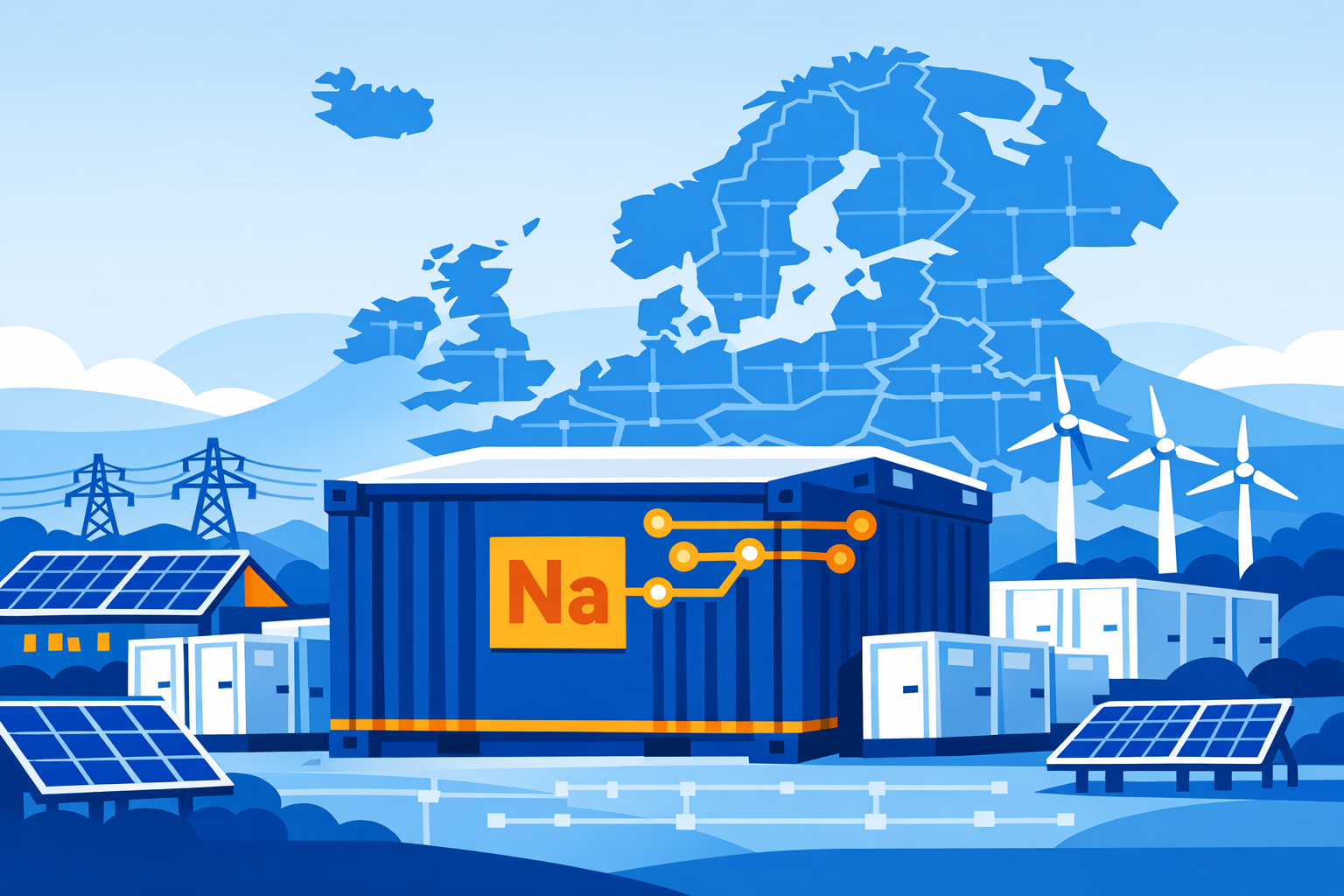
Sodium-ion battery programs are gaining tangible traction across Europe, with pilot deployments, supply chain investments, and large-scale project announcements emerging in close succession - driven in part by renewed lithium price pressure and a strategic push for supply chain independence.
Background
With lithium prices reaching a two-year high in early 2026, sodium-ion batteries are once again in the spotlight. The renewed attention follows a period during which rapidly falling lithium-iron-phosphate (LFP) costs had narrowed the economic rationale for alternative chemistries. For grid storage, energy density matters less than cost per kWh per cycle - precisely where sodium-ion technology is considered most competitive.
In Europe, the EU Green Deal and programs such as the Sodium-Ion-Battery Deutschland-Forschung initiative are accelerating research, while industrial policies promote local battery manufacturing. The EU-funded HORIZON SPRINT project extends this push directly to stationary storage: SPRINT will optimise and demonstrate two safe, quasi-solid-state sodium-ion batteries tailored for stationary applications, harnessing novel NFP cathode materials and hard-carbon anodes over a 46-month program to enhance energy density, cycle life, and cost efficiency. Demonstration sites include Austria, focused on portfolio hybridisation and balancing services, and Lithuania, targeting residential PV integration and grid capacity for EV chargers.
Details
The most visible recent deployment came in September 2025, when Switzerland's Phenogy launched a megawatt-hour-scale sodium-ion energy storage system at a commercial site near Bremen Airport in northern Germany - marking the company's European debut and its ambition to develop fully vertically integrated local manufacturing. The single-container system delivers 400 kW of power and nearly 1 MWh of storage capacity, paired with an existing 50 kW solar array and currently operating in island mode to optimise on-site energy consumption while powering EV chargers. Phenogy CTO Max Kory framed the rationale in supply-chain terms, arguing that investing in large-scale LFP production in Europe would still leave the continent dependent on Chinese precursor imports.
In the UK, Wales-based Batri, supported by the Faraday Institution, produced an 18650 sodium-ion cell using fully domestically manufactured anode and cathode materials - hailed as a "strategic milestone" by Chief Technical Officer Stephen Hughes. Batri said the demonstration cell marks the beginning of a wider development program. The company is scaling material manufacturing and partnering with AceOn Group to integrate the cells into modular, swappable energy systems.
On the supply chain front, Swedish developer Altris and Czech speciality chemicals firm Draslovka entered a strategic partnership to build Europe's first industrial-scale sodium-ion cathode value chain. Draslovka is committing a €19.3 million in-kind investment to scale production of Altris' patented cathode active material (CAM) at its Kolín, Czech Republic facility. Once ramped, the Kolín line will support up to 350 tonnes of CAM annually - a European-controlled supply equivalent to around 175 MWh of sodium-ion cell capacity. Altris CEO Christer Bergquist stated: "Europe is no longer waiting for sodium-ion to mature elsewhere - we are industrialising it here, with Western manufacturing and Western supply."
The largest announced European project integrating sodium-ion came in April 2026. Renalfa Power Clusters acquired a 365 MWp solar plant and a nearby 400 MW / 800 MWh standalone BESS in western Romania's Arad County, with plans to combine them into a single hybrid power cluster targeting commercial launch in 2027. Renalfa intends to expand the combined site using a dual-chemistry approach, mixing lithium-ion and sodium-ion storage while integrating grid-forming technology. Under the plan, the total energy storage capacity of the Horia-Arad cluster will reach 3.6 GWh after both expansion phases. CEO Ivo Prokopiev described the project as a "Sovereign Grid Anchor," capable of providing grid services previously reserved for thermal power plants.
On technology economics, research from Finland's LUT University in cooperation with Germany's Karlsruhe Institute of Technology and Spain's University of Alcalá found that sodium-ion cells are already approaching cost parity with lithium-ion. Longer-term modelling suggests that by 2050, sodium-ion batteries with fast learning rates could deliver storage at 11-14 €/MWh, compared to 16-22 €/MWh for lithium-ion, while also offering higher energy-to-power ratios and cycle durability. However, sodium-ion cells currently carry a slightly higher capital cost than lithium-ion, and the technology must achieve sustained learning-rate improvements to challenge lithium-ion competitively.
Outlook
While sodium-ion production remains at pilot scale, publicly announced expansion plans indicate that global Na-ion production capacity could exceed 100 GWh by 2030. For Europe, the convergence of EU research funding, nascent domestic cathode supply chains, and first utility-scale hybrid project announcements marks a transition from laboratory demonstration toward commercial deployment - though significant advances in performance, safety, and scalability are still required before sodium-ion can fully rival lithium-based technologies in stationary storage. The Altris-Draslovka production line and the Renalfa Romania cluster, both expected to reach key milestones in late 2026 and 2027 respectively, will serve as early stress tests of whether Europe-made sodium-ion systems can deliver grid services at competitive cost.