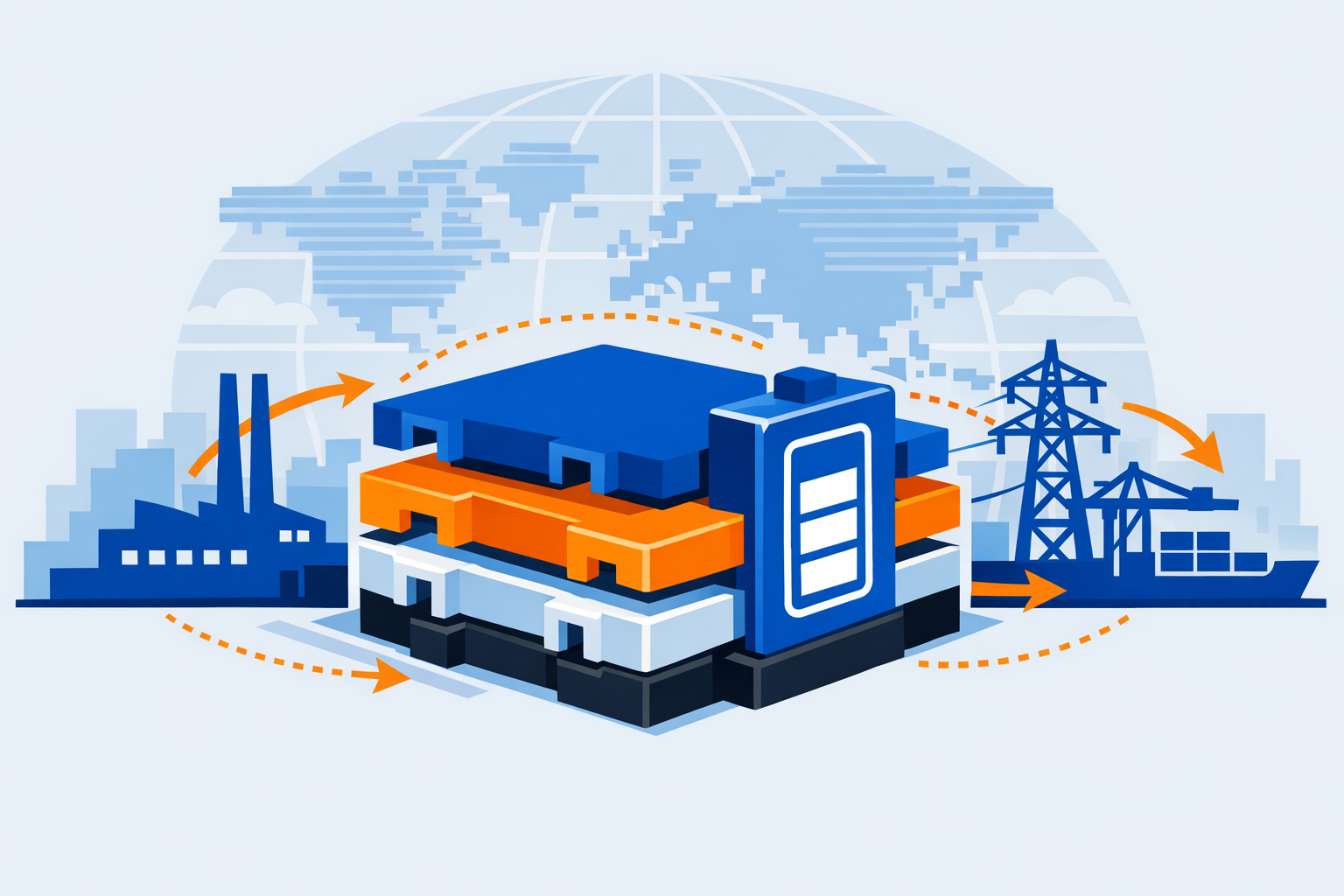
A series of lab-scale breakthroughs in solid-state battery (SSB) chemistry is forcing utilities, project developers, and manufacturers to reconsider where and how next-generation grid storage will be produced. Recent technical milestones-spanning polymer electrolyte engineering in the United States to sodium-based cell chemistry in Singapore-are intensifying a multi-regional race to establish commercial-scale manufacturing before existing lithium-ion supply chains solidify further.
Background
The global lithium-ion battery market topped $150 billion in 2025, a 20% year-on-year increase, according to OilPrice.com, underscoring the scale of infrastructure that next-generation technologies must ultimately displace. Solid-state batteries replace the liquid electrolyte in conventional lithium-ion cells with a solid material-typically a ceramic, sulfide, or polymer-eliminating the flammable liquid that poses thermal runaway risk and enabling higher energy density through the use of a lithium-metal anode.
China currently controls roughly half of the global lithium market and produces over three-quarters of the world's EV batteries, according to OilPrice.com and the Information Technology & Innovation Foundation (ITIF). Chinese institutions account for 65.4% of high-impact research publications in electric batteries, compared with 11.9% for U.S. institutions, according to ITIF. That concentration has made supply chain diversification a strategic priority in both Washington and Brussels.
Details
The pace of technical progress accelerated markedly through 2025. Researchers at the U.S. Department of Energy's Oak Ridge National Laboratory (ORNL) developed a polymer electrolyte engineered to address slow ion movement-one of the field's central manufacturing hurdles-with potential applicability to grid-scale storage. Separately, researchers at the University of Chicago and Singapore's A*STAR Institute reported a sodium-based solid-state electrolyte using a stabilized metastable hydridoborate structure, achieving ionic conductivity at least one order of magnitude higher than previously reported values in the literature, according to ScienceDaily. Sodium presents a lower-cost, more abundant alternative to lithium. Y. Shirley Meng, Liew Family Professor at UChicago's Pritzker School of Molecular Engineering, stated that the same gigafactory could eventually produce cells based on both lithium and sodium chemistries.
On the industrial side, U.S. startup ION Storage Systems achieved a 25x capacity boost and over 1,000 cycles in large-format cells retaining more than 80% capacity, backed by $20 million from ARPA-E, according to Linknovate. Factorial Energy validated 77-ampere-hour cells at 375 watt-hours per kilogram-more than 600 charge cycles-with charging from 15% to 90% completed in 18 minutes, according to Intelligent Living. Solid Power entered a tripartite industrialization alliance with Samsung SDI and BMW, clarifying division of labor across electrolyte, cell, and vehicle production, according to Shanghai Metals Market (SMM).
In Japan, Toyota and Sumitomo Metal Mining developed a proprietary durable cathode material for solid-state batteries, with Toyota targeting a BEV market launch by 2028, according to CleanTechnica. Nissan, working with LiCAP Technologies, is targeting mass production of all-solid-state battery vehicles by fiscal year 2028, according to SMM. In late 2025, China launched a public consultation for its first national standard dedicated to solid-state batteries, addressing terminology, classification, and coding rules, according to Intelligent Living. China's Ministry of Industry and Information Technology (MIIT) also listed solid-state batteries and their key materials as priority manufacturing pilot directions, aiming to close the gap between laboratory results and factory-scale output.
Despite these advances, critical barriers remain. Current solid-state battery production costs are estimated at five to ten times those of lithium-ion batteries, according to Convert Green. SSB development involves three main electrolyte types-sulfides, polymers, and oxides-each presenting different trade-offs in ionic conductivity, scalability, and interface resistance, according to IDTechEx. East Asia, led by Japan, South Korea, and China, continues to dominate battery innovation and production capacity, while North America and Europe are investing heavily in localized manufacturing to reduce that dependence, according to IDTechEx.
New electrolyte chemistries also create fresh upstream dependencies. Solid-state batteries reduce some risks linked to volatile lithium metal markets but introduce new dependencies around specialized electrolyte materials, high-purity precursors, and recycling infrastructure, according to Intelligent Living. Chinese upstream producers including Tianqi Lithium Industry and Yahua Group have announced plans to construct high-purity lithium sulfide and phosphorus pentasulfide production lines expected to be operational in 2026-2027, according to SMM-a move that could extend China's existing materials advantage into the next battery generation.
Outlook
The solid-state battery market was valued at approximately $1.6 billion in 2025 and is projected to reach $27.7 billion by 2035, at a compound annual growth rate of 38%, according to Research Nester. The near-term trajectory points toward coexistence rather than displacement: conventional lithium-ion will remain the backbone of grid storage deployments for several years, while semi-solid and early solid-state systems scale through pilot lines. Industry analysts at Intelligent Living note that success over the next five years will be measured not by laboratory energy-density records but by manufacturers' ability to stabilize supply chains and achieve consistent factory yields. National standards finalization-particularly in China and across the EU-will determine how quickly these technologies move from qualification testing into utility-scale procurement.