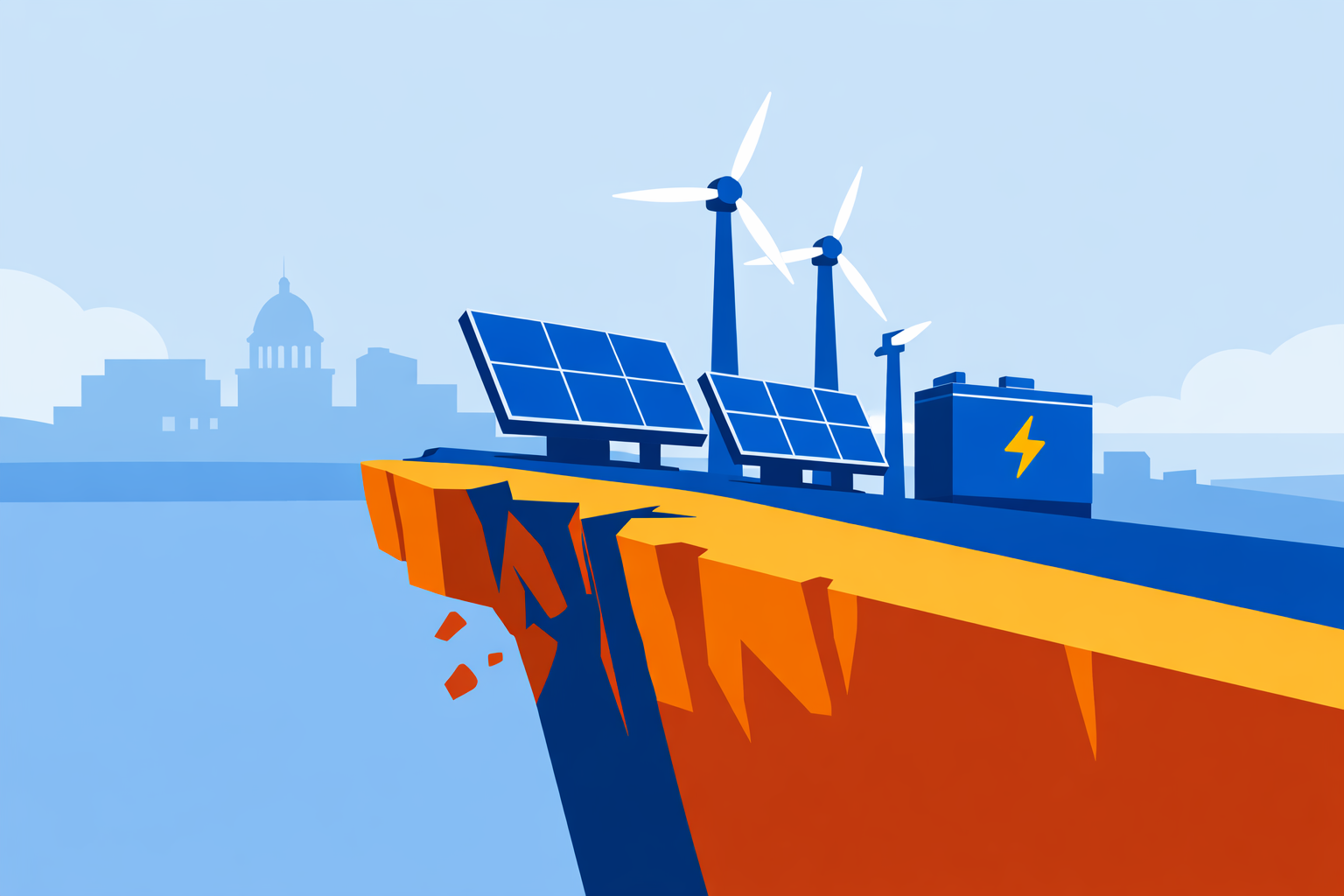
Clean energy developers announced 12 gigawatts (GW) and $18 billion in new U.S. generation investments during Q1 2026, but a simultaneous surge in project cancellations is exposing deep fractures in project finance as the industry confronts an accelerated federal tax credit phaseout. According to Environmental Entrepreneurs (E2), nearly 8 GW of generation capacity and more than $14 billion in planned investments were canceled, closed, or downsized through March 2026 - already more than half of all generation capacity losses recorded in all of 2025. The dual surge in announcements and cancellations reflects a market split between developers racing to lock in credits and those unable to secure viable economics before deadlines close.
Background
The policy pressure stems from the One Big Beautiful Bill Act (OBBBA), signed into law on July 4, 2025, which sharply curtailed the clean energy tax incentives established under the Inflation Reduction Act (IRA) of 2022. Under the IRA, solar and wind developers had access to technology-neutral clean electricity Investment Tax Credits (ITC, Section 48E) and Production Tax Credits (PTC, Section 45Y) with a phaseout schedule beginning in 2032. The OBBBA compressed that timeline significantly. Wind and solar facilities must now either begin construction by July 4, 2026 - within 12 months of enactment - or be placed in service by December 31, 2027, to retain credit eligibility, according to analyses by Latham & Watkins and Mintz. For projects beginning construction after the July 2026 cutoff, the placed-in-service deadline is December 31, 2027, with no extension. The IRS subsequently issued Notice 2025-42, which eliminated the familiar 5% safe harbor for most wind and solar projects, requiring instead that physical work of a significant nature begin before July 5, 2026, according to legal counsel at Mintz.
The treatment of energy storage differs materially. The OBBBA exempts standalone and co-located energy storage from the early placed-in-service deadline, preserving credits under Section 48E through the original phaseout schedule beginning in 2034, according to SEIA and Sidley Austin analyses. This asymmetry is reshaping technology selection and financing strategies across hybrid and co-located project portfolios.
Details
E2's Q1 2026 data show the structural divergence between new activity and cancellations is most acute in solar and hybrid projects. Solar or solar-plus-storage projects represented 37 of the 54 new generation projects announced in Q1 2026, while 25 of the 38 canceled generation projects were solar-related, according to E2's Clean Economy Works report. Texas alone saw 10 new projects announced but also recorded 12 cancellations, including several of the nation's largest solar and storage developments, E2 reported.
The tax credit cliff is triggering a wave of M&A activity. According to Law360, the looming July 2026 construction cutoff is prompting smaller developers who cannot meet the deadline to sell projects to better-capitalized players who can. Deloitte's 2026 Renewable Energy Industry Outlook notes that compressed credit timelines are driving more selective capital deployment, with emphasis on mature assets and financing structures that maximize returns, while developers prioritize long-term power purchase agreements (PPAs) and asset recycling through divestitures to fund accelerated project timelines.
On the supply chain side, projects that begin construction after 2025 are subject to new material assistance restrictions barring the use of components linked to Prohibited Foreign Entities (PFEs), according to Kirkland & Ellis and Chapman and Cutler analyses. This provision compounds cost pressures on developers already navigating tariff exposure on solar and battery inputs.
Manufacturing investment in the clean energy sector continued to slow in Q1 2026, with companies canceling or downsizing roughly $1.4 billion in manufacturing projects while announcing just $750 million in new investments, according to E2 - far below the pace seen between 2022 and 2024. E2 Communications Director Michael Timberlake stated that "developers are clearly rushing to get projects moving before federal tax credits expire, but the sharp rise in cancellations shows how much uncertainty is still hanging over the market."
Interconnection constraints are amplifying financing risk. As of 2026, the U.S. interconnection queue has swelled to a 2,600 GW backlog, with the median wait time for a project to reach commercial operation approaching five years, according to data compiled by Enki AI. In a 2024 Lawrence Berkeley National Laboratory developer survey, respondents ranked interconnection delays and network upgrade costs higher than permitting, supply chain constraints, or workforce shortages as reasons for project cancellations or deferrals, as cited by the Federation of American Scientists.
Outlook
The July 4, 2026 construction commencement deadline represents the pivotal near-term inflection point for the sector. Developers that cannot demonstrate physical work of a significant nature by that date face a hard placed-in-service cliff of December 31, 2027, for solar and wind - a timeline most utility-scale projects cannot meet from a standing start. Battery storage and hybrid projects with co-located storage retain more favorable credit eligibility, a dynamic Deloitte expects will continue accelerating solar-plus-storage deal structures through the remainder of 2026. With only 82 new clean energy projects announced since the start of 2025, compared to more than 720 announced between 2022 and 2024, according to E2, the near-term deployment pipeline remains well below the pace required to sustain state and federal decarbonization commitments.