The enactment of the One Big Beautiful Bill Act (OBBBA) in July 2025 has triggered a compressed surge in U.S. solar and storage project activity. Structural bottlenecks in grid interconnection, permitting, and skilled labor now threaten developers' ability to execute before hard federal deadlines expire.
Background
On July 4, 2025, the One Big Beautiful Bill Act was signed into law, eliminating the residential 25D solar tax credit for systems installed after December 31, 2025.[1] For utility-scale and commercial developers, the stakes differ but remain equally acute: to lock in the full Section 45Y production tax credit or 48E investment tax credit, projects must begin construction by July 4, 2026. Projects that miss this construction-start deadline must be fully placed in service by December 31, 2027, to remain eligible. There is no phase-down or partial credit - projects either qualify at 100% or not at all.
The legislation reversed a decade-long incentive horizon established by the Inflation Reduction Act of 2022. The new law overrides the original phase-out schedule, compressing what was designed as a long-term rollout into a narrow execution window.[2] Standalone battery storage received more favorable treatment: battery storage, nuclear, and geothermal retain full credit value through 2033, stepping down gradually before phasing out in 2036.
The Demand Surge - and Its Consequences
The residential sector responded immediately. According to EnergySage data reported by Electrek, homeowners raced to lock in installations before the year-end deadline after the OBBBA eliminated the 30% federal tax credit for purchased residential solar systems. The rush produced a 205% year-over-year surge in homeowners actively working with installers, along with a record spike in inquiries. Many installers reported reaching annual capacity by October, forcing contractors and customers to make unusual decisions to complete projects on time.
On the utility-scale side, solar represented roughly 75% of the 28 GW of new capacity added to the U.S. grid in the second half of 2025, according to FERC data. Yet executing on a swelling commercial pipeline is proving far harder than signing contracts.
The interconnection queue remains the single largest structural barrier. According to Lawrence Berkeley National Laboratory data, as of the end of 2025, over 2,060 gigawatts of total generation and storage capacity were actively seeking connection to the U.S. grid. Most projects that apply for interconnection are ultimately withdrawn, and those that proceed take increasingly long to complete required studies and reach commercial operation. Projects built in 2023 took nearly five years from interconnection study request to commercial operation, compared to three years in 2015 and fewer than two in 2008, according to Lawrence Berkeley National Laboratory.
Projects that begin construction after July 2026 must be placed in service by December 31, 2027, to qualify. In a market where interconnection queues stretch five years and transformer lead times are similarly extended, the end-of-2027 deadline poses a serious challenge for utility-scale projects seeking eligibility.
Permitting adds further delay. Federal land approvals have slowed under new Department of the Interior directives, while environmental reviews under NEPA can add two to four years to solar or wind projects. Agencies like FERC and DOE face a mismatch between record application volume and limited analytical staff. The financial consequences are already visible: in the first half of 2025 alone, over $22 billion in renewable projects were canceled, erasing 16,500 jobs and stranding billions in tax-equity capital, according to industry data.
Labor Shortfall Compounds Execution Risk
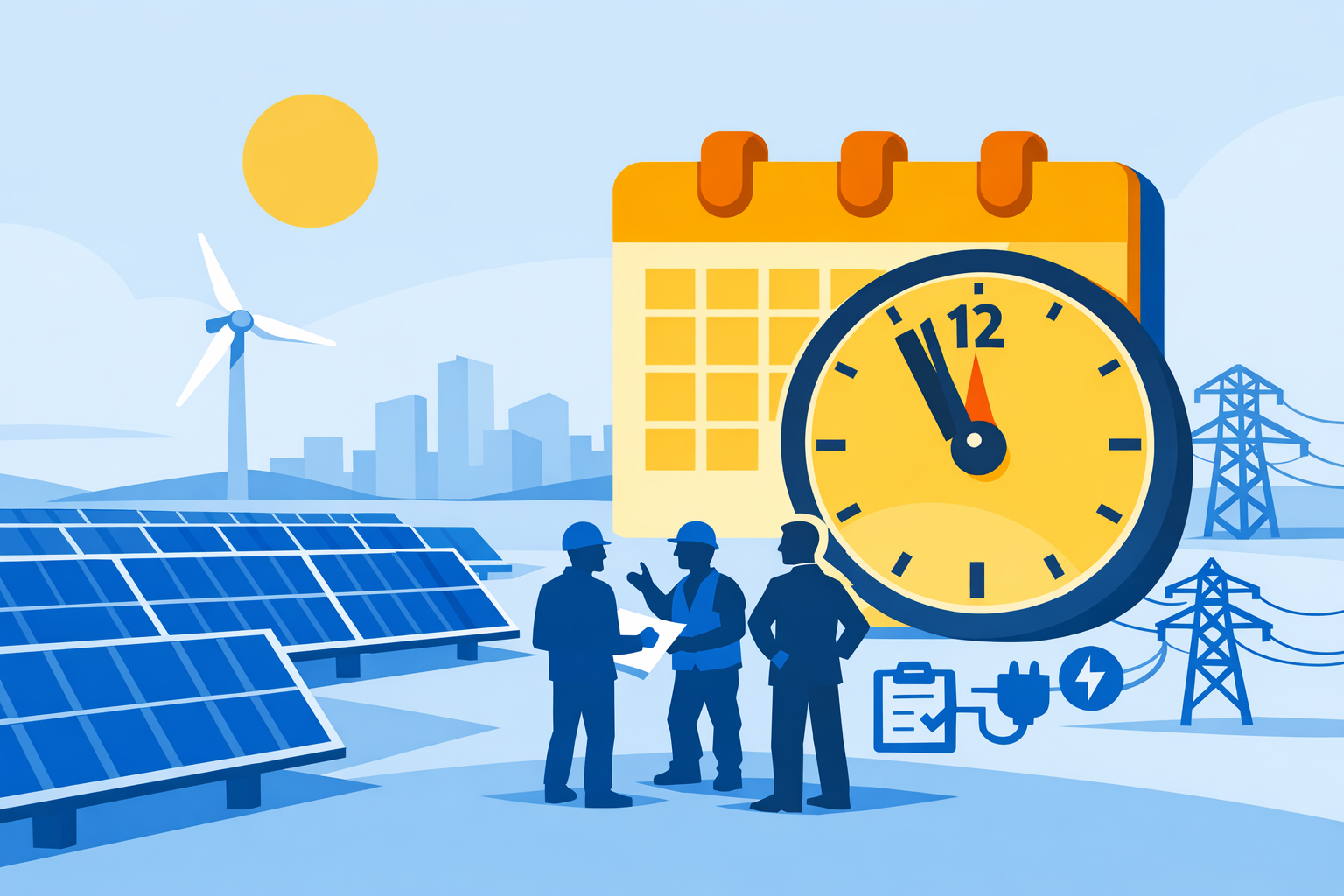
A critical shortage of qualified workers is compounding pressure on developers racing against tax-credit deadlines. According to an analysis drawing on the 2025 U.S. Energy & Employment Report and IREC National Solar Jobs Census, the industry now supports over 280,000 workers, but the supply of qualified personnel is not keeping pace with accelerated project timelines. Projections indicate the industry requires approximately 355,000 workers by late 2026 to support installation targets of 60 GW to 70 GW, leaving a projected near-term gap of 53,000 positions.
Hiring difficulty remains a systemic challenge, with 86% of solar employers reporting some level of difficulty filling open positions. The issue is most acute in the utility-scale sector, where 27% of firms describe hiring for installation and project development roles as very difficult. Structural demographic pressures reinforce the problem: 2.4 energy workers in advanced economies are nearing retirement for every new entrant under 25, according to the IEA.
The OBBBA's own wage and apprenticeship requirements create additional compliance pressure. The 2026 apprenticeship mandate requires that 15% of total labor hours be performed by qualified apprentices to secure the full value of the Section 45Y and 48E tax credits. However, the Interstate Renewable Energy Council Census indicates that only 43% of the U.S. workforce currently has access to the skills training necessary for these roles.
Outlook
Developers and policymakers are pursuing parallel strategies to avert a post-2027 cliff. Virginia's permit digitization platform has cut approval times by 70%, while Colorado and Maine have issued executive orders to fast-track renewable projects ahead of tax credit expirations. At the federal level, experts stress the need for tighter links between long-term transmission planning and project-level interconnection processes - an area where FERC has already issued Order 2023 to improve generator interconnection and Order 1920 to improve transmission planning.
The situation has reached an inflection point as OBBBA-driven clean energy tax credit phase-outs approach 2027, forcing developers, regulators, and commercial actors to move quickly to bring sufficient generation capacity online to meet rising energy demand. Whether streamlined permitting regimes and workforce development programs can scale in time to meet the July 4, 2026, construction-start deadline will determine the near-term trajectory of U.S. solar deployment.