U.S. clean energy developers announced more than 54 utility-scale generation and storage projects in the first quarter of 2026, representing over 12 gigawatts of capacity and $18 billion in planned investment. Companies are racing to lock in federal tax credit eligibility before a hard construction deadline set by last year's One Big Beautiful Bill Act (OBBBA). The surge in announcements-more than double the total generation projects announced throughout all of 2025, according to E2's Clean Economy Works analysis-is running parallel to a sharp acceleration in project cancellations. The combination signals a deepening bifurcation in the U.S. clean energy financing landscape.
Background
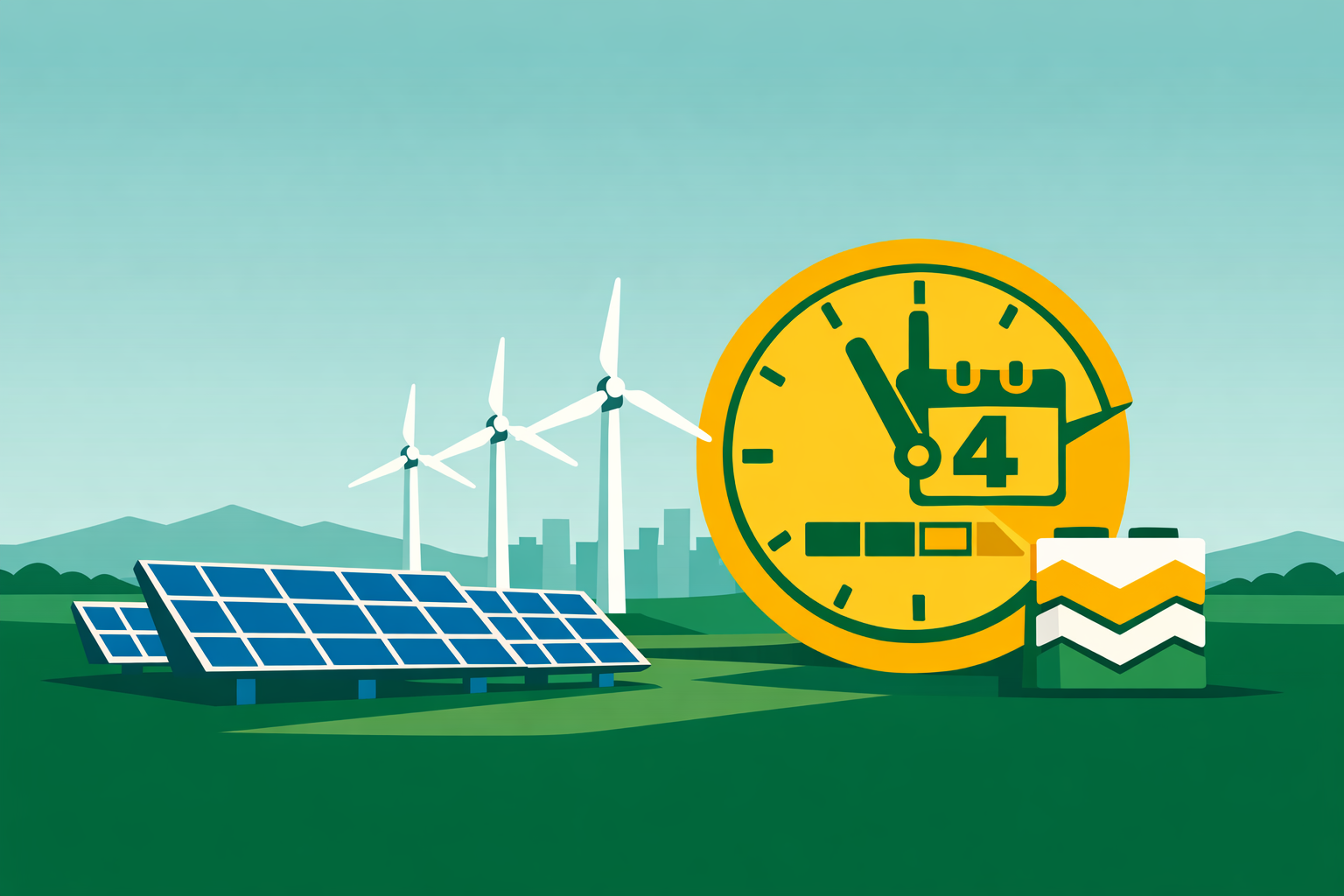
The OBBBA, signed into law in July 2025, restructured the federal tax credit framework that has underpinned renewable energy project finance since the Inflation Reduction Act passed in 2022. For wind and solar projects, the legislation imposed a critical construction-start deadline of July 4, 2026, to qualify for the Section 45Y clean electricity production credit or the Section 48E investment credit. Projects that miss that threshold must be placed in service by December 31, 2027, to remain eligible for any credit value-a timeline most large-scale developments cannot meet if ground has not already been broken.
The law also expanded Foreign Entity of Concern (FEOC) restrictions to six clean energy tax credits, introducing new supply chain compliance requirements that took effect January 1, 2026. Battery energy storage credits remain in a comparatively favorable position, with their phaseout not beginning until 2034-a distinction reshaping which technology stacks attract capital.
The broader investment picture is also dimming. According to the Clean Investment Monitor, total U.S. clean energy and transportation investment in Q1 2026 totaled $61 billion, marking a 9% decline year-over-year-the second consecutive quarter of year-on-year contraction, ending an unbroken growth streak that had held since 2019.
Details
The headline generation figures obscure serious stress at the project level. According to E2's analysis, nearly 8 gigawatts of generation capacity and more than $14 billion in planned investments were canceled, closed, or downsized through March 2026 - already exceeding half of all generation capacity losses recorded across the entirety of 2025. Overall, 45 projects representing $14 billion in investment and an estimated 41,000 jobs were canceled in Q1.
Solar and solar-plus-storage projects dominated both sides of the ledger. According to E2, 37 of the 54 new generation projects announced in Q1 were solar or solar-plus-storage, while 25 of 38 canceled generation projects were also solar-related. Texas remained the most active market, with 10 new projects announced and 12 cancellations in the quarter, including some of the nation's largest abandoned solar and storage developments.
Technology mix is also driving lender differentiation. The Clean Investment Monitor reported that utility-scale solar and storage installations accounted for $18 billion in clean electricity investment in Q1 2026, up 6% versus Q1 2025, while wind investment reached $6 billion - a 56% increase compared to Q1 2025. Energy storage project acquisitions surged more sharply still: according to Mercom Capital Group, energy storage project acquisitions totaled 7.2 GW in Q1 2026, a 227% year-on-year increase from 2.2 GW in Q1 2025, driven by standalone battery and hybrid solar-plus-storage structures.
Clean technology manufacturing, by contrast, continued to deteriorate. The Clean Investment Monitor recorded actual clean tech manufacturing investment at $8 billion in Q1 2026, its lowest level in nearly three years, falling 34% compared to Q1 2025. On an announced-investment basis, E2 tracked just $758 million in new manufacturing commitments for the quarter, while $1.4 billion in manufacturing projects were canceled or downsized-a net outflow at a time when the sector averaged more than 60 new factory announcements per quarter in 2023 and 2024. Four of the seven manufacturing cancellations in Q1 were tied to electric vehicle or battery production.
Outlook
The July 4, 2026, construction-start deadline is the sector's most immediate pressure point. The Clean Investment Monitor noted that whether the Q1 surge in clean electricity announcements represents a durable trend or a deadline-driven pull-forward effect will become clearer in subsequent quarters once that construction window closes. According to the Clean Investment Monitor, cumulative investment in utility-scale solar, wind, storage, nuclear, and other clean technologies grew 29% over the four quarters ending Q1 2026 to reach $105 billion, compared to $82 billion during the prior four-quarter period. However, analysts flagged that revised tax credit deadlines have historically coincided with sharp shifts in investment activity. With FEOC compliance guidance still evolving and interconnection queues remaining congested, lenders and developers face a narrowing window to establish bankable project economics ahead of the credit cliff.