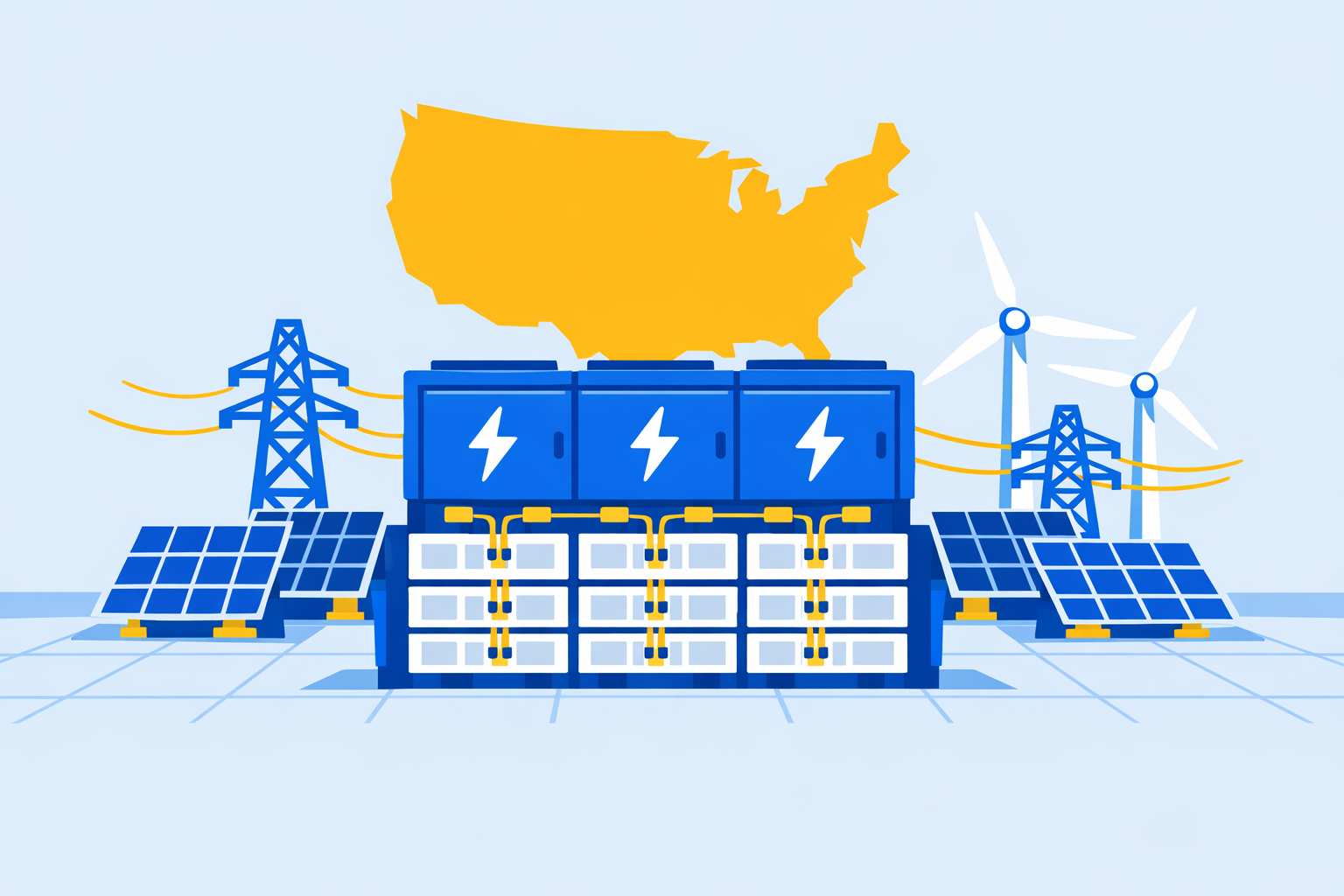
Battery energy storage system (BESS) installations in the United States reached 9.7 GWh in Q1 2026-the largest first quarter in the sector's history-representing a 32% year-over-year increase, according to the Energy Storage Market Outlook Q1 2026 published by the Solar Energy Industries Association (SEIA) and Benchmark Mineral Intelligence.[1] The result extends a streak of record-setting output that began in 2025, when the sector posted its highest-ever annual total, and arrives as market participants assess whether structural constraints can be resolved fast enough to sustain the trajectory.
Background
The U.S. energy storage industry installed a record 57.6 GWh of new capacity in 2025-the largest single year of battery capacity additions-growing 30% from the previous record set in 2024 and representing four times what the industry installed just three years prior. The utility-scale market underpinned that expansion, with just under 50 GWh of capacity installed. California, Texas, and Arizona accounted for 74% of installed capacity.
The Q1 2026 milestone arrives against a shifting federal policy landscape. In July 2025, President Trump signed the One Big Beautiful Bill Act (OBBBA) into law, introducing the most substantial legislative changes to solar, storage, and manufacturing tax credits since the 2022 Inflation Reduction Act. The outlook for 2026 is tempered in part by the OBBBA's passage and new Foreign Entity of Concern (FEOC) requirements.
Details
In Q1 2026, the utility-scale market continued to drive growth, with 7.8 GWh / 1.5 GW installed and six states adding more than 500 MWh of new capacity. The behind-the-meter market fell to 1.91 GWh, largely due to a 35% quarter-over-quarter decline in residential deployments to 515 MWh. The commercial and industrial segment also contracted, adding 648 MWh.[2]
"The U.S. energy storage market has entered a new phase of sustained, high-volume deployments," said Iola Hughes, Head of Research at Benchmark Minerals. "As policy, manufacturing, and market demand align, storage is playing a pivotal role in meeting peak demand, reducing price volatility, and improving overall system resilience. At a time of rising electricity demand, driven in part by the growth of data centers and AI infrastructure, energy storage will be critical to ensuring the grid can scale reliably and efficiently."
Supply chain dynamics are adding complexity to the growth picture. China's dominance in the battery supply chain faces new hurdles; many Chinese firms are expected to restructure ownership stakes to below 25% in 2026 to comply with FEOC requirements. This pivot, combined with new tariffs, is creating a temporary bottleneck for certified battery modules. Storage projects beginning construction in 2026 must source at least 55% of equipment costs from allowable suppliers-a more stringent threshold than the 40% requirement applied to solar and wind projects-with that figure rising to 75% for projects starting construction in 2030 or later.
Interconnection queues present an equally consequential bottleneck. As of the end of 2025, over 2,060 GW of total generation and storage capacity were actively seeking connection to the grid, according to Lawrence Berkeley National Laboratory. Projects that became operational in 2025 spent an average of eight years in the queue waiting to connect, while PJM's capacity auction process operates on a two- to three-year forward-looking basis. Analysis commissioned by GridLab and executed by Aurora Energy Research found that if just 10% of the 107 GW of land-based renewables in the queue before 2024 had been built in time for the 2026-2027 auction, it would have added 1.5 GW of net supply and saved PJM consumers $3.5 billion in costs.
On the manufacturing side, many EV factories are retooling production lines to serve the energy storage market. The United States could reach over 120 GWh of battery cell manufacturing capacity if all planned facilities come online as scheduled.
Outlook
SEIA projects U.S. BESS deployments will rise to 70 GWh / 35 GW in 2026, representing an estimated $25.2 billion in capital investment. The utility-scale market would account for 62.4 GWh and behind-the-meter markets for 7.3 GWh. By 2030, the market is forecast to exceed 110 GWh in annual installations and reach a cumulative 613 GWh. Whether those projections hold will depend heavily on the pace of interconnection reform, FEOC supply chain compliance, and the degree to which domestic manufacturing capacity scales to meet demand.