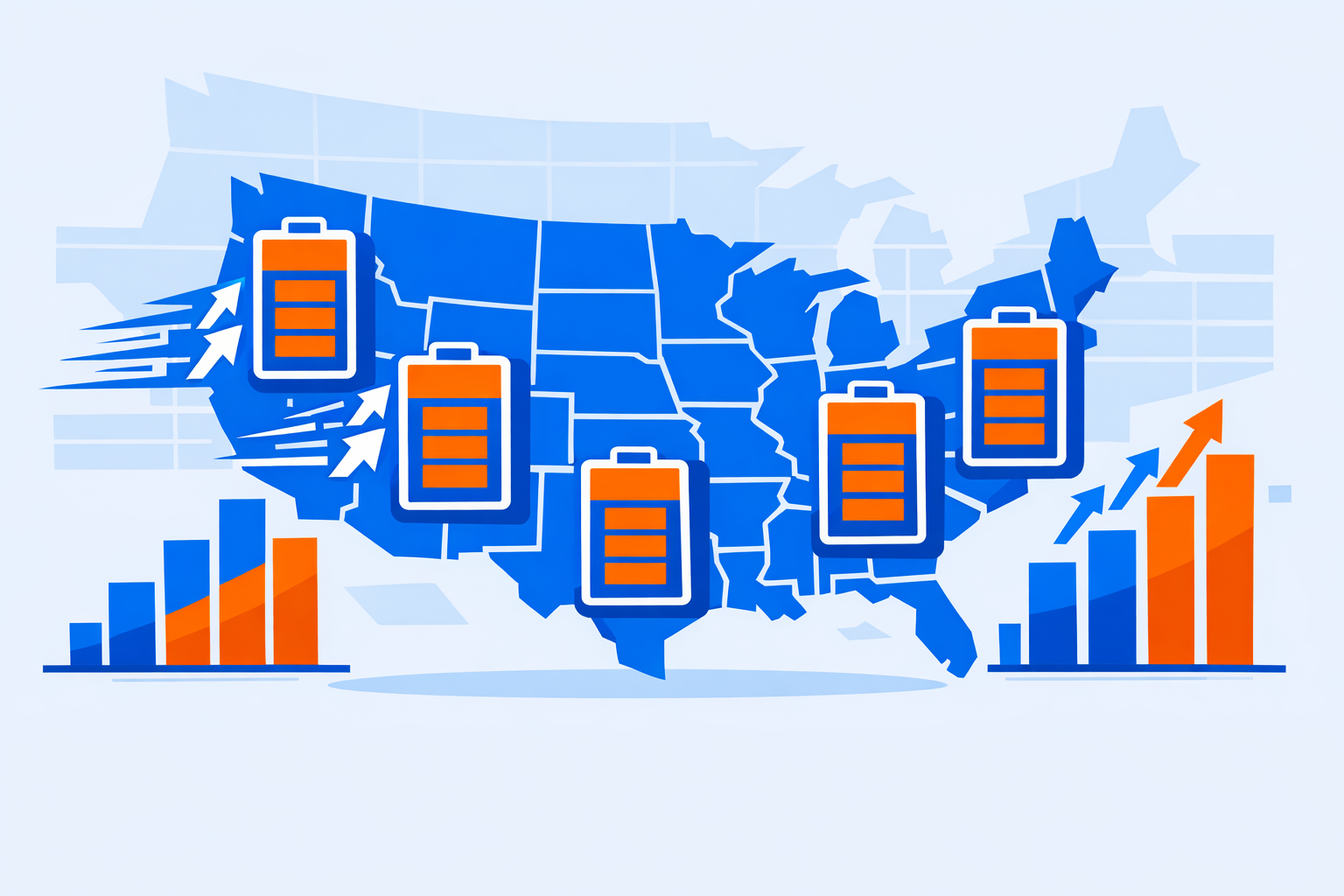
The United States installed 57.6 gigawatt-hours (GWh) of new battery storage capacity in 2025, the largest single-year addition of energy storage on record, according to joint research from the Solar Energy Industries Association (SEIA) and Benchmark Mineral Intelligence. The surge - 30% above the previous record set in 2024 and four times the volume installed just three years earlier - was driven by accelerating utility procurement, expiring tax incentives, and a federal safe-harbor rush. The data also revealed persistent regional concentration that planners and grid operators must navigate.
Background
U.S. battery storage expansion has been structurally linked to federal policy since the Inflation Reduction Act (IRA) of 2022, which made standalone storage eligible for the Investment Tax Credit (ITC) for the first time and introduced domestic content bonus adders. That legislative framework spurred a wave of announced manufacturing capacity and project pipelines. The policy landscape shifted again in mid-2025 with the passage of the One Big Beautiful Bill Act (OBBBA), signed on July 4, 2025. The OBBBA spared energy storage from the accelerated sunsetting applied to wind and solar tax credits, keeping the full ITC rate intact for projects commencing construction through 2033. However, it introduced new "prohibited foreign entity" (PFE) restrictions on ITC and advanced manufacturing tax credit eligibility, creating compliance complexity given China's dominance of the global battery supply chain. According to Morgan Lewis, battery cells currently account for roughly 52% of total storage system costs, making PFE compliance a material financial variable for developers.
Details
The first quarter of 2025 set the tone for the year. The utility-scale segment added 1.5 GW and 4 GWh in Q1 2025, a 57% increase over Q1 2024, according to Wood Mackenzie's U.S. Energy Storage Monitor, making it the strongest opening quarter for storage in U.S. history. Residential storage also reached a Q1 record, with more than 450 MW installed across all residential markets. The full-year utility-scale total reached 16 GW and approximately 50 GWh, while the residential segment closed at 2.7 GW, a 92% year-over-year increase, partly driven by consumers accelerating purchases ahead of the Section 25D residential ITC expiration at year-end. The community, commercial, and industrial (CCI) segment added 95.6 MW in 2025, a 16% increase from 2024.
Geographic data signals both progress and concentration risk. California, Texas, and Arizona accounted for 74% of utility-scale installed capacity in 2025, according to SEIA and Benchmark. Yet Q4 2025 activity spread across 13 different states, according to Wood Mackenzie, and Indiana emerged as a notable breakout market. The state quadrupled its operational storage capacity in Q1 2025 alone, adding 256 MW on the strength of available land and streamlined permitting. Indiana's interconnection queue now holds more than 10 GW of new storage projects - the fifth largest in the country. Noah Roberts, vice president of energy storage at ACP, noted "significant deployment of energy storage resources in emerging markets like Indiana, while states across the Southwest like Nevada and Arizona continue to expand their energy storage portfolio."
Supply-chain dynamics also shaped 2025 deployment patterns. Battery cell manufacturers shifted capacity from electric vehicle production toward stationary storage applications during the year. U.S. domestic lithium-ion battery cell manufacturing for stationary storage rose to over 21 GWh by end-2025, according to SEIA's Solar and Storage Supply Chain Dashboard, while American manufacturing facilities reached 69.4 GWh of battery energy storage system production capacity.
Outlook
Wood Mackenzie forecasts the U.S. will install 500 GWh of new storage capacity between 2026 and 2031, a 250% increase over the 2020-2025 period, with utility-scale additions projected to grow at 16% per year on average. SEIA and Benchmark project U.S. deployments reaching 70 GWh in 2026 and exceeding 110 GWh annually by 2030. The residential segment faces a near-term contraction of approximately 2% in 2026 following the 25D ITC expiration, while CCI is projected to grow 39% between 2025 and 2030 as system costs fall and state-level procurement programs expand. The primary variable shaping that trajectory, according to Allison Weis, global head of energy storage at Wood Mackenzie, is policy stability: "The industry stands at a crossroads, with potential policy changes threatening to disrupt this momentum."