The United States has rapidly expanded domestic grid-scale battery manufacturing, driven by policy incentives and federal support. This growth has key implications for supply chain resilience and deployment capacity through 2026-2027.
Background
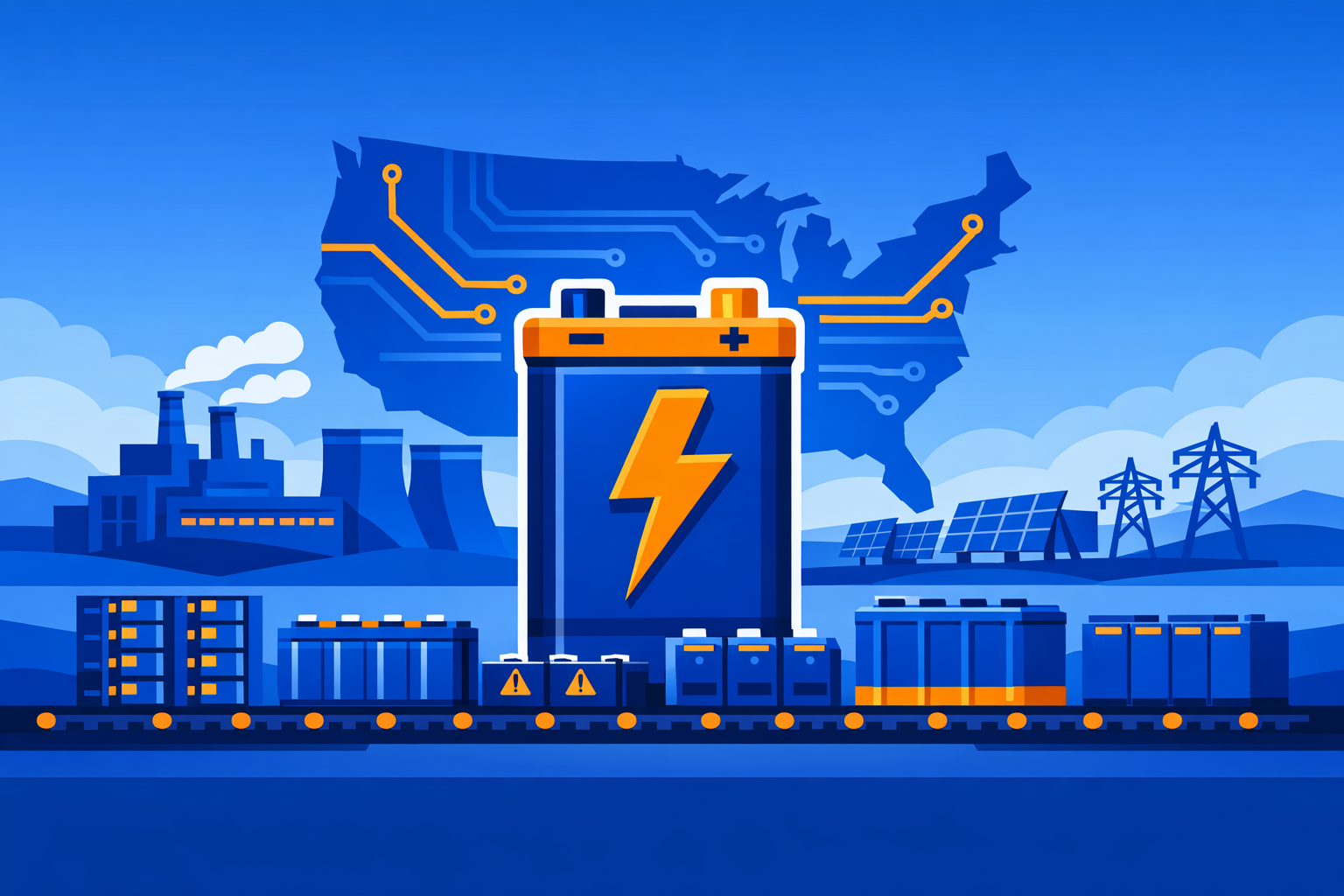
Battery manufacturing is now the most advanced segment of the U.S. clean technology supply chain. The Inflation Reduction Act (IRA) and Section 45X manufacturing tax credits have spurred a surge in investment, with over $115 billion committed to clean energy manufacturing from Q3 2022 to Q1 2025-a substantial rise compared to prior periods. These incentives have boosted activity across critical components, especially battery cells and modules. Domestic capacity for battery cells and modules now exceeds current deployment, with 123 operational battery projects delivering approximately 202 GWh of cell capacity and 208 GWh of module capacity annually. An additional 202 GWh of cell capacity and 114 GWh of module capacity is expected online soon, and 65 facilities under construction are targeting an extra 656 GWh (cells) and 560 GWh (modules) by 2035. According to Rhodium Group, domestic production will match demand by 2035 under a high-emissions scenario-and could keep pace with low-emissions demand if all announced projects proceed. However, upstream materials such as electrode active materials lag in development.
Details
Utility-scale battery storage installations are rising steeply. The U.S. Energy Information Administration (EIA) forecasts nearly 65 GW of utility-scale storage capacity by end-2026, up from about 28 GW at the close of Q1 2025. In early 2025, nearly 19 GW of new storage capacity was under construction, with more than 150 GW of additional planned capacity expected by 2030. In 2024, 12.3 GW (37.1 GWh) was added across all sectors-a year-over-year increase of over 30%.
Federal support further strengthens these trends. The U.S. Department of Energy (DOE) awarded $25 million to 11 projects in December 2024 to advance next-generation battery materials and processes. DOE's Long-Duration Energy Storage (LDES) Liftoff initiative includes support for the KOREPlex zinc-bromine battery facility in Pennsylvania, targeting 8 GWh annually by 2026 and projected to create hundreds of jobs. DOE has also conditionally supported KORE Power's battery cell plant in Arizona, which targets 6 GWh annually.
Major manufacturing investments continue. In Kentucky, a Shelbyville facility will produce industrial-scale batteries for the grid, representing a $712 million investment and 1,572 jobs at full capacity. The GM/Samsung SDI Ultium Cells joint venture is establishing a lithium iron phosphate (LFP) battery plant in Indiana, slated to open in 2026 with over 30 GWh annual capacity and backed by a $2.5 billion DOE loan.
Risks persist, despite progress. Recent cancellations of planned plants in Georgia and Arizona underscore the pipeline's sensitivity to changing demand and policy conditions.
Outlook
U.S. battery manufacturing capacity is poised to meet demand through 2026 and beyond, assuming continued policy support and effective execution. Material supply constraints and workforce development present ongoing bottlenecks. Infrastructure deployment, financing, and regulatory clarity will shape the pace of scale-up across grid, commercial, and residential markets.