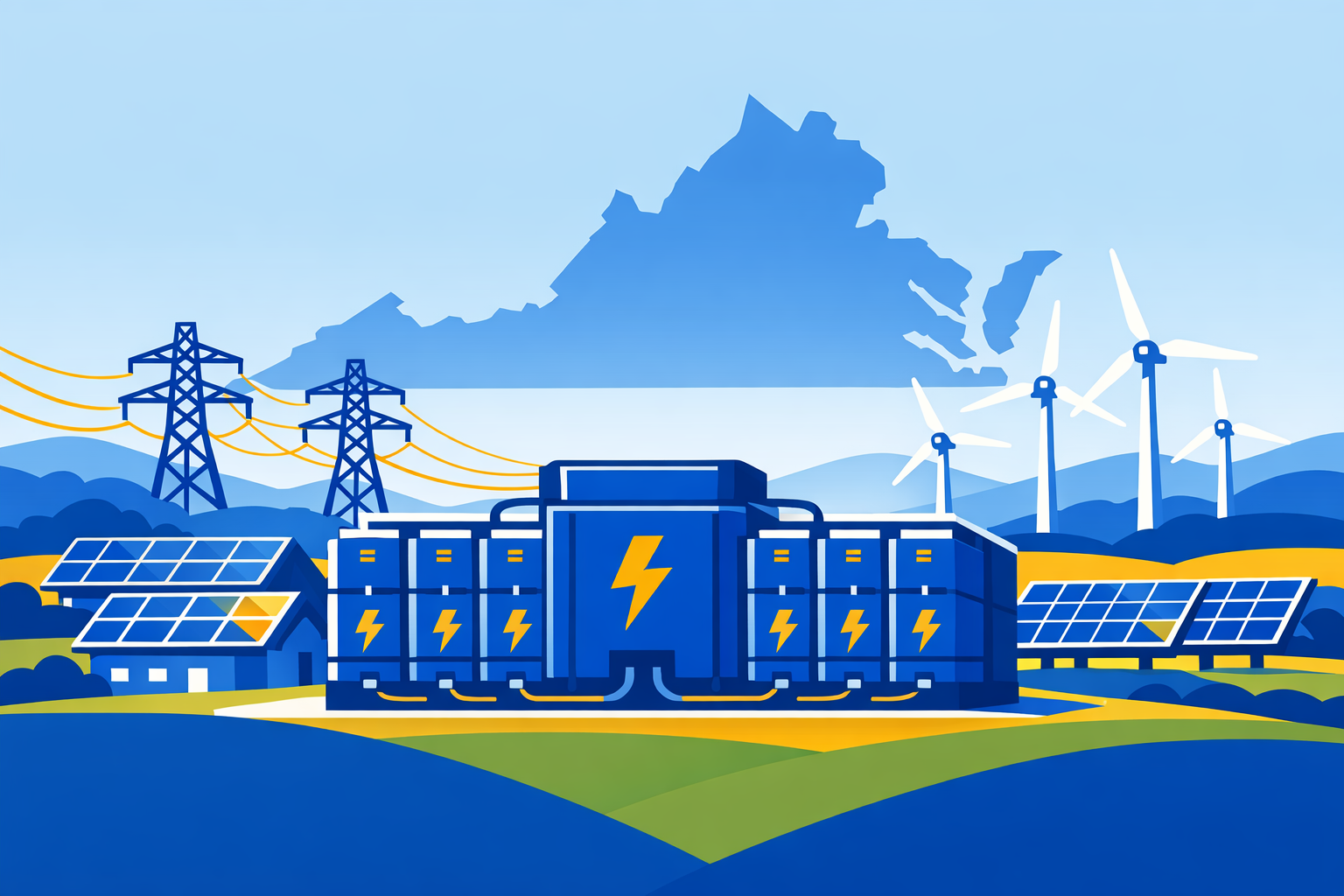
Virginia has enacted the largest state-level energy storage mandate in the United States, setting legally binding targets that require Dominion Energy and Appalachian Power to construct, acquire, or procure more than 20 gigawatts of storage capacity by 2045 - a measure analysts and neighboring states are already tracking as a potential template for regional grid policy.
Background
The legislation, enacted through companion bills HB895 and SB448 during Virginia's 2026 General Assembly session, builds on the 2020 Virginia Clean Economy Act (VCEA), which set more modest storage requirements. The VCEA required Dominion Energy Virginia to petition the State Corporation Commission (SCC) for approval to construct or acquire 2,700 MW of energy storage, and Appalachian Power Company (APCo) to petition for 400 MW. Progress under those original targets proved slow: as of mid-2025, Dominion had petitioned for only 550 MW of the 2,700 MW required under the VCEA.
Rising electricity bills - up 30% since 2021 - motivated the General Assembly to pass a broad slate of legislation during the 2026 session to promote energy affordability. Virginia is home to "data centre alley," described as by far the largest contributor to rapid electricity load growth across the 15 states and the District of Columbia that comprise PJM's service area.
Details
The new legislation raises and extends Virginia's energy storage targets to 16 GW by 2045, sets procurement requirements for Dominion Energy and Appalachian Power, and represents the largest storage target of any state in the country.
The bill also establishes Virginia's first long-duration energy storage (LDES) target at 4.5 GW by 2045, defining "long-duration" as "10 hours or more of generation capacity operating at full nameplate capacity." Half the LDES target must be met by 10- to 24-hour storage capacity, the other half by 24-plus-hour capacity.
The bill commissions a technology demonstration program for LDES resources, directing the SCC to establish the program and evaluate technology viability to validate the targets by 2031.
On costs, the legislation does not eliminate rate risk for consumers. Battery construction costs, like any energy infrastructure, will be passed to customers through riders. Early fiscal analysis flagged significant capital exposure: total capital costs for new battery facilities, including VCEA mandates, could approach $54-$62 billion. Supporters counter that storage competes favorably with alternatives, stressing that battery costs are lower than building fossil fuel plants or small nuclear reactors and that batteries can be deployed far faster.
Through companion legislation, the General Assembly also sought to streamline co-location of battery storage with solar by removing duplicative permitting. On interconnection, Virginia enacted the FAST Act - Facilitating Access to Surplus Transmission - requiring Dominion and Appalachian Power to assess surplus interconnection capacity at existing facilities and establish pilot programs allowing new storage and solar resources to connect using available capacity.
Equity considerations shaped the legislative debate as well. Not-for-profit solar installer GRID Alternatives encouraged the SCC to ensure low- and middle-income customers receive relief, arguing that distributed storage benefits low-income communities more directly than utility-scale projects and calling on the SCC to "affirmatively target disadvantaged communities with incentives for behind-the-meter storage."
The storage expansion bill was embedded in a broader "Affordable Virginia Agenda" championed by Governor Abigail Spanberger. One month into her term, Spanberger reported that the Virginia House of Delegates or Senate had passed every bill in the agenda, with more than half receiving bipartisan support. On the regulatory side, Spanberger signed an executive order creating a Chief Energy Officer - a cabinet-level position focused on addressing rising energy costs and the Commonwealth's long-term energy needs.
The mandate is already generating policy spillover across the PJM footprint. Neighboring states are responding to Virginia's legislation, which greatly increases deployment of energy storage, including long-duration technologies. According to the Solar Energy Industries Association (SEIA), U.S. battery energy storage system deployments are projected to reach 70 GWh in 2026.
Outlook
The SCC now faces a compressed regulatory calendar: it must develop new procurement rules, establish interim deployment milestones, and stand up the LDES demonstration program ahead of the 2031 viability review. Virginia is also overhauling how utilities plan for the future, extending the integrated resource planning period from 15 to 20 years and requiring Appalachian Power to file an IRP under a new framework. Financing structures - including the proposed Virginia Clean Energy Innovation Bank - remain contingent on General Assembly appropriations, leaving project developers and lenders to monitor both state budget negotiations and evolving federal tax credit eligibility rules before committing capital in the 2026-2028 window.