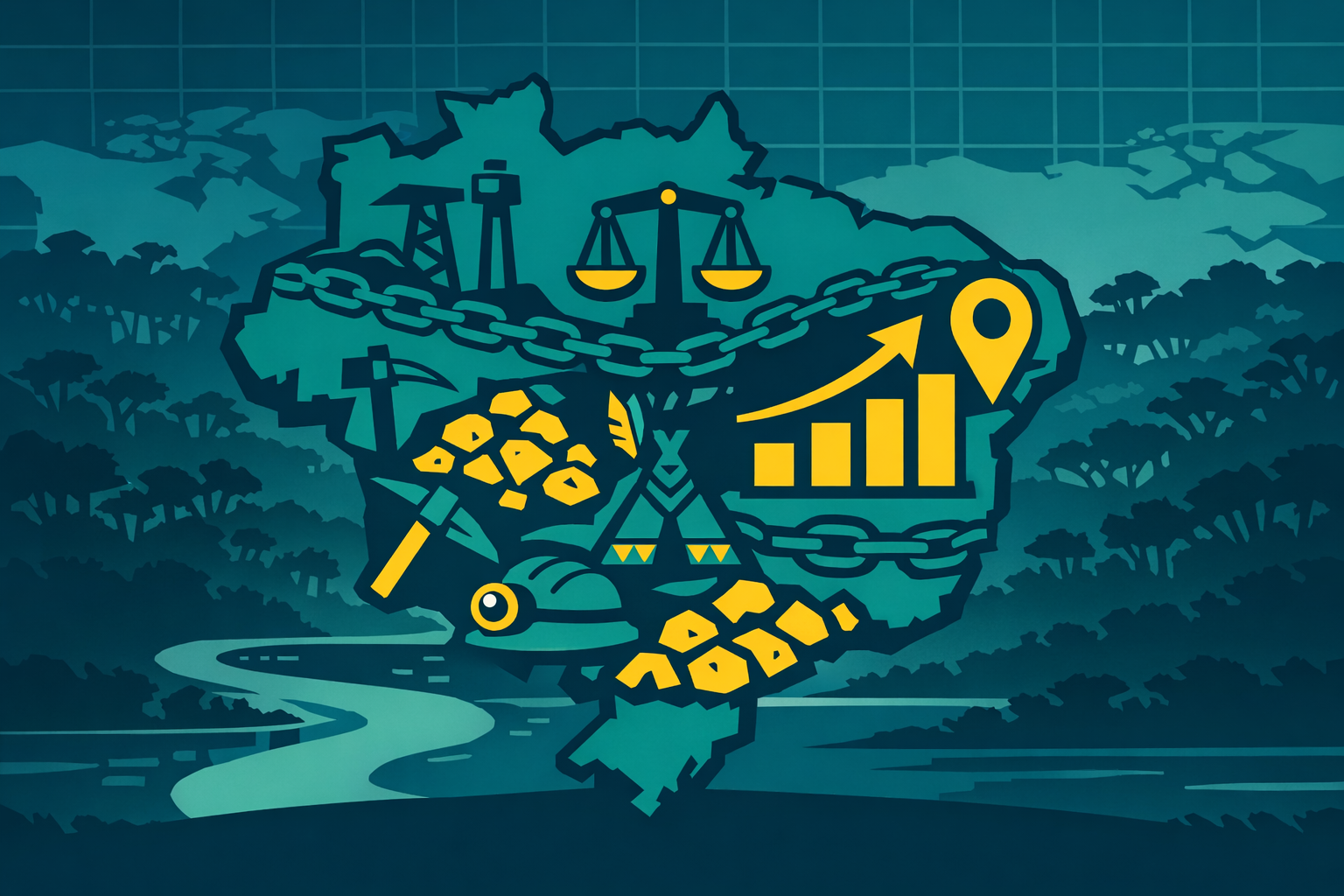
Global battery manufacturers and energy transition investors face a new frontier risk: critical mineral supply chains originating in Brazil's Amazon basin, where vast resource endowments coexist with active deforestation, contested indigenous land rights, and immature traceability infrastructure.
Background
Brazil occupies a strategically significant position in global critical mineral markets. The country holds the second-largest global reserves of nickel (tied with Australia) and graphite, ranks as the third-largest graphite producer, and supplies approximately 14% of the world's lithium, according to the Wilson Center. Studies indicate that 12 Brazilian states show rare earth element potential, placing Brazil second globally in REE reserves behind China.
This endowment has drawn heightened international attention as diversification from China-dominated supply chains becomes a policy imperative. China currently refines 65% of global lithium, 91% of graphite, and 97% of rare earth elements, according to Wilson Center analysis. The IEA's 2025 Global Critical Minerals Outlook confirmed that the average market share of the top three refining nations for key energy minerals rose from 82% in 2020 to 86% in 2024. Against this backdrop, Brazil presents a potential alternative-but access to its mineral wealth carries significant conditions.
Details
The commercial opportunity is substantial and accelerating. Mining companies have filed more than 5,000 mining requests in the Brazilian Amazon, covering 26 million hectares, according to Mongabay. One economic projection cited by CNN Brazil estimates mining expansion could generate gains of up to 243 billion reais ($45 billion) to Brazil's GDP by 2050. Demand fundamentals reinforce this interest: according to the IEA, demand for nickel, cobalt, graphite and rare earth elements increased by 6-8% in 2024, driven primarily by electric vehicles and battery storage.
The governance environment, however, remains deeply contested. In the Brazilian Congress, controversial bills including PL 1331/2022 and PL 6050/2023, which aim to legalize mining and other large-scale economic activities within indigenous lands, are currently under discussion, according to Mongabay. Critics contend the so-called "Devastation Bill"-passed in 2025-allows medium-impact projects, including most mining, to self-approve licenses online with no prior impact studies or regulatory oversight, as reported by the Rainforest Foundation US. In May 2025, forest loss in the Amazon jumped 92% compared with the same month in 2024, contributing to a 27% increase in 2025, according to data from Brazil's Environment and Climate Change Ministry.
The judicial branch has pushed back. A Brazilian federal court canceled the mining contract for the Belo Sun project, which would have established a large open-pit mine along the Xingu River, citing violations of indigenous rights and environmental protections, according to Amazon Watch. Meanwhile, by 2022, illegal mining accounted for 66.2% of Brazil's total mined area, disproportionately affecting indigenous lands, per MapBiomas data cited in Wiley Online Library research.
For buyers and downstream manufacturers, these conditions create concrete compliance exposure. The EU's deforestation regulation (EUDR)-now set for large operators on 30 December 2025, and for SMEs on 30 June 2026-requires supply chain due diligence and geolocation data down to plot-of-land level, according to the European Commission. Although the EUDR currently covers agricultural commodities rather than battery metals directly, no major ESG guidelines or regulations have been introduced in Brazil specifically for the mineral sector, according to Chambers and Partners' Mining 2025 guide, leaving critical mineral buyers reliant on voluntary frameworks.
Industry-led traceability tools are filling part of the gap. The Nickel Mark, launched in November 2022, covers a wider range of ESG risks and responds to increasing assurance requirements of regulatory and value chain initiatives, according to the Nickel Institute. Brazil's National Mining Agency separately launched the Brazilian Forum for Responsible Gold in September 2025, focusing on digital traceability technologies, eliminating mercury use, and dismantling criminal networks in the informal mining sector, according to the World Gold Council. The Brazilian Federal Police have developed a national database cataloguing gold samples from different regions to support traceability back to source concessions.
Columbia University's Center on Global Energy Policy noted that Brazil is building an ESG taxonomy for the mining and mineral processing sector to guide investment criteria and indicators on how activities relate to sustainable practices, though geological mapping currently covers only about 27% of the country.
Outlook
The convergence of rising demand, supply concentration risks, and tightening global due diligence frameworks will intensify scrutiny of Brazilian Amazon mineral projects over the next 12 to 24 months. Insurers, development finance institutions, and institutional investors are likely to demand demonstrable traceability and free, prior and informed consent (FPIC) documentation from project developers seeking to bring Amazonian deposits to market. The resolution of Brazil's competing legislative pressures-executive-led protection measures versus Congress-driven liberalization-will determine whether the region can credibly serve global battery supply chains facing mounting regulatory expectations in the EU and the US.