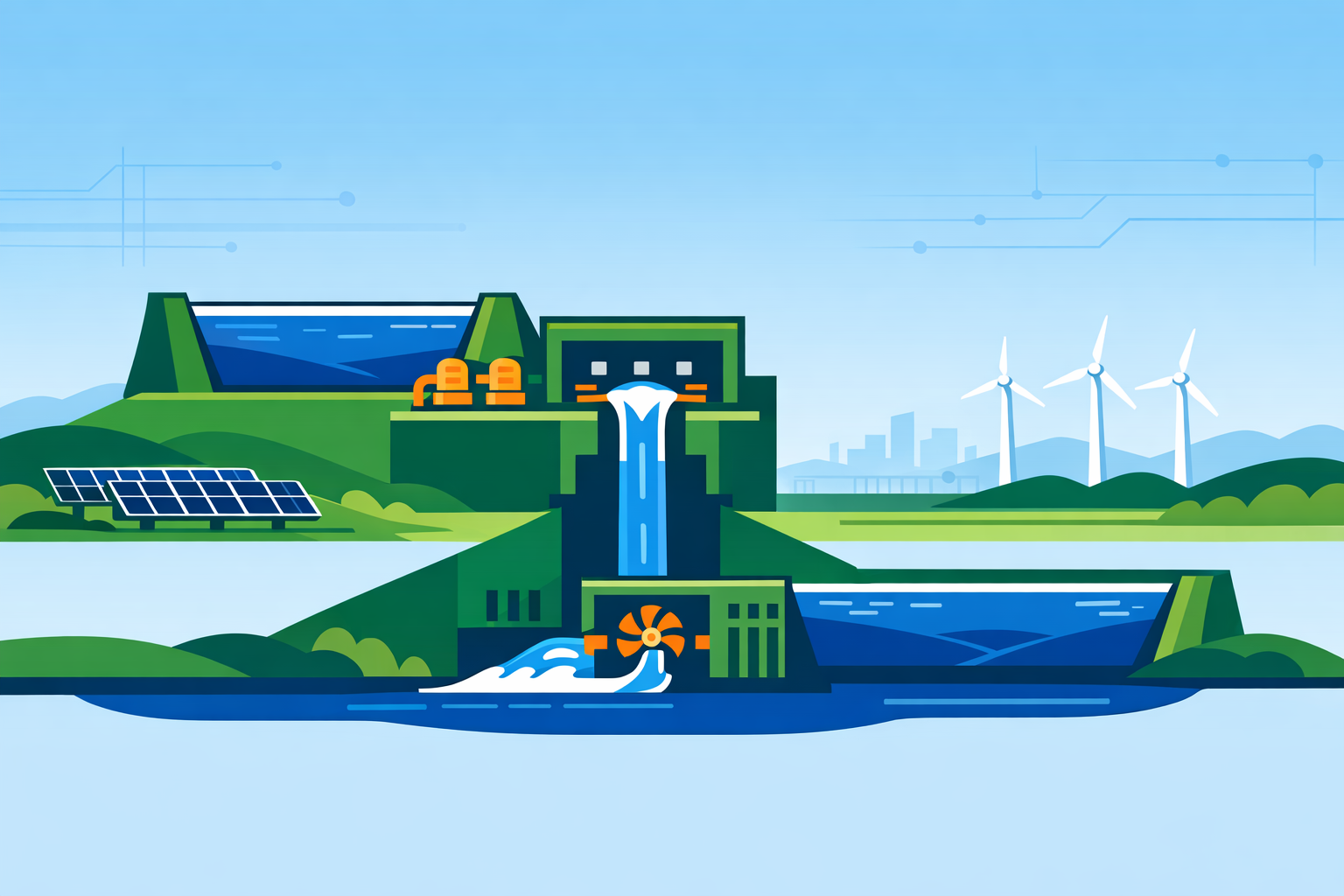
China has accelerated large-scale pumped storage hydropower development, altering global energy storage dynamics. By the end of 2024, cumulative pumped hydro capacity surpassed 58 GW, with nearly 200 GW under construction, according to the China Renewable Energy Development Report 2024 from the China Renewable Energy Engineering Institute. In 2024 alone, authorities approved 23 new pumped storage projects, reinforcing the country's lead in this sector. China aims for its pumped storage capacity to reach over 120 GW by 2030, as detailed in the National Energy Administration's medium- and long-term plan.
Background
China's rapid installation of pumped hydro energy storage-systems that use surplus power to transfer water between reservoirs-plays a central role in integrating variable renewable sources, including wind and solar, into the national grid. Closed-loop systems, which cycle water within a contained circuit, are recognized by the U.S. National Renewable Energy Laboratory as having the lowest life-cycle greenhouse gas emissions among storage technologies. Independent estimates indicate China will contribute 81% of all new global pumped storage installations over the next 30 years.
Details
China's energy storage landscape is shifting. By mid-2025, new energy storage capacity-primarily lithium-ion batteries-reached over 100 GW, outpacing pumped hydro additions, according to the China Energy Storage Alliance. Battery energy storage installations rose sharply: in July, China accounted for 75.5% of global grid-scale battery deployments, amounting to nearly 4.8 GW of power and more than 14 GWh of capacity. Pumped storage, however, remains the lowest-cost option for long-duration applications and continues to offer advantages in both duration and scale. China's electrolyzer manufacturing sector is also advancing. Orders surged to 3.75 GW in the first half of 2025, driven by state-owned enterprises, leading to significant expansions in alkaline electrolyzer capacity and performance.
From a supply chain perspective, China's influence over pumped storage infrastructure and component production now extends internationally. Countries such as Indonesia, Kazakhstan, and the Philippines have signaled interest in collaborating on pumped storage projects. Concurrently, China's electrolyzer sector faces overcapacity and increasing export barriers, as the U.S. and EU implement more stringent carbon and content rules.
Outlook
China's scale in pumped storage and established supply chains could intensify global energy storage competition, prompting policymakers in the U.S., EU, and other markets to further diversify their storage options. As battery and hydrogen technologies evolve, conventional pumped hydro may remain a key asset in grid stability and decarbonization initiatives.