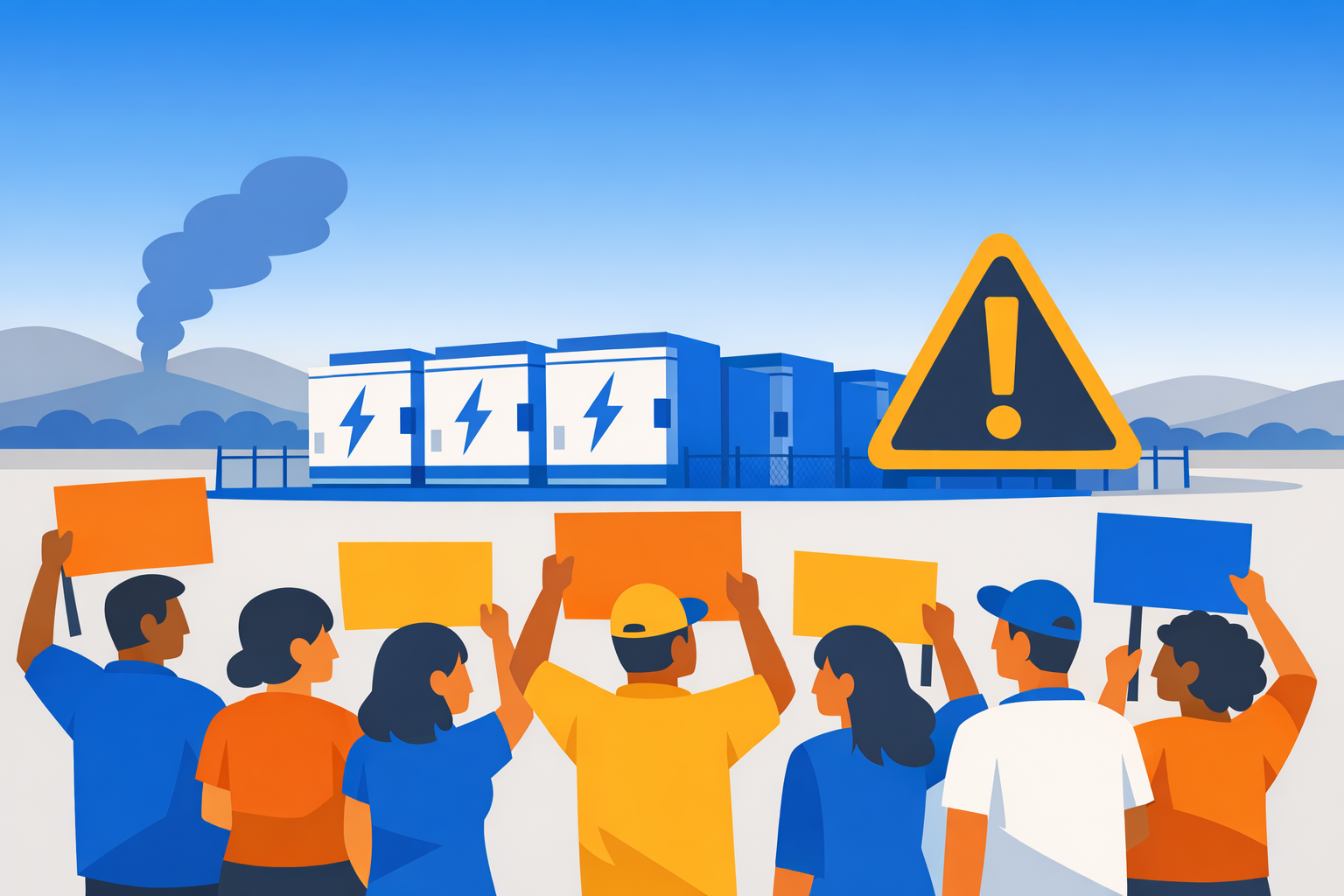
A wave of local moratoriums, public hearings, and outright project cancellations is testing the pace of utility-scale battery energy storage deployment across the United States. Community groups cite fire risk, noise, and perceived regulatory gaps. The resistance has intensified since a high-profile fire at one of the country's largest battery facilities in January 2025 and now spans states from California and New York to Massachusetts and Kansas.
Background
Battery energy storage systems (BESS)-which store electricity from the grid during periods of low demand and discharge it at peak times-have seen rapid deployment in the U.S. The energy storage industry installed a record 57.6 GWh of capacity in 2025, according to the Solar Energy Industries Association. States including New York and Massachusetts have set ambitious mandates: New York's Climate Act requires 6,000 MW of battery storage by 2030, while Massachusetts officials announced contract negotiations with four companies to procure nearly 1,300 MW of battery storage in December 2025.
That buildout, however, collided with a galvanizing incident. On January 16, 2025, a fire broke out at Vistra's Moss Landing Energy Storage Facility in Monterey County, California-one of the world's largest BESS installations-forcing a 24-hour evacuation of approximately 1,200 residents and sending plumes of toxic smoke into the atmosphere. The fire burned through nearly the entire battery inventory at the 300 MW facility. Community organizers reported that hundreds of nearby residents experienced symptoms including headaches, rashes, and a metallic taste in the mouth.
Details
The Moss Landing incident accelerated opposition already building nationwide. According to tracking by Heatmap News, at least 96 battery projects with a cumulative capacity of 25,000 MW have faced public pushback in the U.S. since 2021. At least a few dozen localities have moved to temporarily block development of large battery systems in recent years, with the number of moratoriums rising sharply from 2023 onward, according to the Pacific Northwest National Laboratory.
Opposition clusters around several themes. Resistance to battery storage systems typically centers on the risk of thermal runaway-a chain reaction of uncontrolled heating that can lead to fire or explosion-as well as noise pollution, land use conflicts, and proximity to schools and homes. In California's Orange County, the cities of San Juan Capistrano and Laguna Niguel both formally opposed a proposed 250 MW BESS facility, citing the site's location approximately 1,500 feet from homes in a high fire severity zone. San Juan Capistrano enacted a temporary prohibition on new commercial energy storage systems, extended through April 1, 2026, while undertaking a review of siting standards. The developer, ENGIE North America's Compass Energy Storage, suspended its California Energy Commission application in December 2025 to evaluate alternative sites.
Community backlash has also produced collateral consequences. In November 2025, the South Orange County Community College District board voted to terminate a $750,000 grant agreement with Compass Energy Storage after residents objected to the district accepting funds linked to the controversial project. The developer subsequently threatened litigation.
In New York, opposition emerged across multiple boroughs and suburban communities. Approximately 91 MW of battery storage is operational across 80 projects in New York City's five boroughs, according to state data through August 2025. New York State Energy Research and Development Authority President Doreen Harris maintained that the state has adequate safety rules and that expanded battery deployment will "strengthen and modernize our grid," according to published reports. The FDNY cited its modular enclosure requirements and automatic cell shut-off systems as evidence that facilities approved in New York operate to a higher standard than the indoor configuration at Moss Landing.
Regulators have responded to the pressure. In late January 2025, the California Public Utilities Commission unveiled a proposal to implement Senate Bill 1383, establishing new standards for the maintenance and operation of BESS facilities and expanding requirements for emergency response plans. The EPA issued its first comprehensive federal safety guidance for BESS in August 2025, covering siting, installation, operation, and emergency response, and stressing early coordination with first responders.
Industry experts argue that communication failures compound the problem as much as safety deficiencies. Michelle Nicholson, Project Scientist at Solas Energy, identified "misinformation and misunderstanding" as among the biggest challenges facing BESS deployment in a 2025 industry webinar. Environmental assessments from real-world BESS fire incidents, compiled in a report by The Fire & Risk Alliance for the American Clean Power Association, found that toxic gas emissions dissipate quickly and that firefighting runoff does not result in hazardous contamination under standard stormwater management practices. The EPA similarly concluded that air quality monitoring following the Moss Landing fire found no risks to public health beyond the immediate fire scene.
Outlook
With developers adding 4,908 MW of battery storage capacity in the second quarter of 2025 alone, according to the American Clean Power Association, the deployment pipeline remains substantial despite opposition. Whether community resistance reaches a scale sufficient to slow aggregate build rates remains an open question. The American Public Power Association noted in late 2025 that opposition has not yet reached a tipping point capable of materially disrupting overall growth. Developers and regulators are increasingly converging on proactive community engagement, standardized setback requirements, and early first-responder coordination as the primary tools for keeping projects on track-an approach that, if adopted consistently, could redefine standard practice across the utility-scale storage sector. The existing post Adirondack Moratoriums on Battery Storage Spur Call for Guidelines examines how this tension is playing out in New York's sensitive upstate communities.