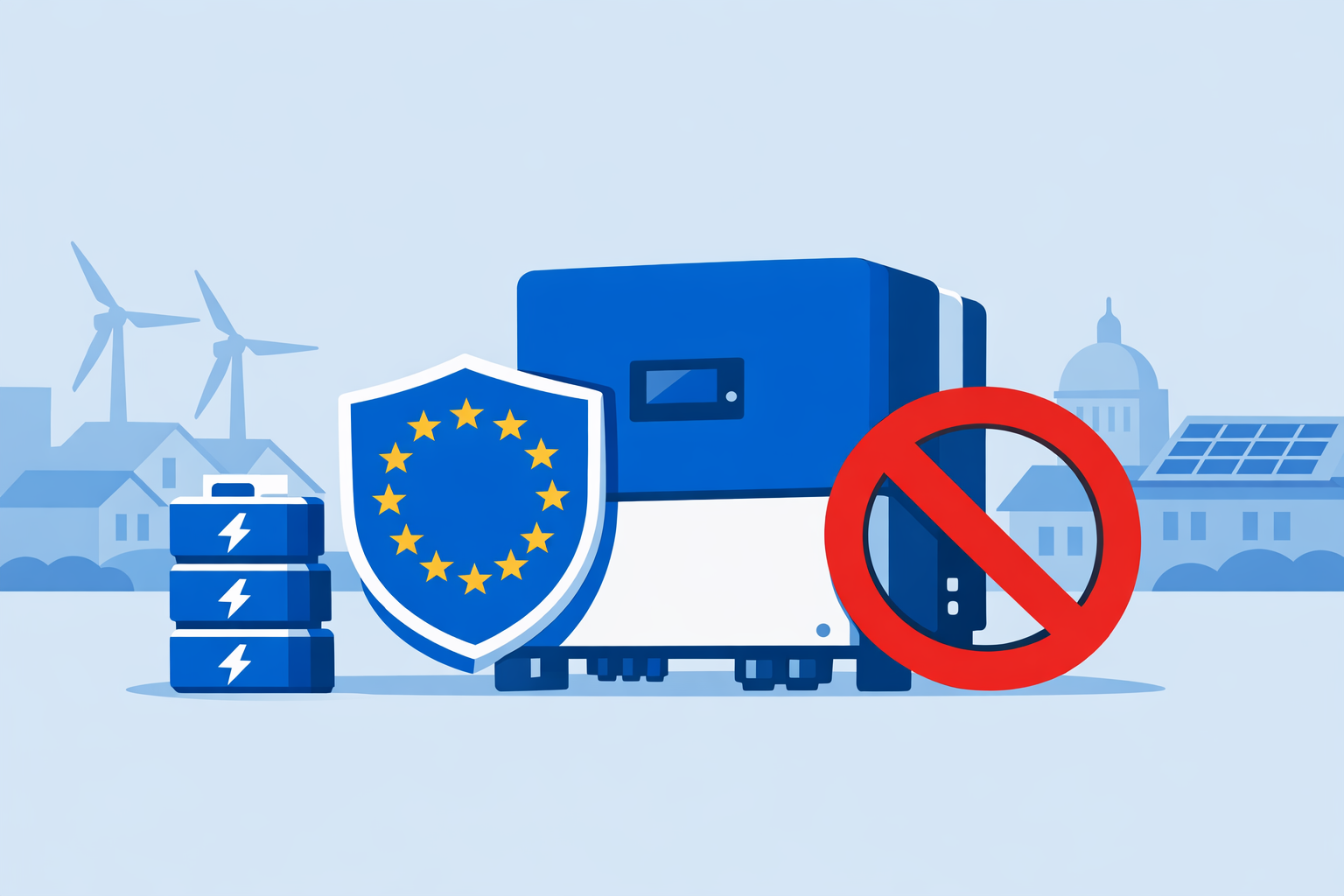
The European Commission has formally extended its funding ban on inverters from high-risk countries to cover battery energy storage system (BESS) power conversion systems (PCS). The move, communicated to financial institutions on May 1, 2026, forces an immediate reassessment of procurement strategies across Europe's rapidly expanding storage sector.
The Commission restricted EU funding - including through the European Investment Bank (EIB) and European Investment Fund - for solar, wind, and energy storage projects using inverters from China, Russia, Iran, and North Korea, citing cybersecurity risks. While prior media reporting focused on photovoltaic solar, Commission documents confirm that "Energy storage systems / Power Conversion Systems (PCS) are explicitly included," placing EU-backed battery storage projects on notice - particularly those relying on integrated PCS supply from Chinese and other manufacturers.
Background
The decision follows a policy first outlined in December 2025, when the EU executive signaled it would leverage funding rules to reduce dependencies on suppliers deemed a security risk. In November 2025, 30 MEPs with energy-sector expertise urged the Commission to prevent "risky" technology providers from accessing European infrastructure. The escalation tracks a broader EU pattern, following earlier efforts to reduce reliance on Chinese vendors in telecoms networks, where the bloc flagged Huawei and ZTE as security risks.
The market dependency underpinning the ban is substantial. Around 70% of solar inverters installed across the EU come from Chinese manufacturers, and Huawei alone accounted for approximately 29% of global solar inverter capacity in 2024, according to Wood Mackenzie. Many batteries supplied from Asian sources include all-in-one packages bundling cells with the PCS, meaning the BESS inclusion carries wider supply-chain implications than the earlier solar-focused guidance.
Rather than introducing new legislation, the Commission will enforce restrictions through existing tools, including project-level policy checks and provisions under the EU's financial regulation that allow security-based conditions on funding.
Details
The announcement is explicitly framed as an economic security measure rather than industrial policy, meaning companies from trusted partners such as Japan and South Korea remain eligible for EU-funded projects, according to an EU official. Speaking on condition of anonymity, the official told reporters: "We have identified serious economic and cybersecurity risks," noting the Commission's assessment drew on both classified and non-classified evidence provided by multiple member states.
The regulation carries no power-class exemptions. Christoph Podewils, Secretary General of the European Solar Manufacturing Council (ESMC), confirmed the decision has no exemptions based on power class, describing it as "a strict regulation, without many loopholes." He noted it also covers inverters supplied by entities under the control of designated high-risk countries.
The new guidance applies broadly across all EU funding instruments - both direct and indirect - including financing from the European Investment Bank and the European Bank for Reconstruction and Development. The ban extends to products from companies owned or controlled by entities or persons from those countries, as well as to projects in EU neighboring regions such as North Africa and the Western Balkans connected to the European electricity grid.
On supply-side capacity, the ESMC argues the transition is manageable. A February 2026 manufacturing survey of leading Western inverter producers found EU production capacity exceeds 100 GW per year, against a European solar market of around 65 GW in 2025, with a further 45 GW of expansion planned at existing European facilities by 2027. On cost impact, a Wood Mackenzie analysis found residential and small commercial PV projects using Western inverters require an additional investment of just 1.7% to 4.3% of total project costs, depending on project size and location.
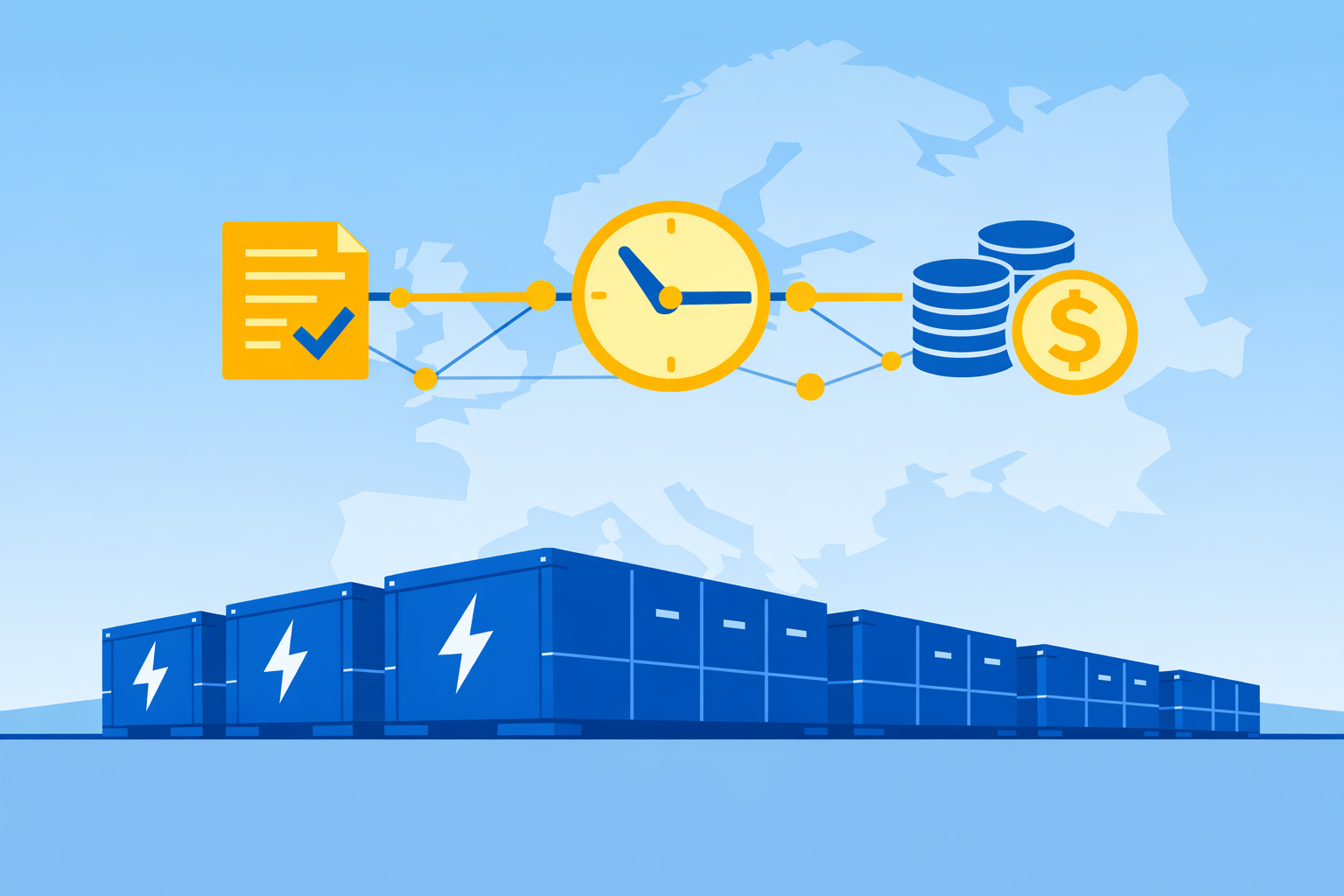
The transition timeline is structured around firm deadlines. Financial institutions were required to notify the Commission of all pipeline projects by May 1, 2026. A grandfathering clause covering the most advanced pipeline projects takes effect September 1, 2026, but only projects sufficiently mature to gain approval by November 1, 2026, qualify; projects at an early enough stage to switch inverter suppliers are not eligible for exemption. For projects outside the EU connected to the European grid, high-risk inverters and PCS must be phased out by April 15, 2027.
Outlook
By July 1, 2026, all Commission services must review ongoing activities and propose how to integrate the new restrictions, followed by a further assessment due July 15 to evaluate whether alternative suppliers can meet demand and ensure sufficient production capacity. A stricter phase-in follows from April 2027, when new contracts and agreements will fully incorporate the restrictions, though limited derogations may be granted on political or security grounds, according to an EU official. The Commission also expects the initiative to have a broader ripple effect, encouraging EU member states and international partners to adopt similar approaches.