An automotive manufacturer has become a grid storage supplier at gigawatt-hour scale. On May 18, 2026, Ford Energy - the wholly owned battery energy storage subsidiary of Ford Motor Company - and EDF Power Solutions North America announced a five-year framework agreement[1] under which EDF will procure up to 20 GWh of DC Block battery energy storage systems. The announcement arrived alongside Ford's renewed European growth push, and together the two developments carry implications that extend well beyond a single supply contract.
For grid operators, project developers, and fleet electrification managers in European markets, the convergence of events demands close attention.
The Deal at a Glance
Ford Energy and EDF Power Solutions North America have signed a five-year framework agreement enabling EDF to procure up to 4 GWh of Ford Energy DC Block BESS per year, for a total potential volume of up to 20 GWh over the term. Deliveries under the agreement are expected to begin in 2028[1].
The agreement targets North American grid-scale projects, positioning Ford Energy as a key BESS supplier for EDF's growing U.S. portfolio covering renewable integration and grid resilience. But its strategic logic - an automotive OEM converting underutilized EV manufacturing capacity into utility-grade energy storage supply - maps directly onto pressures building in European markets.
Ford Energy plans to invest approximately $2 billion over the next two years to scale the business, targeting annual deployments of at least 20 GWh, with first customer deliveries expected in late 2027. The manufacturing base is Ford's Glendale, Kentucky facility[2], repurposed from EV battery production following the collapse of the $11.4 billion BlueOval SK joint venture - a direct consequence of EV demand falling materially short of earlier projections.
The DC Block: Engineered for Utility-Scale Demands
Ford Energy's flagship product, the DC Block, is engineered to meet the performance and durability thresholds required by transmission-connected grid operators and large-scale developers.
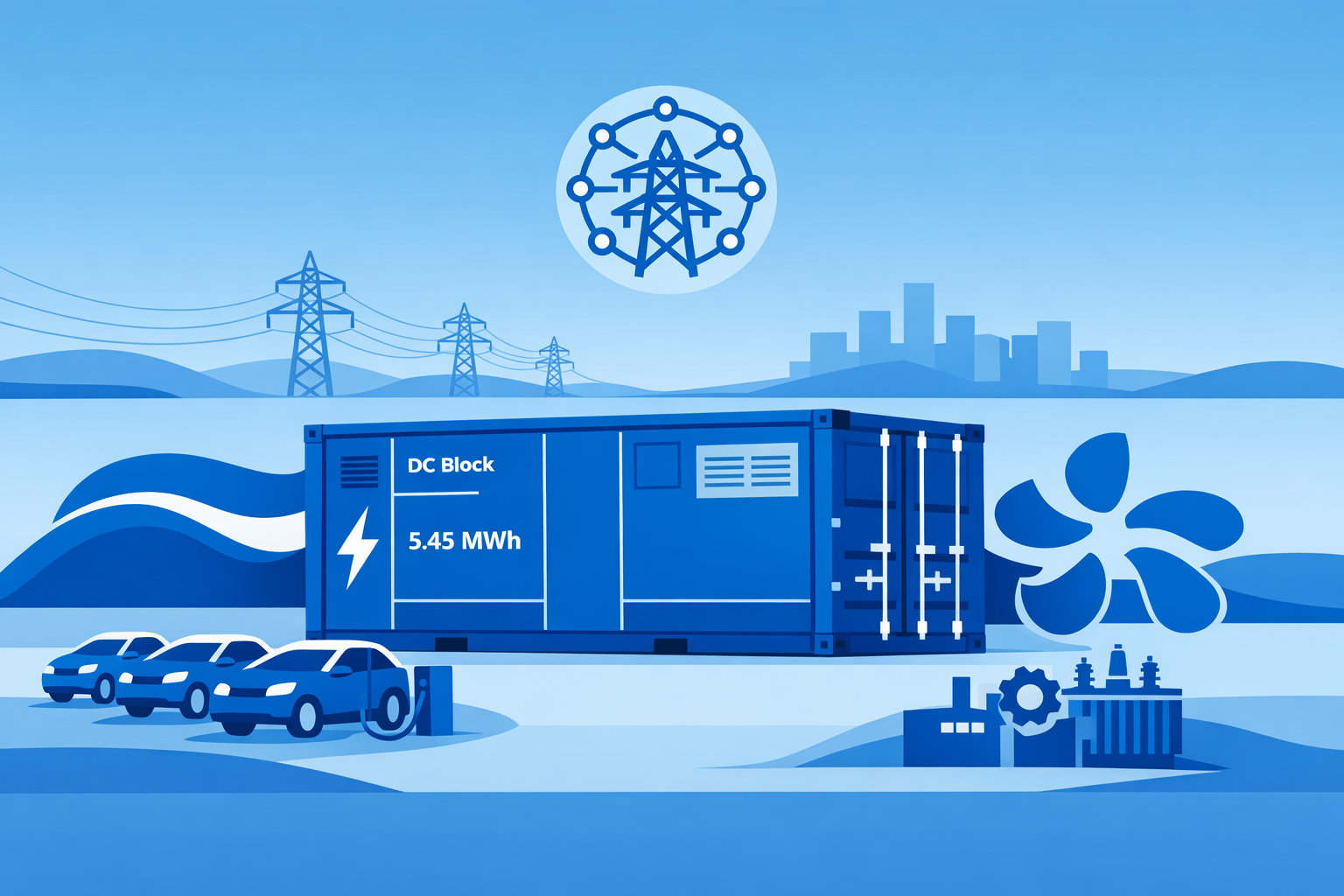
The Ford Energy DC Block is a standardized, 20-foot containerized energy storage system with a rated capacity of 5.45 MWh per unit, utilizing 512 Ah lithium iron phosphate (LFP) prismatic cells and available in 2-hour (FE-250) and 4-hour (FE-450) discharge configurations. The system operates across a 1,040-1,500 VDC voltage range with integrated liquid-cooled thermal management[1] and is rated for a 20-year operational life.
The environmental hardening is notable for European project contexts: an operating temperature range of -35°C to +55°C, IP55 ingress protection, C5 corrosion resistance, and full performance at altitudes up to 4,000 meters without derating. These parameters make the system technically compatible with a wide range of European deployment environments, from UK coastal substations to Alpine co-located renewable sites.
The DC Block supports utility-scale applications including frequency regulation, voltage support, energy arbitrage, peak load shifting, demand response, backup power, and microgrid integration[1] - a service stack that aligns directly with ancillary service frameworks under development across European transmission system operators.
Why EDF Is the Right Counterparty - and What It Reveals About European Strategy
EDF's role in this agreement is not that of a passive purchaser. The EDF Group has assembled one of Europe's most sophisticated grid-scale BESS portfolios, and the procurement strategy behind this deal reflects that operational maturity.
EDF Power Solutions won a decentralized Grid Booster project from German TSO Amprion in December 2025, comprising 250 MW of battery storage spread across five sites designed to alleviate grid imbalances and north-to-south transmission congestion. In the UK, EDF signed a 10-year optimization agreement[3] for the Hams Hall BESS project - a 400 MW/1,424 MWh facility under construction in North Warwickshire expected to enter commercial operation in Q4 2026, using its PowerShift AI optimization platform to maximize balancing service revenue.
EDF's European presence also includes development of 2 GW of transmission-connected battery storage across the UK and construction of Poland's first large-capacity BESS - a track record that makes supply chain reliability and product quality non-negotiable at the procurement stage. As Tristan Grimbert, CEO of EDF Power Solutions North America, noted in the joint announcement: "Ford Energy's commitment to domestic manufacturing and its rigorous approach to traceability and lifecycle support align with the standards we hold across our portfolio."
The framework structure itself - annual volume flexibility within a defined ceiling - is a contracting model European BESS developers should note. It provides offtake certainty for the manufacturer while preserving procurement optionality for the developer as project pipelines evolve. This type of bankable, multi-year BESS supply agreement is increasingly necessary as European lenders demand supply chain predictability before reaching financial close on large storage assets.
The deal also reinforces a broader trend already visible in European markets, where the economics of battery storage have shifted dramatically. For additional context on how European storage markets are evolving, see our analysis of grid-forming inverter standards advancing for cross-border long-duration storage.
The European Dimension: V2G, Ford Pro Fleets, and Grid Services
The commercial logic of Ford Energy extends beyond hardware supply - and its European context amplifies the grid services angle considerably.
Ford Pro has held the top commercial vehicle position in Europe for 11 consecutive years, with more than 1.2 million connected European customers generating approximately 6 million vehicle health signals daily. That connected fleet - spanning E-Transit, E-Transit Custom, E-Transit Courier, and Ranger PHEV models - represents a latent distributed energy resource of significant scale.
Ford's F-150 Lightning already provides full V2L, V2H, and V2G capability[4]. In 2023, Honda partnered with BMW and Ford to establish ChargeScape, a platform designed to optimize EV charging and grid services at fleet scale. As European regulatory frameworks mature - particularly under the revised Electricity Market Directive and evolving capacity market rules in the UK, Germany, and Italy - the pathway for commercial fleets to provide aggregated grid services via V2G is becoming commercially viable.
Analysts estimate V2G could save Europe up to €22 billion annually in energy system costs by 2040[5]. Volkswagen, through its Elli subsidiary, is already preparing a full V2G commercial product for German private customers in Q4 2026. Ford's commercial fleet scale - combined with EDF's grid optimization expertise and PowerShift dispatch capabilities - positions the two companies as natural partners for a future fleet-scale V2G contract structure in Europe.
The technical architecture for this exists: depot-based bidirectional charging, integrated with EDF's balancing service contracts, could allow aggregated Ford Pro fleet batteries to participate in frequency response, spinning reserve, or capacity market auctions - revenue streams that materially improve fleet electrification business cases for operators in constrained urban delivery zones.
Our earlier analysis of how Europe is unlocking home battery revenue through regulatory reform is directly relevant here: the same regulatory pathways enabling residential storage to access grid services are being extended to commercial fleet assets.
European Market Design Implications
The Ford Energy-EDF supply structure raises several forward-looking questions for European market participants:
- Capacity market qualification: As OEM-manufactured BESS units with standardized specs and full lifecycle support become available, European capacity market rules (UK CM, French PP4, Italian MACSE) may need to incorporate explicit pathways for fleet-integrated and co-located storage assets.
- Revenue stacking frameworks: EDF's PowerShift platform already optimizes across energy arbitrage, balancing mechanism, and ancillary service markets in the UK. A Ford-supplied BESS with automotive-grade BMS and predictable cycle-life data could improve the actuarial basis for stacked revenue projections in project finance models.
- Supply chain diversification: European BESS developers facing Chinese supplier concentration risk - reinforced by European Investment Bank funding restrictions on high-risk inverter suppliers - now have a credible domestically manufactured U.S. alternative to evaluate in due diligence processes.
- Co-location economics: Italy's MACSE mechanism procured approximately 10 GWh of new BESS in September 2025 at an average price below €13,000/MWh-year, with delivery starting in 2028 for a 15-year period. Germany's Grid Booster approach is attracting BESS assets sized at 250 MW and above for congestion management[6]. Both represent procurement environments where a supplier with Ford Energy's manufacturing scale and LFP chemistry standardization could compete - particularly as the 2028 delivery window aligns with Ford Energy's first shipment timeline.
OEM Entry Into Storage: A Structural Shift, Not a One-Off
Ford is not alone. As previously reported in this publication on how battery makers are pivoting to grid-scale storage amid the EV slowdown, Tesla, Mercedes-Benz, and General Motors have all initiated stationary storage strategies leveraging automotive manufacturing competencies. Ford joins a growing list of automakers - including Tesla, Mercedes-Benz, and General Motors - expanding into the stationary energy storage market.
What distinguishes the Ford Energy model is its deliberate construction as a standalone entity with full lifecycle scope: from electrode coil manufacturing through module and container assembly to after-sales service support. Lisa Drake, President of Ford Energy, characterized this vertical integration as delivering "the kind of predictable quality and long-term operational confidence that grid operators and large-scale developers require."
For European project developers and grid operators, this matters for a specific reason: bankability. Lenders and equity investors in utility-scale BESS projects require counterparty durability. An automotive OEM with a century of industrial manufacturing history - and a subsidiary purpose-built for grid storage - offers a credit profile and warranty backstop that pure-play BESS manufacturers have historically struggled to match.
Key Takeaways for European Energy Decision-Makers
- The Ford Energy-EDF agreement signals that OEM-to-developer BESS supply contracts are maturing into a bankable asset class, with framework structures offering volume flexibility and lifecycle accountability.
- EDF's European storage expertise - spanning UK balancing services, German Grid Booster projects, and PowerShift AI optimization - provides a template for how an automotive BESS supplier could enter European markets through a utility partner rather than direct project development.
- Ford Pro's European commercial fleet represents a latent V2G resource. As ancillary service frameworks evolve and bidirectional charging standards consolidate, fleet-scale V2G integration with grid optimization platforms could emerge as a distinct revenue line for both OEMs and utility developers.
- European procurement frameworks - particularly Italy's MACSE, Germany's Grid Booster model, and the UK's Capacity Market - are moving toward scale thresholds and delivery timelines that align with Ford Energy's 2028 production ramp.
- Supply chain diversification pressure in European BESS markets, reinforced by EU funding restrictions on high-risk suppliers, creates a structural opening for domestically manufactured, full-lifecycle BESS alternatives.