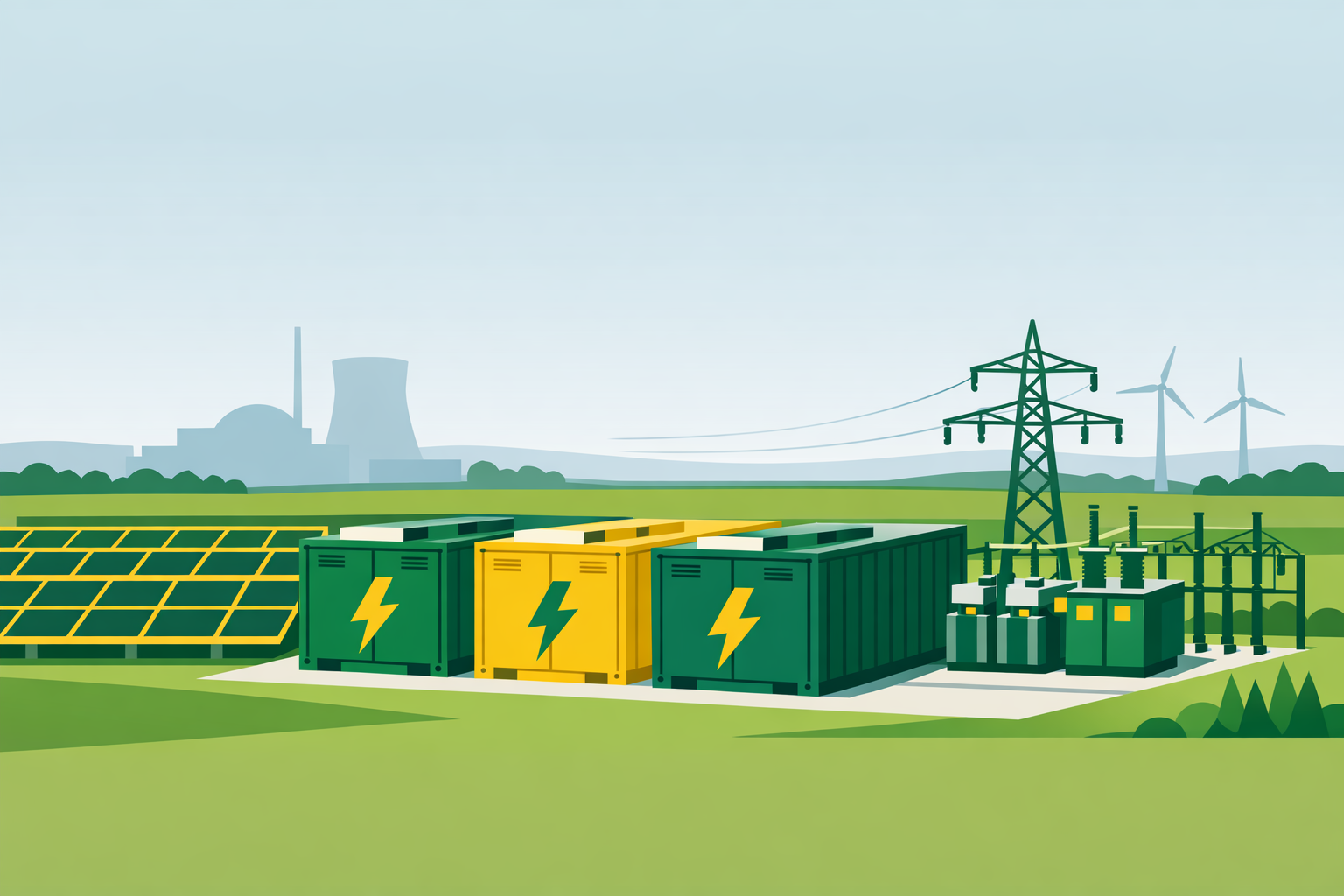
Three battery storage developers have secured grid connection commitments for a combined 1.4 gigawatts (GW) of capacity adjacent to the retired Grohnde nuclear power plant in Lower Saxony, positioning the Emmerthal energy cluster as one of the most significant repurposing efforts at a decommissioned nuclear site in Europe. The projects, led by Green Energy Storage Initiative (GESI), FRV, and Elements Green, are designed as four-hour lithium iron phosphate (LFP) systems that would collectively store up to 6 gigawatt-hours (GWh) of energy, exceeding the output once delivered by the 1.36 GW nuclear reactor they aim to replace.
Background
The Grohnde pressurized water reactor, operated by PreussenElektra - a subsidiary of E.ON - was shut down on 31 December 2021 as part of Germany's Atomausstieg nuclear phase-out. In December 2023, the Lower Saxony Ministry for the Environment, Energy and Climate Protection issued the first decommissioning and dismantling permit for the plant, with active dismantling beginning the following month. Full decommissioning is not scheduled for completion until 2039, after which the site will be available for redevelopment. The nuclear facility remains under PreussenElektra's jurisdiction during this period, so the battery projects are sited on adjacent municipal land rather than the reactor footprint itself.
The impetus for the Emmerthal cluster is straightforward: the former Grohnde substation sits at a confluence of high-voltage transmission infrastructure. Grid operator TenneT is constructing a new Emmerthal substation that will replace the existing Grohnde substation and couple two 380-kilovolt (kV) power lines with several 110 kV lines. The site also lies near the SüdLink high-voltage direct current (HVDC) transmission line - currently under construction - and the future RheinMainLink corridor, both designed to move surplus wind power from northern Germany to demand centers in the south. According to Heise Online, battery operators at the site plan to buy cheap wind power surpluses from northern Germany and sell into southern markets during periods of high demand.
Germany's grid-scale battery storage market has accelerated rapidly. According to the German Federal Network Agency (Bundesnetzagentur), as of October 2025, Germany had grid-scale battery storage systems with a total installed gross power of 2.4 GW and 3.2 GWh of storage capacity, with hundreds of projects totaling 5 GW and 10.4 GWh in development, according to The Mobility House.
Project Details
The municipality of Emmerthal has approved up to three battery energy storage system (BESS) facilities on a maximum of 35 hectares of land within the "Energiecluster Emmerthal". All three developers have received grid connection commitments, according to public municipal documents cited by Heise Online.
GESI's project - the most advanced in published specifications - plans to install containers with Lithium Iron Phosphate (LFP) batteries storing a total of 3.84 GWh and delivering up to 870 MW of power in a four-hour discharge configuration. Allianz Global Investors (Allianz GI) acquired a 51 percent stake in GESI on 23 April 2026, representing what the firm described as its second direct equity investment in German battery storage in a short period. Allianz GI noted that GESI has secured grid connection commitments for three sites with a total capacity of 2.6 GW, of which Emmerthal is the largest.
FRV's "Grohnde III" project is also structured as a four-hour system storing 2.4 GWh and delivering up to 600 MW. It is co-located with a 53-hectare ground-mounted photovoltaic system operated by Solizer, which is expected to deliver a peak output of 72 MWp. Such solar-BESS co-location is increasingly common in Germany as changes to tender conditions make combined projects more commercially attractive, according to Heise Online.
British developer Elements Green has not yet published detailed technical specifications for its Emmerthal project. The company has, however, stated plans to invest two billion euros in Germany and is constructing a 400 MW BESS in Elsfleth. If a comparable 400 MW system is built at Emmerthal, the cluster's combined capacity could reach 1.87 GW with 7.8 GWh of total storage, according to Heise Online estimates. The two confirmed projects from GESI and FRV alone - at 1.47 GW - would deliver more power than the former Grohnde nuclear plant's net output of 1.36 GW.
The financing structure for projects of this scale reflects a broader shift in German BESS investment. According to Modo Energy, physical tolling dominated German BESS offtake agreements in 2025, with seven of nine disclosed deals fixing 70-100% of capacity for 5-10 years, unlocking debt gearing of up to 85 percent. The firm calculates that a four-hour German BESS delivers a 13.7% unlevered internal rate of return at 2026 commercial operation date, against 12.2% for two-hour systems, despite higher capital expenditure.
Outlook
The Emmerthal cluster faces the same regulatory bottlenecks constraining Germany's broader BESS pipeline. Cumulative BESS connection requests at the transmission level alone reached approximately 211 GW as of Q3 2025, according to White & Case, creating a congested interconnection queue that policymakers are attempting to address through a proposed "first-ready, first-served" allocation procedure. Germany's capacity market, confirmed in early 2026, is expected to add an estimated €10-15k per MW per year in revenue from 2031, according to Modo Energy, improving long-term bankability for projects such as those at Emmerthal. Separately, Germany's four TSOs began procuring inertia services under a fixed-price remuneration model from January 2026, opening an additional revenue stream for BESS assets equipped with grid-forming inverters.
Whether Emmerthal reaches binding financial close on all three projects will test the viability of Germany's emerging model for repurposing legacy nuclear infrastructure - and could establish a template for similar conversions at the country's remaining decommissioned reactor sites.