Corporate procurement of multi-day energy storage has moved from aspiration to contractual commitment. On April 21, 2026, Noon Energy announced that Meta Platforms agreed to reserve up to 1 GW / 100 GWh of ultra-long-duration energy storage (ultra-LDES) capacity - the largest single corporate offtake of multi-day storage technology announced to date. The agreement marks a pivotal moment for a nascent technology sector long dependent on grants and demonstration projects to prove commercial viability.
The deal's structure reflects the execution realities of bringing a first-of-kind technology to hyperscale: the collaboration begins with a 25 MW / 2.5 GWh pilot project scheduled for completion by 2028, with the full 1 GW / 100 GWh supply contract activating only upon successful delivery of that initial phase. For developers, project financiers, grid operators, and policymakers tracking the energy storage market, the contract's terms - and the market dynamics it signals - merit close analysis.
The Deal Structure: Phased, Performance-Gated, and Strategically Significant
The milestone-linked architecture of the Meta-Noon Energy agreement is as consequential as its headline volume. Rather than a straightforward capacity reservation, the deal requires Noon Energy to demonstrate performance at commercial scale before the full procurement obligation takes effect.
This structure is deliberate. It reflects the current bankability gap facing ultra-LDES technologies: LDES adoption remains constrained by high upfront capex, relatively immature cost curves, and the difficulty of securing bankable long-term offtake contracts, according to a 2026 market analysis by Research and Markets. Early projects in favorable policy environments have typically depended on grants, concessional finance, or bespoke revenue support rather than purely commercial project financing.
A commitment from a creditworthy, investment-grade corporate buyer like Meta changes the calculus. Securing long-term contracts with creditworthy offtakers is essential for attracting debt and lowering the cost of capital in cleantech project finance - a structural requirement the Meta deal begins to satisfy, conditionally and at scale.
Meta's rationale is equally clear. "Bringing data centers online faster requires rapid deployment of reliable energy sources," said Nat Sahlstrom, VP of Energy and Sustainability at Meta. "Our agreement with Noon advances that goal with a storage technology that delivers grid resilience and firm power."
The agreement aligns with Meta's broader push to accelerate AI infrastructure[1] using quickly deployable renewable generation backed by reliable storage - a strategy that bypasses increasingly congested grid interconnection queues.
Noon Energy's Technology: What Makes 100+ Hours Viable
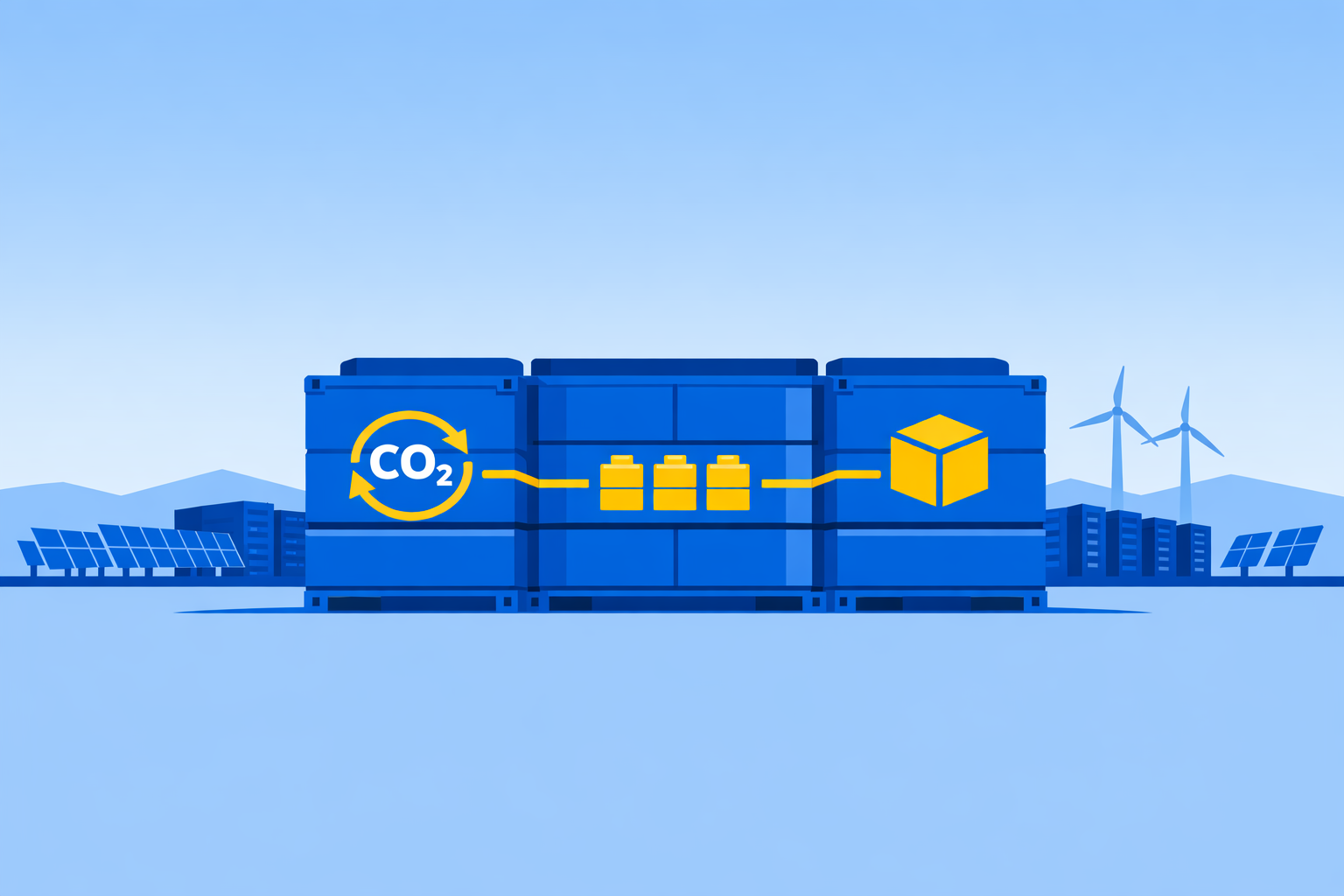
Noon Energy, founded in 2018 and based in Palo Alto, California, developed a modular, containerized energy storage system built around reversible solid oxide fuel cell (rSOFC) technology. The chemistry is unconventional: Noon's system stores energy by splitting CO₂ into solid carbon and oxygen during charging, then recombines stored carbon with atmospheric oxygen during discharge to generate electricity.
The system's three core components - a ceramic-based power block, a charge tank, and a discharge tank - work together in a cycle that uses carbon dioxide as a working medium. During charging, electricity powers the power block to convert CO₂ into solid carbon, releasing oxygen to the air. During discharge, the process reverses: oxygen drawn from the atmosphere recombines with the stored carbon to produce electricity. The CO₂ is reformed and returned to the discharge tank, completing the cycle.
Critically, the architecture decouples power capacity from energy capacity. Power output depends on the size of the power block; energy duration depends on how many tanks are connected. Storage duration can therefore be extended at low marginal cost by adding inexpensive CO₂-filled tanks, without proportionally increasing the cost of power electronics. Noon Energy targets a system cost of approximately $20 per kilowatt-hour - comparable to Form Energy's iron-air target and a fraction of the $300/kWh typical for utility-scale lithium-ion systems.
The company's demonstration project, completed in January 2026 at a solar array in Yolo County, California - supported by an $8.76 million grant from the California Energy Commission - validated the approach at scale. The reversible solid oxide fuel cell battery became the first fully containerized, modular ultra-LDES system to operate successfully for thousands of hours, with over 200 hours of storage capacity.
One additional supply chain advantage warrants attention: Noon's system uses approximately 1% of the critical minerals required by lithium-ion batteries of equivalent capacity, reducing exposure to the geopolitical and procurement risks that have weighed on conventional battery supply chains.
The ULDS Competitive Landscape: Noon Enters a Crowded Field
The Meta announcement does not occur in isolation. The hyperscaler segment has become the primary proving ground for ultra-LDES chemistries, each competing on cost, footprint, cycle life, and supply chain resilience.
| Technology | Lead Developer(s) | Discharge Duration | Core Chemistry | Target Cost ($/kWh) | Status |
|---|---|---|---|---|---|
| Reversible Solid Oxide Fuel Cell | Noon Energy | 100-200+ hours | CO₂ -> solid carbon + O₂ | ~$20 | Demonstration proven; 25 MW pilot underway |
| Iron-Air Battery | Form Energy | 100+ hours | Iron oxidation/reduction | ~$20 | First commercial deployments (2025) |
| CO₂ Battery | Energy Dome | 10-24+ hours | Liquid/gas CO₂ thermodynamic cycle | ~$50-80 | Pilot deployments; Google partnership |
| Vanadium Redox Flow | Invinity, VFlowTech | 8-24 hours | Vanadium electrolyte redox | $150-300 | Commercial; scaling to GWh |
| Zinc Hybrid (Znyth) | Eos Energy | Up to 16 hours | Zinc hybrid cathode | ~$75-120 | Commercial; data center focus |
Form Energy has been the most prominent competitor. In February 2026, Google secured 30 GWh of Form Energy's iron-air batteries for a data center in Pine Island, Minnesota, installed through utility Xcel Energy. Form also signed a 12 GWh supply agreement with AI data center developer Crusoe around the same time. Both Google and Microsoft are end-user members of the Long Duration Energy Storage Council (LDES Council), a trade association formed to promote LDES commercialization.
Noon Energy's differentiation rests on its compact footprint. Chris Graves, co-founder and CEO of Noon Energy, has stated the system's energy density is "five to 50 times more compact"[2] than competing long-duration technologies. For constrained urban data center sites or locations where land availability is a binding constraint, this could prove decisive.
The Meta deal also validates Noon's go-to-market strategy: targeting hyperscale data centers as the primary entry point, where the "bring your own generation" model pairs quickly deployable solar with multi-day storage to bypass grid connection bottlenecks.
Project Finance Implications: From Pilot-Dependent to Offtake-Anchored
The financing implications of the Meta agreement extend beyond Noon Energy's balance sheet. Global long-duration energy storage installations grew 49% year-on-year to exceed 15 GWh in 2025, according to Wood Mackenzie - yet the sector has struggled to access conventional project finance due to shallow offtake markets and technology risk premiums.
The LDES market reached $4.84 billion in 2024 and is projected to reach $10.43 billion by 2030 at a CAGR of 13.6%, according to MarketsandMarkets. Studies for the LDES Council and McKinsey suggest the world may need 1.5-2.5 TW and 85-140 TWh of long-duration storage by 2040 to decarbonize power systems while maintaining reliability.
Reaching that scale requires project finance capital, not just venture and grant funding. Noon Energy has raised more than $50 million in venture capital and government grants to date - a modest sum for a company now committed to delivering gigawatt-scale systems. The Meta offtake, even in its gated form, provides the revenue certainty anchor that enables Noon to approach project finance lenders for the capital needed to build manufacturing at scale.
A related challenge involves the revenue structures available to ULDS projects beyond the data center segment. Traditional energy storage project finance relies on contracted cashflow structures[3] - capacity-only payments, energy-plus-capacity offtakes, or build-transfer agreements. ULDS, with its value proposition anchored in multi-day reliability and contingency reserves rather than daily arbitrage cycles, requires lenders to underwrite performance metrics that lack standardized market precedents.
The Meta deal's phased, performance-milestone structure serves as a template for bridging that gap: pilot performance data generates the independent engineer reports and operational track records that lenders require before committing to a full project finance stack.
Grid Reliability and Policy Dimensions
For grid operators and policymakers, the Meta-Noon Energy agreement raises questions beyond a single corporate procurement.
ULDS technologies offer services that existing market frameworks do not consistently compensate: contingency reserves, black-start capability, extended peak shaving, and multi-day resource adequacy. Average U.S. interconnection study timelines exceed four years, with projects frequently experiencing two-to-three-year delays between study phases - a structural barrier that pushes hyperscalers toward behind-the-meter ULDS deployments and away from grid-connected projects that would provide system-wide reliability benefits.
The U.S. Department of Energy's Long Duration Storage Shot aims to cut ULDS costs by 90% by 2030. The DOE has allocated $349 million for demonstration-scale projects and $100 million for pilots, prioritizing technologies capable of sustaining power beyond 24 hours. California's Public Utilities Commission has ordered procurement of 1,000 MW of LDES by 2026, creating the guaranteed offtake structure that underpins early commercial deployments.
Still, as one recent analysis of grid market design noted, long-duration storage "remains difficult to finance at scale" without structural reform in revenue certainty - a challenge that corporate offtake, however large, addresses only partially.
The AI-driven surge in data center power demand has accelerated the timetable. Data centers are projected to consume up to 12% of total US electricity by 2028, a trajectory already outpacing utility planning and grid build-out timelines. The resulting urgency among hyperscalers to secure firm, clean capacity is creating a de facto demand signal for ULDS that policy frameworks have been slow to formalize.
Execution Risks and Market Outlook
Industry observers identify several execution risks that the deal structure cannot fully mitigate.
Manufacturing scale-up remains the most immediate challenge. Noon Energy has stated its next strategic priority is scaling from containerized demonstration systems to volume production manufacturing. The transition from prototype to production line - particularly for ceramic-based solid oxide components - involves supply chain complexity that few players have navigated at speed.
Deep discharge constraints specific to solid oxide fuel cell architectures also warrant monitoring. Unlike flow batteries, which can safely reach 0% state of charge, solid oxide fuel cell stacks have limited deep-discharge tolerance. The operational boundaries of Noon's design under real-world grid conditions will become clearer during the 25 MW Phase 1 deployment.
Climate and grid variability at different deployment sites may affect system performance in ways that controlled demonstrations do not fully capture. The Phase 1 project's performance data will be critical for independent engineers underwriting subsequent phases.
Despite these risks, the directional signal from the Meta deal is clear. As Chris Graves, co-founder and CEO of Noon Energy, stated: "We're partnering with a company that is actively securing stable power for the AI infrastructure of tomorrow, and Meta recognizes the promise in our 100+ hour ultra-long duration storage technology."
The LDES sector, which has expanded alongside the broader AI-driven rollout of long-duration storage, now produces contracts of sufficient scale to anchor project finance capital, inform procurement frameworks, and set performance benchmarks. Whether Noon Energy's rSOFC chemistry, Form Energy's iron-air, or another electrochemistry ultimately dominates the ultra-LDES segment remains an open question. What the Meta agreement confirms is that the market is no longer waiting for the answer before committing capital.
Key Takeaways
- Deal scale: Meta has reserved up to 1 GW / 100 GWh of Noon Energy's ultra-LDES capacity - the largest single corporate ultra-LDES procurement announced to date - structured as a milestone-gated, phased agreement beginning with a 25 MW pilot due by 2028.
- Technology differentiation: Noon Energy's reversible solid oxide fuel cell chemistry stores energy as solid carbon, enabling 100-200+ hour discharge durations at a target cost of ~$20/kWh and a footprint significantly smaller than flow batteries or pumped hydro.
- Finance signal: The deal provides the creditworthy offtake anchor that ULDS project finance has lacked, though execution risk during the manufacturing scale-up phase remains the central variable.
- Policy gap: Grid market design across most jurisdictions does not yet consistently compensate ULDS for the full range of reliability services it provides - a reform agenda that deals of this scale are likely to accelerate.
- Competitive context: Google, Microsoft, and Crusoe are pursuing parallel ULDS procurement strategies, confirming that hyperscaler demand is becoming a primary commercialization pathway for multi-day storage technologies.
Frequently Asked Questions
How does Noon Energy's carbon-oxygen battery differ from lithium-ion systems? Noon Energy's system stores energy by splitting CO₂ into solid carbon and oxygen using a reversible solid oxide fuel cell (rSOFC). Unlike lithium-ion batteries - limited to 2-10 hours of discharge - Noon's technology decouples power capacity from energy capacity, enabling 100+ hour discharge at low incremental cost. The system uses approximately 1% of the critical minerals required by lithium-ion batteries of equivalent capacity.
Why is Meta pursuing ultra-long-duration storage rather than conventional backup solutions? Data centers supporting AI workloads require near-continuous uptime and increasingly co-locate with renewable generation to meet sustainability commitments. Conventional lithium-ion systems cannot bridge multi-day renewable generation gaps, and diesel generators carry carbon and fuel supply risks. Ultra-LDES provides firm, clean capacity for multi-day periods while integrating with solar or wind assets, enabling a behind-the-meter model that reduces dependence on grid interconnection queues.
What are the primary execution risks? Key risks include manufacturing scale-up from demonstration to volume production; supply chain resilience for ceramic solid oxide fuel cell components; solid oxide fuel cell performance constraints under deep-discharge conditions; and U.S. interconnection study timelines, which currently average more than four years. The phased, milestone-gated deal structure manages technology risk before the full 100 GWh commitment activates.
Are other hyperscalers pursuing similar strategies? Google has secured 30 GWh of Form Energy's iron-air batteries for a Minnesota data center and partnered with Energy Dome. Form Energy also signed a 12 GWh supply agreement with AI data center developer Crusoe. Both Google and Microsoft are members of the LDES Council. The Meta-Noon Energy deal is the largest single corporate ultra-LDES procurement announced to date.