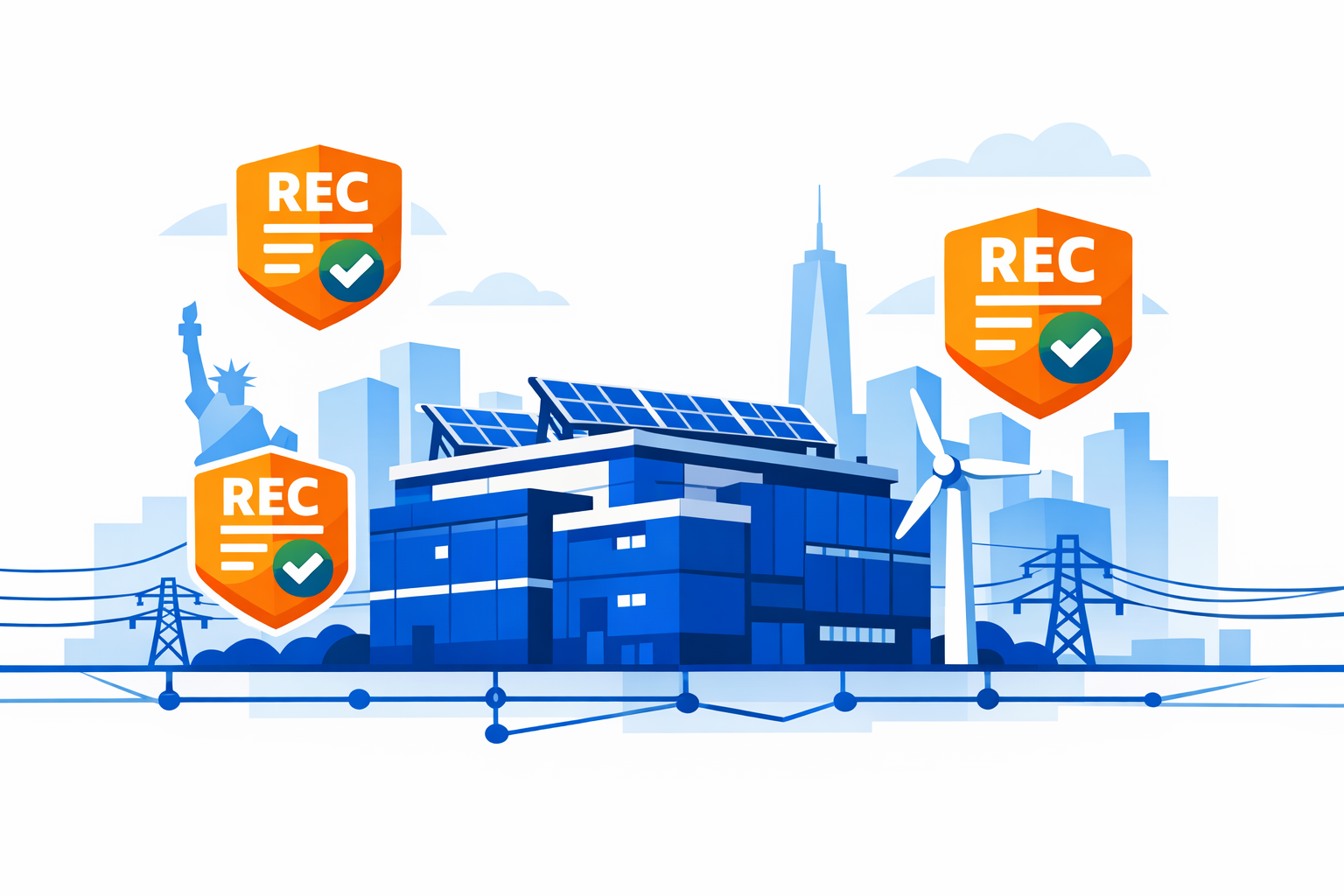
New York State's expanding renewable energy certificate procurement program is emerging as a structural force shaping how land-based data centers source clean power, price long-term contracts, and plan grid interconnection. Contract decisions from the authority's 2025 solicitation remain pending, and a new round launched this week.
Background
New York State is pursuing 70% renewable energy by 2030 and 100% carbon-free energy by 2040, making NYSERDA's annual Tier 1 Renewable Energy Standard (RES) solicitations a central pillar of that strategy. The RES mechanism requires load-serving entities (LSEs)-the utilities that supply power to large consumers, including data centers-to fund the procurement of Tier 1 Renewable Energy Certificates (RECs) on a proportional basis. Effective January 1, 2025, the RES obligation for LSEs shifted to a load-share approach, under which NYSERDA and state staff calculate a uniform per-MWh rate applied to each LSE's actual wholesale load. That formula directly ties the cost of state renewable procurement to the load profile of the grid's largest electricity consumers, including data centers.
The grid context is pressing. NYISO reports dramatic recent growth in large load interconnection activity. In 2022, the interconnection queue included six large load projects accounting for 1 GW of demand; as of December 31, 2025, it included 48 proposals totaling approximately 12 GW. Large load demand in New York is projected to rise from 3.7 TWh in 2025 to 15.1 TWh by 2030, driven overwhelmingly by data centers and semiconductor fabs operating near-flat demand profiles across hours and seasons.
Details
On September 26, 2025, NYSERDA issued its ninth annual RES Request for Proposals, RESRFP25-1, targeting the procurement of 5.6 million Tier 1 eligible RECs from facilities with "a viable path to entering commercial operation in the near future."[1] The solicitation drew competitive interest, with NYSERDA receiving bids from 19 projects comprising 1.4 GW of capacity and 2.8 TWh of generation.
The RFP's evaluation framework carries direct implications for project siting and PPA economics. Proposals are assessed on factors including interconnection viability, permitting progress, energy deliverability, financing, and embodied carbon emissions. The Fixed or Index REC bid price is weighted at 70%, with non-price factors at 30%. The non-price component breaks down into 20% for project viability, operational flexibility, and peak coincidence, and 10% for incremental economic benefits to New York State. The "peak coincidence" sub-criterion rewards generation resources that produce during periods of peak grid stress, creating a price signal favoring configurations that align output with high-demand hours-a characteristic relevant to hybrid solar-plus-storage or dispatchable renewable projects that could also serve co-located data center loads.
Evaluation of RESRFP25-1 bids concluded in February 2026; NYSERDA will publicly disclose results upon the completion of contracting. Simultaneously, NYSERDA launched a new land-based renewable energy solicitation, RESRFP26-1, focused on advancing mature large-scale renewable projects ready to begin construction. Step one eligibility requirements are due May 19, 2026; non-price components of step two proposals are due June 25, 2026; price components are due July 30, 2026; and conditional award notifications are expected by September 2026.
For data center developers and their clean power counterparts, the REC contract structure shapes how virtual power purchase agreements (VPPAs) and physical PPAs are priced. Power procurement mechanisms for data centers include green tariffs for renewable energy credits, 24/7 clean utility tariffs for hourly matching, behind-the-meter PPAs, virtual PPAs, and REC transactions. In New York, where the state procures RECs centrally through NYSERDA and passes costs to LSEs, data centers face an embedded clean energy cost in their utility bills regardless of whether they separately execute a corporate PPA. This dynamic can either incentivize bilateral contracting-to claim additionality and meet corporate net-zero targets-or lead some operators to rely on the state-administered mechanism, particularly smaller facilities without the scale to execute independent 100-200 MW PPA transactions.
Several states are considering requiring data centers to procure some or all of their electricity from non-emitting sources, while others have proposed Bring Your Own Power (BYOP) or Bring Your Own Generation (BYOG) requirements, demand response participation, or first-curtailment obligations. New York has not yet legislated a BYOP mandate, but state lawmakers are seeking to get ahead of potential data center proliferation, with affordability top of mind.
Outlook
NYSERDA President and CEO Doreen M. Harris stated that by supporting additional land-based renewable projects amid significant federal headwinds, the state continues to grow its renewables pipeline-furthering New York's energy independence and maintaining focus on energy affordability. As RESRFP25-1 contract results become public and RESRFP26-1 bids are submitted, the REC price signals embedded in each award will serve as a reference benchmark for developers structuring PPAs with data center offtakers in NYISO zones where large load growth is concentrated. NYISO projects continued growth in data center electricity demand over the coming decade, with the scale and timing of these additions expected to significantly affect statewide load growth and system risk-including distinct reliability challenges around in-service timing, ramp-up, and on-site generation capability.