More than 150 local governments across 17 U.S. states have enacted moratoriums, bans, or restrictive ordinances targeting battery energy storage systems, according to a database published in March 2026 by Carina Energy, even as utility-scale storage deployment hit record levels last year. The rising restrictions highlight a deepening tension between grid decarbonization targets and rural land-use concerns, particularly as developers propose gigawatt-scale projects in areas with limited experience hosting industrial energy infrastructure.
Background
The U.S. energy storage market installed a record 18.9 gigawatts of battery storage in 2025, a 52% increase over 2024, according to the U.S. Energy Storage Monitor published by the American Clean Power Association and Wood Mackenzie. The Solar Energy Industries Association separately reported 57.6 gigawatt-hours of new capacity added that year, the largest single-year total on record. Wood Mackenzie projects the country will install roughly half a terawatt-hour of storage between 2026 and 2031, a 250% increase over the prior five-year period.
That deployment surge has collided with local governance structures unprepared for utility-scale battery facilities. New York leads the country with 98 BESS moratoriums - 65% of the national total - concentrated in the Hudson Valley, Capital Region, and Long Island, according to Carina Energy's BESS Moratorium Monitor. States including Indiana, Michigan, Iowa, and Maine are seeing a rising wave of new restrictions as projects expand beyond traditional markets in California and Texas.
Details
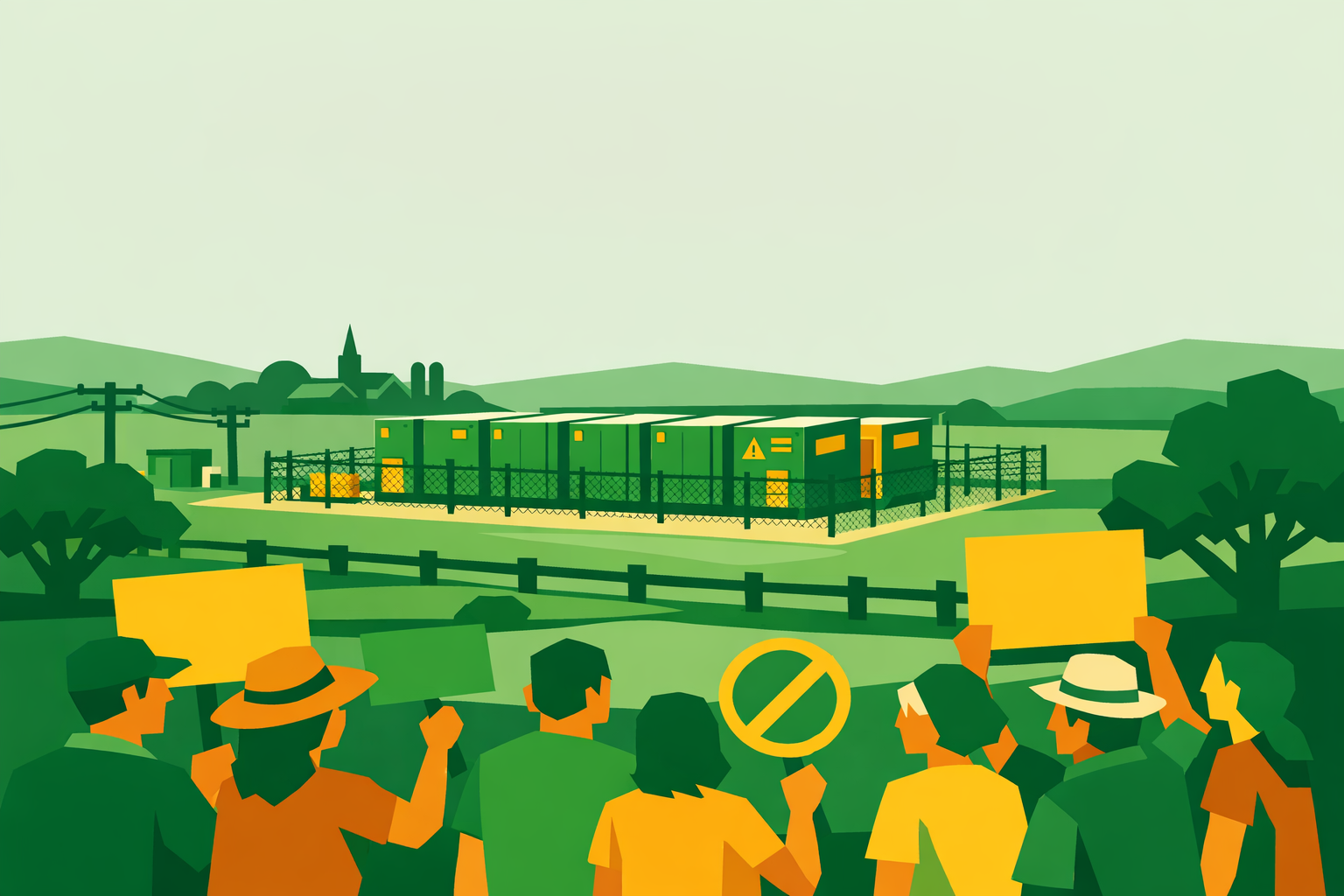
Recent cases illustrate the pattern. In Escondido, California, AES Corporation withdrew its application for the Seguro BESS project in April 2026 after community opposition over fire safety and easement challenges near a hospital. In rural Oakham, Massachusetts, residents organized against a proposed 180-megawatt facility on a 43-acre site near the Ware River Watershed, which feeds the Quabbin Reservoir serving 2.7 million people. In Acton, California, a community coalition called Save Our Rural Town won a court ruling against a 300-megawatt project after arguing that Los Angeles County failed to uphold its own zoning rules.
Compensation frameworks remain inconsistent. The Clean Coalition, a nonprofit, has benchmarked community benefits agreements across 19 clean energy projects and found that host community payments for wind developments average around $3,800 per megawatt annually, with escalators tied to inflation. The U.S. Department of Energy now requires community benefits plans for all grant and loan programs, aiming to channel public investment into local hiring, workforce development, and environmental protections. However, formal community benefits agreements remain uncommon for standalone battery storage, according to research from the Clean Energy Transition Institute.
Developers are adapting. Organizations such as the Great Plains Institute have published siting standards and fact sheets to help rural local governments establish zoning best practices for BESS, including setbacks, emergency response training requirements, and decommissioning plans. Several states have adopted or are drafting model ordinances to standardize permitting and preempt patchwork local restrictions.
Outlook
"The moratorium problem is growing faster than the industry realizes," said Malaquias Encarnacion, Managing Director of Carina Energy. With annual utility-scale additions forecast to double between 2025 and 2030, the industry faces a choice: invest in structured community engagement and enforceable benefit-sharing frameworks, or risk an expanding patchwork of local resistance that delays projects and adds cost to the energy transition.