A pilot-stage seawater battery system now serves multiple functions, combining energy storage, desalination, and carbon capture within a single electrochemical platform. Researchers, water utilities, and energy companies are testing integrated systems that store electricity, produce freshwater, and sequester CO₂. Early deployments are underway, and relevant support policies are under consideration.
Background
Seawater batteries, a type of rechargeable electrochemical storage, operate by transferring ions-typically sodium-through a membrane between electrodes, using seawater as the electrolyte. These systems have achieved more than 2,000 charge-discharge cycles while retaining approximately 92.8% of their initial capacity, according to research led by Pohang University of Science and Technology [1].
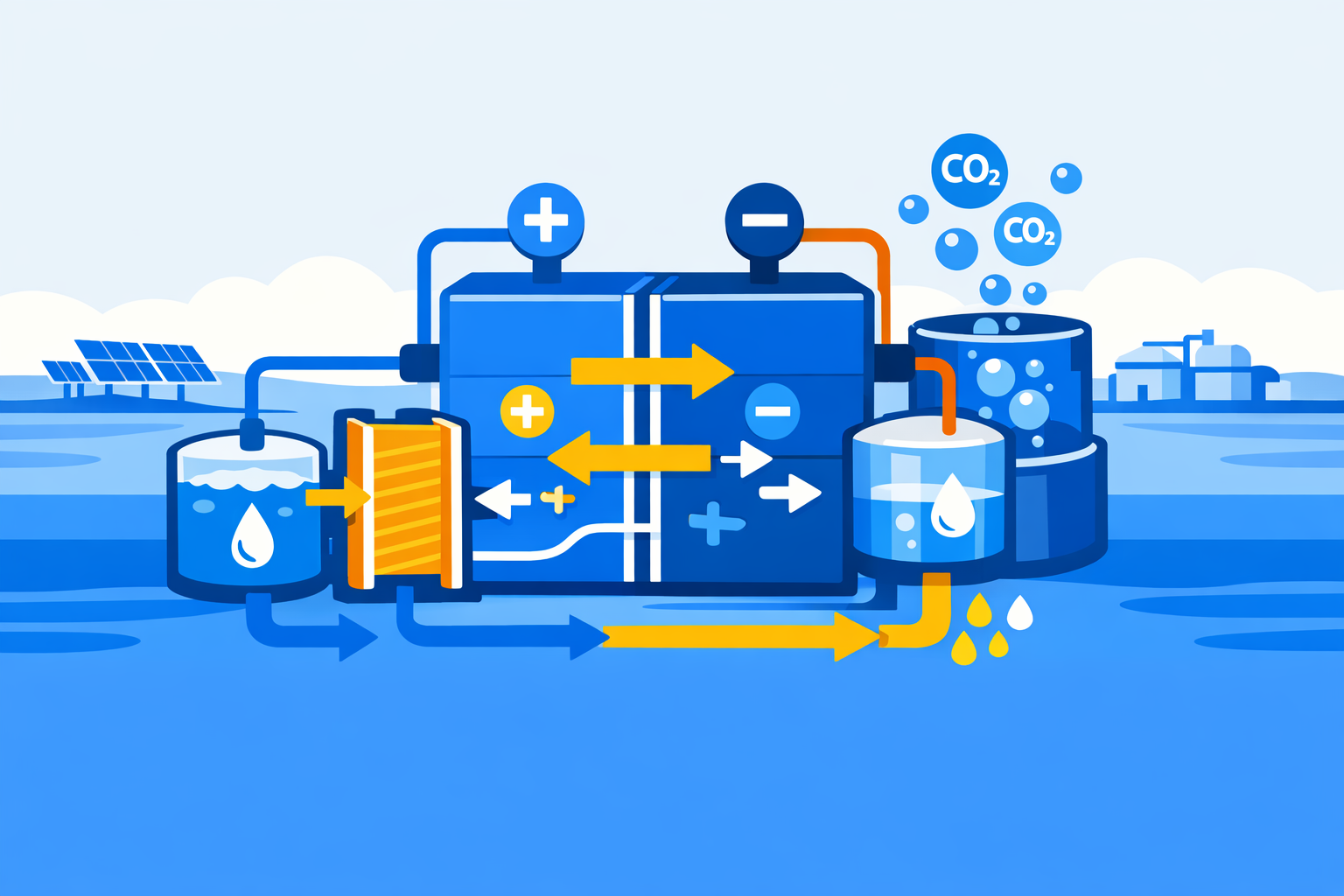
Laboratory studies published in the Journal of Power Sources have demonstrated a hybrid seawater battery that can perform desalination during charging and capture CO₂ through carbonate precipitation during discharge [2]. Pilot-scale projects are emerging, including a partnership in South Korea among Capture6, K-water, and BKT to develop a facility that combines freshwater recovery, CO₂ capture, and reduced brine discharge [3].
Details
At the Delft campus of Deltares in the Netherlands, a collaboration with AquaBattery has installed a saltwater flow battery that uses water and table salt. The system separates saltwater into acidic and alkaline streams stored in tanks, then recombines them to produce electricity. The project aims to align with onsite solar energy production to support the campus's decarbonization goals [4].
In South Korea, Capture6, K-water, and BKT plan to integrate CO₂ capture into an operational desalination plant. The memorandum of understanding (MOU) outlines a system designed to recover freshwater, remove CO₂, and minimize environmental impacts by reducing brine discharge [3].
Outlook
Commercial use of seawater battery systems remains limited to pilot and demonstration stages. Scaling these multi-functional technologies will depend on further technical validation, regulatory frameworks that support combined energy and water infrastructure, and competitive costs. Government incentives and targeted policies could help accelerate adoption in coastal energy, water, and industrial markets.
To date, pilots indicate strong technical potential, but broader deployment will require resolving challenges in system integration, economic viability, and environmental impact. Projects in the Netherlands and South Korea provide key insights into the advancement of multi-use seawater battery technologies.