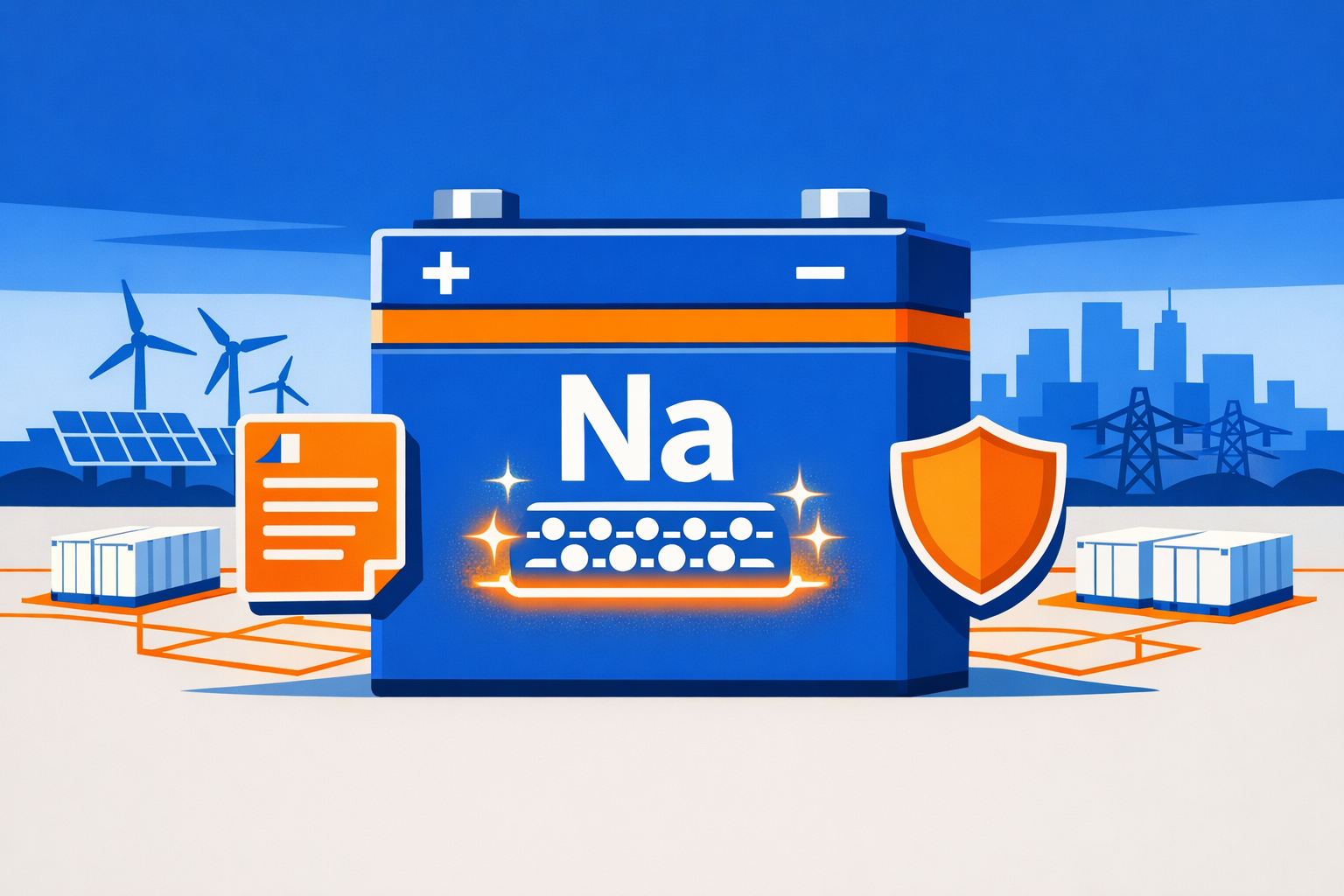
A new class of sodium-based all-solid-state batteries is emerging as a potential grid storage alternative to lithium-ion, combining non-flammable chemistry with the prospect of sharply lower lifetime costs - though without dedicated safety standards and targeted policy incentives, widespread U.S. commercial deployment remains constrained.
Background
Grid-scale energy storage has been dominated by lithium iron phosphate (LFP) batteries, a chemistry dependent on lithium - a mineral sourced predominantly outside the United States. As of 2025, sodium-ion battery global production remained below 1% of lithium-ion output, according to the International Energy Agency. That imbalance has intensified efforts to identify commercially viable alternatives, particularly as storage procurement accelerates to support renewable energy integration.
All-solid-state sodium batteries replace the liquid electrolyte in conventional lithium-ion and standard sodium-ion cells with a solid material such as a ceramic or polymer composite. By eliminating the liquid electrolyte, solid-state designs significantly reduce the risk of thermal runaway - the primary cause of battery fires - making them potentially safer for high-density urban and utility-scale installations. The chemistry also avoids graphite, which, like lithium, faces geopolitically concentrated supply chains. According to the IEA, while sodium-ion batteries eliminate lithium and graphite dependency, some commercial formulations still rely on nickel and manganese, whose processing remains geographically concentrated.
Our earlier coverage of Chinese sodium-ion pilot deployments and the first national technical standards issued in February 2026 showed that standardization is advancing fastest in China.
Details
In the United States, San Diego-based Unigrid - a University of California, San Diego spin-off founded in 2021 - has emerged as the primary domestic developer of all-solid-state sodium chemistry for grid storage. The company's proprietary sodium chromium oxide (NCO) chemistry achieved 5,000 full-depth discharge cycles at 100% depth of discharge with greater than 95% capacity retention in commercial-grade cells, translating to a projected cycle life of 20,000 and an operational lifespan of up to 25 years, according to the company. Conventional lithium-ion batteries typically degrade within 7 to 10 years under daily full-depth cycling.
Unigrid received a $2.9 million California Energy Commission RAMP grant in June 2025 to build a low-rate initial production line. By late 2025, the company had expanded production capacity to 100 MWh per year via Asian contract manufacturing and was targeting a tenfold increase to 1 GWh in 2026. The company describes itself as the first battery firm outside China to export sodium-ion cells at commercial scale, with shipments to Southeast Asia in partnership with Singapore-based virtual power plant operator Blue Whale Energy. "This 25-year lifespan changes the economics of energy storage," said Darren H. S. Tan, CEO of Unigrid. "Operators can now align storage with the full life of their solar assets."
On cost trajectory, a 2025 IRENA report projected sodium-ion battery cell costs could eventually fall to approximately $40/kWh, compared to $70/kWh for LFP - a cost inversion that, if achieved, would represent a structural shift in grid storage economics. By 2025, however, sodium-ion battery packs still cost approximately 30% more than LFP equivalents due to limited manufacturing scale. Major manufacturers are working to close that gap: CATL, the world's largest battery manufacturer, unveiled what it described as the world's first platform-based sodium-ion battery designed specifically for energy storage at ESIE 2026 in Beijing in April, with commercial deployment targeted within 2026.
The safety regulatory landscape presents a critical bottleneck. The U.S. National Fire Protection Association is developing NFPA 800, a new standard governing all aspects of battery transportation and storage, intended to address sodium-ion and other emerging chemistries. No equivalent to the established NFPA 855 standard - which covers lithium-ion stationary storage installation - yet exists specifically for all-solid-state sodium systems. Experts at the National Renewable Energy Laboratory have noted that advances in battery chemistries are "outpacing researchers' ability to understand and gauge their safety risks," according to Chemistry World.
On the policy side, the EU's IPCEI Batteries III program (2025-2027) allocated €400 million in subsidies for solid-state battery projects, while the U.S. Inflation Reduction Act continues to provide tax incentives for domestic battery manufacturing and grid-scale storage deployments. Neither framework currently includes provisions specific to sodium all-solid-state chemistries for stationary storage, leaving developers reliant on general clean energy incentive structures. Global solid-state battery penetration was estimated at approximately 0.1% in 2025, with all-solid-state penetration projected to reach around 4% by 2030, according to SMM forecasts.
Outlook
Commercialization of sodium all-solid-state grid storage hinges on three parallel tracks: finalization of NFPA 800 and equivalent transport safety frameworks, dedicated procurement incentives that recognize sodium solid-state chemistry as distinct from conventional lithium storage, and build-out of a domestic supply chain for sodium chromium oxide and related materials. According to SMM, all-solid-state battery shipments across all chemistries are forecast to reach 13.5 GWh by 2028, compared to 160 GWh for semi-solid-state variants. Without targeted regulatory and policy action, the sodium all-solid-state segment risks remaining a niche offering despite its technical and supply chain advantages over incumbent lithium-ion technologies.