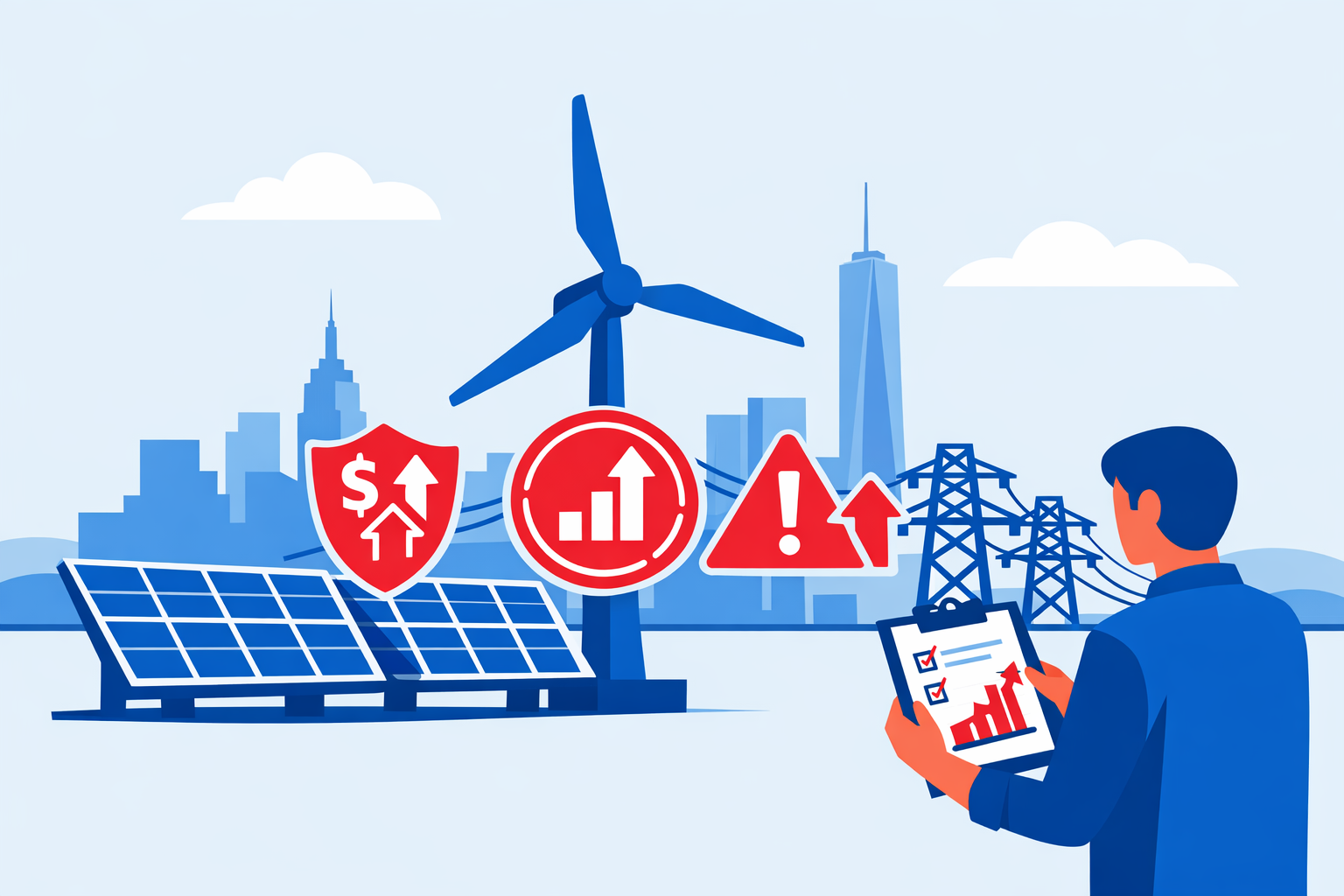
Federal tariff expansions are placing New York's clean-energy project pipeline at risk, jeopardizing financing schedules and supply chains critical to the state's decarbonization targets. Tariffs on imported solar modules, wind components, batteries, and grid infrastructure inputs have raised project costs and increased uncertainty for developers and lenders. Projects across solar, offshore wind, and transmission sectors now face higher input prices and constrained financing models.
Background
Federal tariffs introduced or expanded in 2025-including Section 301 duties on Chinese modules, Section 201 safeguards, antidumping and countervailing measures, and steel and aluminum tariffs-present significant challenges for clean-energy project costs. Industry analysis indicates tariff increases can raise the levelized cost of energy (LCOE) for solar projects by 23-26%. Battery energy storage system (BESS) costs have also surged due to dependence on Chinese components. Wind and grid project inputs face elevated prices from the same trade measures. Unpredictable cost escalation and shifting tariff regimes have added challenges for developers and lenders. These pressures come as New York advances its Climate Leadership and Community Protection Act, which targets 9 GW of offshore wind by 2035 and a fully zero-emission grid.
Details
Tariff volatility has driven up solar LCOE by 23-26%, per industry estimates. BESS costs peaked-doubling for projects utilizing Chinese imports at the highest tariff rates. Although some tariffs have since eased, costs remain about 20% above pre-tariff levels. Wind supply chains also face increased costs, though to a lesser extent. Steel and aluminum tariffs have further raised expenses for transmission and distribution projects. These changes have disrupted financing: lenders and tax equity investors have postponed or scaled back projects in response to higher risk premiums and tighter margins. Developers are pursuing greater local content to qualify for Inflation Reduction Act incentives and reduce tariff exposure.
The Empire Wind project illustrates these challenges. In 2025, Empire Wind 2 lost its power purchase agreement due in part to supply-chain disruptions and cost pressures, undermining its financial feasibility. Empire Wind 1 remains on schedule. Tariffs and inflation were significant contributors to the contract cancellation. State agencies warn that tariffs on energy-related and non-energy products could increase electricity costs by tens of millions of dollars annually due to costlier imports and infrastructure. The Champlain Hudson Power Express (CHPE), set to deliver 1,250 MW of Canadian hydropower to New York City by mid-2026, also faces higher capital costs from tariffs on construction inputs.
Outlook
Developers and financiers in New York are adopting mitigation strategies such as diversifying suppliers, maximizing domestic content bonuses, structuring power purchase agreements (PPAs) to secure revenue, and procuring critical components early. Policymakers may consider waivers, joint procurement, and streamlined permitting to buffer projects from tariff-related disruptions. Without further action, the state's clean-energy buildout faces risks from ongoing regulatory volatility.